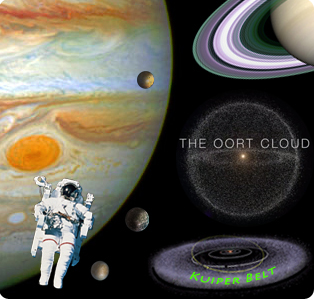
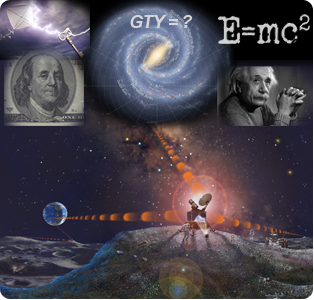
Galacticity, or galaxy awareness and energy, is developing as a primary, lead understanding and force for 21st Century opportunities, resources and realization. As awareness generated by Multi World Species realities of the Apollo Moon missions fifty years ago, and now by Mars settlement visions, Galacticity with its magnitudinal potential and implications is coming of age in higher science research and in college, secondary, primary and pre school education, less than a century after Edwin Hubble’s revolutionary Galaxy / galaxies discoveries. Our Milky Way Galaxy may be considered and studied through five elementary perspectives: Size, Speed, Life, Learn, Use. Size (Vitals, Superlatives) – 200-400 billion stars, trillions of worlds, 100,000 light-years across, 1-3 trillion solar masses. Speed (Physics, Revolutions) – Earth rotates 1,600 kph at equator, Earth orbits Sun at 108,000 kph, Sun orbits MWG every 250 million years, all traveling on 4th dimensional space-time helix. Life (Starlife in the Galaxy) – The Galaxy, quite logically, is teeming with life, or it is all ours / humankind’s: either way, though vastly differing, the implications are mind-boggling. Learn (Education) – 21st Century Galaxy Education (above); space agencies Macroplanning. Use (Uses, Applications). We are all in, part of the Galaxy; it begins at our feet, on the ground we walk, in the air we breathe; Useful, diverse, practical applications since the Galaxy is big, very, very, very big: bigger than the USA, bigger than China, bigger than Mideast madness, bigger even than New York; Galacticity, as important for the 21st Century as Relativity is for the 20th and Electricity for the 19th, perhaps, may be one of this century’s first $Trillion realizable ideas. (Image Credit: ILOA, US Treasury, NASA/JPL-Caltech)
MONDAY
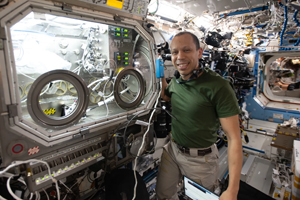
Jan 18 — ISS, LEO: Six-member Expedition 46 crew setting up JAXA Electrostatic Levitation Furnace equipment, finalizing Cygnus OA-4 for its departure / Earth atmosphere reentry in 1 week, working with Russian Chibis (lower body negative pressure) experiment, Cosmonauts preparing for February 3 EVA, Kelly & Kornienko have 44 days left in their one-year mission.
Jan 18 — Chang’e-3 Lander, Guanghan Gong, Sinus Iridum / Mare Imbrium, 44.12°N 19.51°W, Moon Surface: China mission receives funding to continue science / Astronomy from the Moon through 2016.
Jan 18 — Dawn, Ceres Orbit 385-km Altitude: In lowest and final orbit over largest known body in Main Asteroid belt, making high-resolution maps, collecting data on its surface features, 130 bright spots, salt deposits, potential geological & hydrothermal activities, radiation, gravity field.
Jan 18 — Cassini OTM-437, Saturn Orbit: Spacecraft conducts Orbital Trim Maneuver #437 today.
Jan 18 — Shackleton Energy Company, Del Valle TX: NewSpace company working with Zaptec of Norway to create lightweight power infrastructure to extract water from Moon, plans to be operating on Moon surface in 8 years for ~US$10B, predicts generating revenue within 4 years & break even within 12.
Jan 18 — Swiss Space Systems (S3), Payerne, Switzerland: Working to launch smallsats up to 250 kg, developing SOAR suborbital reusable shuttle for Humans (launch ~2018) & CleanSpace One space debris demonstrator satellite, offering ZeroG flights (5 mins weightlessness), advocating for spaceport in Switzerland.
Jan 18 — Astrotecture, Palo Alto CA: Presenting design concepts for the First Mars Habitat, Robotic Asteroid Prospector, Water Walls Life Support system, Lunar and Planetary bases, EVA and Mobility systems.
Jan 18-22 — Fermi Asian Network, National Research Foundation of Korea, The Korean Space Science Society, Muju, South Korea: 6th Fermi Asian Network (FAN) Workshop.
= All times
for terrestrial events in local time unless noted.
= All times for international terrestrial events in local time unless noted.
= All times for space events, and…
= All times for international space / astro events in Hawaii Standard Time unless noted. Add 10 hours to obtain UT (‘Universal Time;’ Greenwich, England).
Human Jupiter, Saturn,
Solar System Complete
Mission Design Project: 2013-2021
Human exploration of the complete Solar System from 363,000 km to 50 AU – the Moon to the unexplored Kuiper Belt – is the ultimate 21st Century program and goal (not just Mars). Juno, the first spacecraft to orbit Jupiter in over 25 years, will reach the massive alien world with 67 known moons on July 4 to study its fast flowing rivers of gas, atmosphere, rings and potentially life-harboring Galilean moons (Europa, Io, Callisto, Ganymede). ESA JUpiter ICy satellite Explore (JUICE) with 11 science instruments is targeting a 2020 launch. NASA Europa Clipper will investigate from orbit the subsurface global ocean for its depth and salinity. The 2016 NASA budget supports adding a lander to the mission, which is likely to have a 14-day lifespan due to Europa surface temperatures reaching -210° C. Cassini continues to send stunning imagery and science from Saturn and its moons. Its Saturn atmospheric impact is planned for September 15, 2017 after it weaves its way through the innermost rings. New Horizons Pluto system flyby data continues to be released to the public, as the craft speeds its way toward Kuiper Belt Object 2014 MU69 for a Jan 1, 2019 flyby. Vast efforts and planning continue for Asteroid and NEO identification and encounters. The Space Age Publishing proposed Human Solar System Complete Mission Design Project (beginning as Jupiter Mission Design Competition in 1988) calls for the 2017 U.S. Administration to exponentially increase Space Exploration funding and trajectory to reflect the value of technology, science and medicine enabled by development of Human Solar System capacities. (Image Credit: NASA / ESA / A. Simon, GSFC, APL, SwRI)
Jan 19 — New Horizons, KBO 2014 MU69 Trajectory: Spacecraft enters 11th year in space today, launched Jan 19, 2006 – flew by Pluto July 2015; expected to encounter Kuiper Belt Objects of interest and operate until at least 2030s.
Jan 20 — ISRO, Launch PSLV / IRNSS 1E,Satish Dhawan Space Center, Sriharikota, India: India Polar Satellite Launch Vehicle to launch Indian Regional Navigation Satellite System IRNSS 1E navigation satellite.
Jan 23 — Space Center Houston, Houston TX:Independence Plaza grand opening, featuring eight-story-tall multiple-exhibit complex with shuttle replica mounted on top of the first shuttle carrier aircraft.
Jan 23-29 — Committee on Space Research (COSPAR), International Living with a Star (ILWS), Center of Excellence in Space Sciences India (CESSI), Goa, India: Conference: Science for Space Weather.
Includes ~150 meetings covering the fields of COSPAR Scientific Commissions / Panels / Task Groups, such as SC B: The Earth-Moon System, Planets, and...
From 02 to 07 August 2026, a few thousand geoscientists across diverse disciplines will gather at the 23rd annual meeting of the Asia Oceania Geosciences...
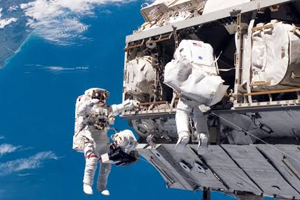
2:45 pm EDT from Johnson Space Center, NASA astronaut Chris Williams will recap his recent eight-month mission aboard the International Space Station. Williams returned to...
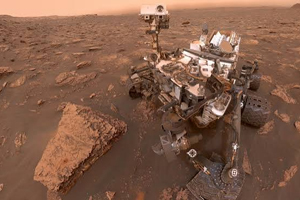
NASA Curiosity (Mars Science Laboratory) rover surpasses another full year of operations on Mars surface today; launched Nov 26, 2011 – landed Aug 5,...
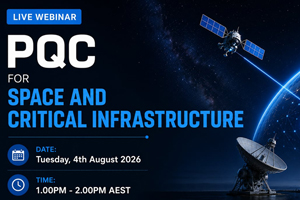
Virtual Series 2026 will offer deeper conversations on why PQC matters and the practical steps businesses should be taking; starts 1:00 pm AEST. Featuring:...
This international lunar science meeting has two objectives: to provide a platform for leading experts to review recent advances across lunar research, from the...
At CSIR International Convention Centre. Key topics are Earth Observation, Developing Space Tourism, Space Supply Manufacturing. Cultural tours are offered.
Participants will receive theoretical and hands-on training in electron imaging and X-ray spectroscopy for application to planetary samples. This training opportunity is targeted at...
"Leading Australia’s Space Future for Our Strategic Advantage". Southern Space 2026 brings together decision-makers who set the direction for Australia’s space sector. It is...
 = All times
 = All times for international terrestrial events in local time unless noted.
 = All times for space events, and…
 = All times for international space / astro events in Hawaii Standard Time unless noted. Add 10 hours to obtain UT (‘Universal Time;’ Greenwich, England).