Japan Space Astronomy and 21st Century Exploration Advancing
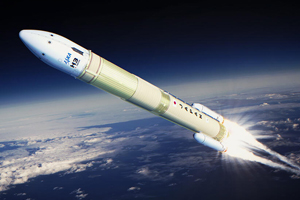
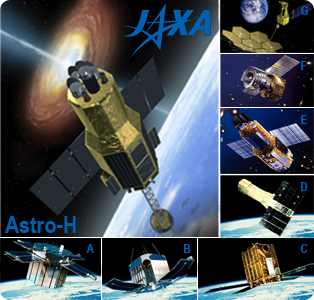
Launch of Astro-H Astronomy Satellite from Tanegashima Space Center, Japan aboard the 30th H-2A rocket is indicative of a greater expansion of Astronomy into Space, both with satellites and lunar missions. Initial countdown toward Feb 12 launch is scrubbed due to inclement weather, next available window to be announced. Reaching its designated orbit at 575-km altitude to begin conducting X-ray and gamma-ray observations of some of the most powerful phenomena in the Universe, it will become known by an as-of-yet unannounced new official name. The primary objective is to explore the structure and evolution of the Universe by studying objects such as supernova explosions, supermassive black holes, and galaxy clusters. One stated goal is to elucidate dark matter and dark energy. The project is lead by JAXA and includes participation of more than 200 researchers at 70 contributing institutions in Japan, the USA, Canada, and Europe. The Astro-H space observatory is 10-100 times more sensitive than its predecessor, 14 meters in length when fully extended and with a mass of 2,400 kg is the heaviest of 8 total that Japan has developed (only seven launched; Astro-G was cancelled). Japan seems to specialize in space-based X-ray astronomy; Astro-A through E, now known as Hinotori, Tenma, Ginga, ASCA, and Suzaku, have all been X-ray observatories. The exceptions Astro-F and G, were designed for Infrared astronomy and radio astronomy respectively. National Astronomical Observatory of Japan is hosting the International Lunar Observatory Association public education event known as Galaxy Forum, at their Mitaka, Tokyo headquarters, including participation of JAXA lunar exploration representatives, Japan space enterprise leaders, NAOJ astronomy experts and former Astronaut Naoko Yamazaki. (Image Credit: JAXA, Space Age Publishing Company)
MONDAY
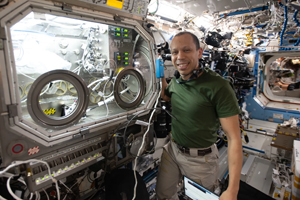
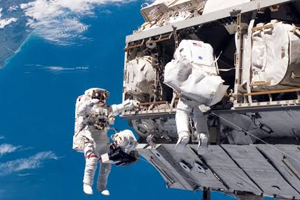
Feb 15 — ISS, LEO: Expedition 46 six-member crew working with two 3D printers (one from Made in Space – USA and one from Altran of Italy for ASI), planning to release Cygnus OA-4 on Friday, gathering data on how 16 sunrises & sunsets a day affects humans, Sally Ride EarthKAM continues to gather images of Earth & allows middle school students to choose specific locations.
Feb 15 — Chang’e-3 Lander, Guang Han Gong, Sinus Iridum / Mare Imbrium, 44.12°N 19.51°W, Moon Surface: Should awake from hibernation for Lunar Day 28 on Feb 18 to continue data observations from Moon, new Chang’e data now available online.
Feb 15 — Akatsuki, 400 x 440 km Venus Orbit: JAXA craft in instruments check out phase, planning to begin observations of Venus atmosphere & monitor weather beginning in April for at least 2 years.
Feb 15 — Ad Astra Rocket Company, Webster TX: NewSpace company with Astronaut Franklin Chang Díaz as president & CEO, developing Variable Specific Impulse Magnetoplasma Rocket (VASIMR) prototype, creating documentary to show space applications of VASIMR engine including Jupiter Slingshot Mission, lunar cargo transport & deep space robotic missions.
Feb 15 — Tethers Unlimited, Bothell WA: Working on Positrusion Recycler concept to convert ISS / Space waste into filament able to be used in 3D printing, developing SpiderFab system capable of manufacturing antennas, solar arrays, sensor masts, and producing Terminator Tape for decommissioning nano- and microsatellites; founders Dr. Robert Hoyt and Dr. Robert Forward, BoD member Arthur M. Dula.
Feb 15 — Icarus Interstellar, Multiple Locations: Discussing possibility of making science-based competition for designing interstellar missions; Drexel University Icarus chapter working on propulsion designs of CubeSats for Icarus Project Tin Tin (mission to Alpha Centauri); offering free online Interstellar newsletter.
Feb 15 — Chelyabinsk Meteor Explosion 3-Year Observation,Chelyabinsk, Russia / Worldwide: Known Near Earth Asteroid count totals 13,534, awareness of the need for NEO detection & tracking is increasing as people mark Chelyabinsk meteor explosion 3-year anniversary which injured 1,000 people.
for terrestrial events in local time unless noted.
= All times for international terrestrial events in local time unless noted.
= All times for space events, and…
= All times for international space / astro events in Hawaii Standard Time unless noted. Add 10 hours to obtain UT (‘Universal Time;’ Greenwich, England).
SLS, Orion, EM-1 CubeSats Promise Innovative Moon / Deep Space Science and Technologies
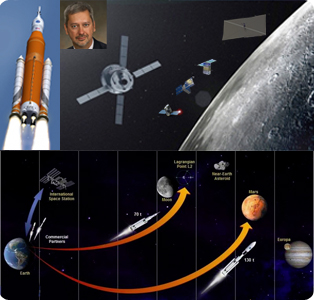
The long-awaited, next-generation NASA Space Launch System (SLS) maiden launch date is set for no later than November 2018. Dubbed Exploration Mission 1, SLS 70-metric ton configuration will loft the Orion crew module on a 21-day journey, flying 70,000 km past the Moon. It will also carry 13 CubeSats, four of which will target the Moon: 6U (12 kg) Lunar Flashlight with a 80 m2 solar sail to map ice deposits in permanently shadowed craters at Moon South Pole from 20-km altitude, 6U (14 kg) Lunar IceCube will use an electric RF ion engine and search for water ice from 100-km altitude over 6 months, LunaH-Map will map hydrogen within craters at the Moon South Pole, and 14-kg Skyfire will take sensory data of the Lunar surface during its flyby. Another CubeSat “Near Earth Asteroid Scout” will attempt to reach an NEA using solar sail propulsion, send images to Earth and observe its position in space. The Orion command module, currently at KSC, will undergo 30-flight systems installations this year and be powered on for the first time in early 2017. The first Human Moon flyby mission is planned for 2023. Future configurations of SLS / Orion could carry crews to Asteroids, Mars and the Jupiter system. (Image Credit: NASA, ASU, LMCO) Pictured: Chris Crumbly SLS Program Manager
Feb 16 — Eurorockot, Launch Rockot / Sentinel 3A, Plesetsk Cosmodrome, Russia: Eurorockot Rockot to launch Sentinel 3A Earth observation satellite for ESA and European Commission; mission will measure sea surface topography, sea & land surface temperature, ocean & land color.
Feb 17 — Rutgers Hillel Center for Israel Engagement,Rutgers University,New Brunswick NJ: Update on GLXP SpaceIL; presented by SpaceIL engineer / co-founder Yonatan Winetraub.
Feb 17-19 — Japan Ministry of Education, Culture, Sports, Science & Technology, Sapporo, Hokkaido, Japan: Solar-System Symposium; at Rusutsu Resort.
Feb 18 — Cornell University,Ithaca NY: Lecture: Blown Away; Ralph Lorenz from JHU/APL discusses research topics on wind in planetary environments.
Feb 18 — Apollo Asteroid 2016 CG137: Near-Earth flyby (0.056 AU).
Feb 18 — Apollo Asteroid 2016 CA138: Near-Earth flyby (0.064 AU).
Feb 18 — Apollo Asteroid 1999 VF22: Near-Earth flyby (0.094 AU).
FRIDAY
Feb 19 — ISS, Cygnus OA4 Unberthing & Release, LEO: Cygnus OA4 to be released at 11:25 UT, live coverage available, for Earth Atmosphere disintegration with ISS waste.
Feb 19 — Cassini OTM-443, Saturn Orbit: Spacecraft conducts Orbital Trim Maneuver #443 today.
Feb 19 — Virgin Galactic, Scaled Composites, Mojave CA:Second SpaceShipTwo roll out and naming; Steven Hawking expected to attend and name newest SpaceShipTwo; company hopes to launch people into space starting 2018.
Feb 20 — British Interplanetary Society, Worcs, United Kingdom: British Interplanetary Society (BIS) West Midland Event; Dave Shayler will talk on Hubble Space Telescope & sign copies of his recent book, Mark Perman will talk about the First German Rocket Research Establishment Kummersdorf; at the Gardeners Arms.
Feb 20 — Moon: 5.0° S of Beehive Cluster, 07:00.
Feb 20 — Apollo Asteroid 2016 CO29: Near-Earth flyby (0.040 AU).
SUNDAY
Feb 21-23 — Space Exploration Alliance, NSS, AIAA, Moon Society, Federation of Galaxy Explorers, Planetary Society, SEDS, et al,Washington DC: SEA Legislative Blitz 2016; advocating for the exploration and development of Space.
Feb 21-27 — National Society of Professional Engineers, AIAA, Boeing Co., SAE International,Nationwide USA: 65th Annual Engineers Week (2016); held during week of George Washington’s birthday, observed by more than 70 engineering, education, cultural societies & more than 50 corporations and government agencies.
Feb 21 — Mercury: At aphelion (distance 0.4667 AU from Sun), 07:00.
Includes ~150 meetings covering the fields of COSPAR Scientific Commissions / Panels / Task Groups, such as SC B: The Earth-Moon System, Planets, and...
From 02 to 07 August 2026, a few thousand geoscientists across diverse disciplines will gather at the 23rd annual meeting of the Asia Oceania Geosciences...
2:45 pm EDT from Johnson Space Center, NASA astronaut Chris Williams will recap his recent eight-month mission aboard the International Space Station. Williams returned to...
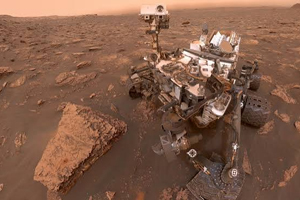
NASA Curiosity (Mars Science Laboratory) rover surpasses another full year of operations on Mars surface today; launched Nov 26, 2011 – landed Aug 5,...
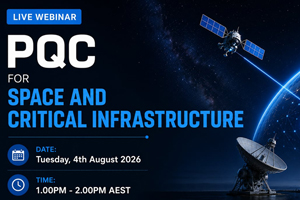
Virtual Series 2026 will offer deeper conversations on why PQC matters and the practical steps businesses should be taking; starts 1:00 pm AEST. Featuring:...
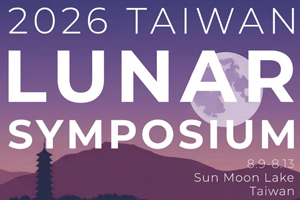
This international lunar science meeting has two objectives: to provide a platform for leading experts to review recent advances across lunar research, from the...
At CSIR International Convention Centre. Key topics are Earth Observation, Developing Space Tourism, Space Supply Manufacturing. Cultural tours are offered.
Participants will receive theoretical and hands-on training in electron imaging and X-ray spectroscopy for application to planetary samples. This training opportunity is targeted at...
"Leading Australia’s Space Future for Our Strategic Advantage". Southern Space 2026 brings together decision-makers who set the direction for Australia’s space sector. It is...

 = All times
 = All times for international terrestrial events in local time unless noted.
 = All times for space events, and…
 = All times for international space / astro events in Hawaii Standard Time unless noted. Add 10 hours to obtain UT (‘Universal Time;’ Greenwich, England).