ISS Expedition 47/48 to Launch, Will Welcome 3 Cargo Ships and BEAM
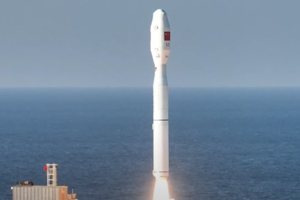
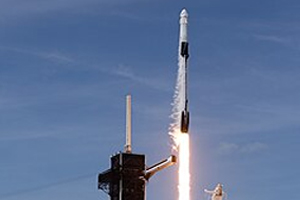
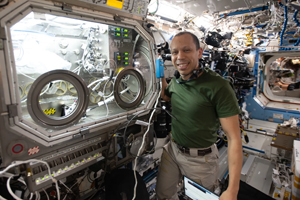
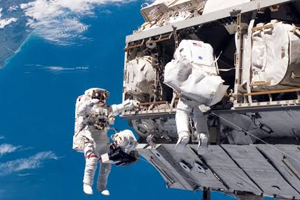
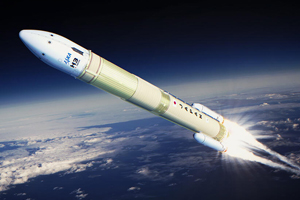
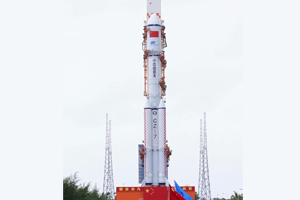
Three Astronauts prepare to launch to the International Space Station on March 18 from Baikonur Cosmodrome, Kazakhstan on the upgraded Soyuz rocket MS-01 (marking the 130th flight of a Soyuz spacecraft). After reaching 400-km altitude on a 6-hour journey, Jeff Williams, Oleg Skripochka and Alexey Ovchinin will join Commander Tim Kopra, Yuri Malenchenko and Tim Peake. Expedition 47 is scheduled to perform USA EVAs 36 and 37 in April or May, and work with 3 cargo ships planning to launch before April: ULA launching Orbital ATK Cygnus OA-6 on Mar 22, Roscosmos launching Progress 63P on Mar 31, and SpaceX launching Dragon CRS 8 on Apr 4 – its Falcon 9 first stage will attempt a barge landing. Dragon will be carrying the Bigelow Expandable Activity Module (BEAM) which will be attached by Candarm2 to the ISS Harmony node for two years to test its integrity, leak rate, radiation dosage and temperature changes. They will also work with a technology demonstrator experiment for smaller exercise devices, research on rodent musculoskeletal systems and a study on how microgravity affects dissolution. Of the 546 humans that have been to Space (beyond 100-km altitude), 221 have visited the ISS during its 15+ years in orbit, 24 have visited the Moon and only 12 have walked on its surface. (Image Credit: NASA, Bigelow Aerospace, JSC)
MONDAY
Mar 14 — ISS, LEO: Expedition 47 preparing for arrival of 3 crew members, setting up Microgravity Science Glovebox and Common Communications for Visiting Vehicles, transferring cargo from Progress 62P, testing acoustic equipment in U.S. Destiny lab to listen for air / pressure leaks, working with experiments involving liquid crystals, radiation, cognitive abilities, micrometeoroid impacts.
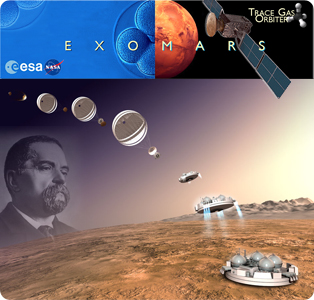
Mar 14 — RSA, Launch Proton / ExoMars 2016 Orbiter & EDM, Baikonur Cosmodrome, Kazakhstan: ESA Trace Gas Orbiter and Entry, Descent & Landing Demonstrator Module launch window opens today (March 14-25), expected to reach Mars in December, live coverage available.
Mar 14 — ASTRO-H, LEO: JAXA x-ray astronomy satellite to study energetic processes in the universe, verifying instruments & equipment for ~1.5 months, then planning calibration observations for another 1.5 months before main mission begins.
Mar 14 — Lunar Reconnaissance Orbiter, Elliptical Polar Moon Orbit: Continuing to collect data from 20 km over South Pole and 165 km over North Pole, data set 25 containing new data acquired between Sep – Dec 2015 to be made public, LRO 61-print exhibit “A New Moon Rises” open at National Air & Space Museum.
Mar 14 — Blue Origin, Kent WA: Newspace company CEO Jeff Bezos states New Shepard human test flights could occur 2017 with commercial flights in 2018, preparing for 1st full-scale firing test of 550,000-lb thrust BE-4 by end of year; company to receive NSS 2016 Space Pioneer Award for Science and Engineering for recent rocket vertical landing & reusability performance.
Mar 14 — Parabolic Arc, Mojave CA: Editor Doug Messier continues to cover space industry news for more than 9 years, asking for freelance work, advertising, contributions to support ongoing space coverage.
Mar 14 — CosmoCourse, Moscow, Russia: Planning to develop 6-person reusable suborbital tourist spacecraft by end of 2020 with estimated cost of US$150M, will use Kapustin Yar testing range; CEO Pavel Pushkin (formerly of Khrunichev State Research and Production Space Center).
= All times
for terrestrial events in local time unless noted.
= All times for international terrestrial events in local time unless noted.
= All times for space events, and…
= All times for international space / astro events in Hawaii Standard Time unless noted. Add 10 hours to obtain UT (‘Universal Time;’ Greenwich, England).
Launch of 1st Mission in ESA ExoMars Program: Trace Gas Orbiter and Schiaparelli Lander
RSA Proton rocket with Breeze M upper stage is set to launch the ExoMars 2016 mission for the European Space Agency on March 14 from Baikonur Cosmodrome, Kazakhstan. With optimal timing the cruise phase will only be about 7 months, seeing the pair to Mars by October expects ExoMars Spacecraft Operations Manager Peter Schmitz. The Trace Gas Orbiter is to perform detailed, remote observations of the Martian atmosphere for methane and other gases of possible biological relevance during an expected 5-year Science Mission set to begin December 2017. From 400-km altitude the Orbiter can also act as a data relay station for the broader ExoMars program through 2022, including the 2018 rover mission. Schiaparelli entry descent and landing demonstrator module is testing critical European technology for future missions. It is named after Italian Astronomer, Science Historian and avid Mars observer at the dawn of the 20th Century Giovanni Virginio Schiaparelli. Three days prior to reaching Mars atmosphere Schiaparelli will be ejected from the Orbiter to enter Mars atmosphere at 21,000 km/h and decelerate in stages with aerobraking, parachute, and thrusters. Once on the surface, data transfer and communications will be assisted by Mars Express and from a NASA Relay Orbiter. A variety of short-lived science instruments (wind, humidity, pressure, temperature, atmospheric dust, atmospheric charging) will rely on excess energy left in the batteries. (Image Credit: ESA, SPC)
Mar 14 — W. M. Keck Observatory, Kona Kohala Chamber of Commerce, Kamuela HI: KKCC AfterHours in the Cosmos; learn how the world looks to Hawaii for answers about the Universe, 17:00-19:00.
Mar 14 — HAO, LASP, NSO, NWRA, SwRI, Boulder CO: Boulder Solar Day; provides an overview of solar research being accomplished at local institutes.
Mar 14 — Comet 252P LINEAR: At perihelion (distance 0.9962 AU from Sun), 21:00.
Mar 14 — Gamma Normids Meteor Shower Peak: Meteors offer up to 6 per hour in deep-southern Milky Way appearing to radiate from star Gamma2 Normae in the constellation Norma.
Mar 15-17 — ESA, European Union Satellite Center (SatCen), Joint Research Centre (JRC), Canaries Institute of Astrophysics, Science & Technology Park of Tenerife (PCTT),Santa Cruz de Tenerife, Spain:2016 Conference on Big Data from Space.
Mar 15 — Moon: At first quarter, 07:03; 6.1° S of M35, 19:00.
Mar 15 — Apollo Asteroid 2010 FR: Near-Earth flyby (0.089 AU).
Mar 17 — Canadian Space Commerce Association,Toronto, Ontario, Canada:CSCA Bi-Monthly Meeting; featuring Professor Krishna Kumar of Ryerson University, 19:00.
Mar 17 — Moon: 14.7° S of Castor, 05:00; 11.2° S of Pollux, 11:00.
FRIDAY
Mar 18 — RSA, Launch Soyuz MS-01 / ISS 46S, Baikonur Cosmodrome, Kazakhstan: An RSA Soyuz rocket set to launch members of Expedition 47/48: Aleksei Ovchinin of RSA, Oleg Skripochka of RSA, Jeffrey Williams of NASA.
Mar 19-26 — France National Center for Scientific Research (CNRS), LPNHE, Belgian Science Policy, et al,La Thuile, Italy:Rencontres de Moriond: Cosmology 2016.
Mar 19 — Spring / Vernal Equinox: The Sun rises exactly in east traveling through sky for 12 hours, sets exactly in west; day and night are approximately equal duration every place on Earth; 18:30
Mar 19 — Venus: At aphelion (distance 0.7282 AU from Sun), 07:00; 0.49° SSE of Neptune, 07:00.
Mar 19 — Apollo Asteroid 2010 FX9: Near-Earth flyby (0.018 AU).
Mar 19 — Amor Asteroid 2016 CX30: Near-Earth flyby (0.088 AU).
Includes ~150 meetings covering the fields of COSPAR Scientific Commissions / Panels / Task Groups, such as SC B: The Earth-Moon System, Planets, and...
From 02 to 07 August 2026, a few thousand geoscientists across diverse disciplines will gather at the 23rd annual meeting of the Asia Oceania Geosciences...
2:45 pm EDT from Johnson Space Center, NASA astronaut Chris Williams will recap his recent eight-month mission aboard the International Space Station. Williams returned to...
NASA Curiosity (Mars Science Laboratory) rover surpasses another full year of operations on Mars surface today; launched Nov 26, 2011 – landed Aug 5,...
Virtual Series 2026 will offer deeper conversations on why PQC matters and the practical steps businesses should be taking; starts 1:00 pm AEST. Featuring:...
This international lunar science meeting has two objectives: to provide a platform for leading experts to review recent advances across lunar research, from the...
At CSIR International Convention Centre. Key topics are Earth Observation, Developing Space Tourism, Space Supply Manufacturing. Cultural tours are offered.
Participants will receive theoretical and hands-on training in electron imaging and X-ray spectroscopy for application to planetary samples. This training opportunity is targeted at...
"Leading Australia’s Space Future for Our Strategic Advantage". Southern Space 2026 brings together decision-makers who set the direction for Australia’s space sector. It is...

 = All times
 = All times for international terrestrial events in local time unless noted.
 = All times for space events, and…
 = All times for international space / astro events in Hawaii Standard Time unless noted. Add 10 hours to obtain UT (‘Universal Time;’ Greenwich, England).