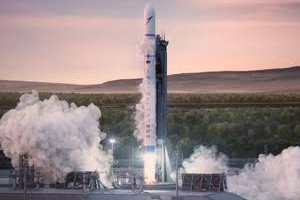
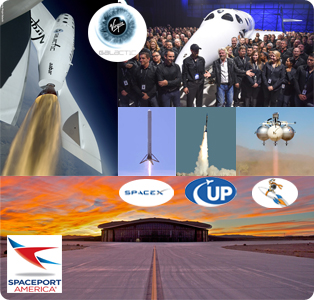
The second Spaceport America Open House Day occurs April 2 at the 7,280-hectare (18,000-acre) facility with 3,700-meter ‘spaceway’ in a New Mexico desert basin. Organizers expect to welcome at least 1,600 participants in 2 sessions that include demonstrations at the horizontal launch area, hands-on fun and educational activities. A fly-in is planned by Aviators from New Mexico Chapters of Experimental Aircraft Association and New Mexico Pilots Association. Anchor tenant Virgin Galactic, lead by Chairman Sir Richard Branson and CEO George Whitesides, is building back up to test flights after the SpaceShipTwo / VSS Enterprise catastrophe in 2014. Virgin Galactic has not yet been able to offer long-promised operational flights, 10 years on from the State legislature enacting the law providing for the world’s first purpose-built commercial spaceport and 6 years on from the grand opening. This has caused revenue to fall well below official projections for the ~US$220M publicly funded development, although SpaceX Falcon 9R testing, development programs for UP Aerospace and Armadillo Aerospace rockets, and a number of other companies’ activities have tallied up 20+ suborbital test flights from the location. Interest and investment in space technologies and space access continue to grow in Florida, Virginia, Texas, California, Alaska, Hawai`i, and elsewhere, as forward looking and productive contributions to the innovative spirit of America applied in reaching for the Stars. (Image Credit: Spaceport America, Virgin Galactic, SpaceX, Up Aerospace, Armadillo Aerospace)
MONDAY
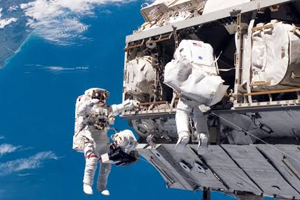
Mar 28 — ISS, LEO: Expedition 47 six-member crew unloading cargo from Cygnus OA 6, scheduled to release Progress 62P on Tuesday & welcome Progress 63P on Saturday, will review procedures for Dragon CRS-8 arrival next week, working on new Additive Manufacturing Facility and Meteor Composition Determination study to observe meteor showers & explore their chemistry.
Mar 28 — Iridium 46 Flare, LEO: Iridium 46 satellite flare to occur West of Hawai`i Island at 05:27:11 HST, magnitude of 0, 48° altitude, distance to satellite will be about 1,006 km.
Mar 28 — ARTEMIS 1 and 2, Highly Elliptical Moon Orbits: In stable flight, expected to operate for years, collecting information on solar wind interacting with Moon, working with THEMIS, Van Allen Probes, Magnetospheric Multiscale (MMS) mission.
Mar 28 — ExoMars 2016, Mars Trajectory: First of 2 ExoMars missions containing Trace Gas Orbiter & Schiaparelli Entry Descent and Landing demonstrator module projected to approach Mars mid-October, will attempt to investigate atmosphere for present-day geological & potential biological activity.
Mar 28 — Rocket Lab, Auckland, New Zealand: NewSpace company working to begin Electron rocket test launches in June likely from Pacific Spaceport Complex in Alaska, successful testing qualifies 22,241 N (5,000lbf) Rutherford engine for flight tests, developing launch site on New Zealand Mahia Peninsula.
Mar 28 — Copenhagen Suborbitals (CS), Copenhagen, Denmark: Will test Nexø I and II rockets in spring or summer from 12,000-kg steel catamaran in Baltic Sea, taking on interns to aid with projects, working on new test stand, 100 kN Spica rocket & suborbital Tycho Deep Space II capsule.
Mar 28 — Altius Space Machines Inc., Broomfield CO: Developing vacuum / gripper concept for Asteroid Retrieval Mission (ARM) to remove a boulder from surface of an asteroid, and aerobreaking technology for human & deep space missions to planets, moons with atmospheres.
Mar 28 — International Sun-Earth Explorer 3 (ISEE-3) / ICE – 30th Observation of comet Halley distant flyby, Heliocentric Orbit: Craft heading away from Earth in orbit around Sun, was last contacted in 2014 for crowd-funded lunar flyby reboot project, observations from Halley’s Comet in 1986 provided upstream solar wind data.
= All times
for terrestrial events in local time unless noted.
= All times for international terrestrial events in local time unless noted.
= All times for space events, and…
= All times for international space / astro events in Hawaii Standard Time unless noted. Add 10 hours to obtain UT (‘Universal Time;’ Greenwich, England).
USA National Academies Experts Convene for Space Science Week and CAPS Meeting
The National Academies of Sciences, Engineering, and Medicine in Washington DC is holding the Committee on Astrobiology and Planetary Science (CAPS) Meeting, and Space Science Week featuring a lecture by Alan Stern on New Horizons, Mission to Pluto: Exploring the Frontier of Our Solar System between March 29-31. Space Science week will include updates from Alvaro Gimenez (ESA), Chi Wang (CAS), Saku Tsuneta (JAXA), Pascale Ehrenfreund (DLR), Paul Hertz (NASA), Ames Ulvestad (NSF), Mike Gold (Bigelow), Frank Culbertson (Orbital ATK), and John Olson (Sierra Nevada). Alan Stern will discuss the dynamic world of Pluto and its 5 moons, its “active geology, exotic surface chemistry, a complex atmosphere, [and] puzzling interaction with the Sun.” The CAPS meeting will cover space-based and supporting ground-based planetary research within the Solar System, including planets, moons, small bodies, astrobiology, planetary astronomy and planetary protection. Future CAPS meetings are already scheduled to be held twice a year, March and September, through 2020. The National Academies produces around 200 reports each year, has a total membership of over 6,300 scientists, engineers, and health professionals, and was created by an Act of Incorporation in 1863 signed by Abraham Lincoln. (Image Credit: The National Academies, NASA) Pictured: Bottom: Alan Stern; Top L-R: Ralph Cicerone – President of National Academy of Sciences, C. Dan Mote Jr. – President of National Academy of Engineering, Victor Dzau – President of National Academy of Medicine.
Mar 28 — Moon: 4.1° N of Mars, 10:00; 9.7° N of Antares, 16:00.
Mar 28 — Aten Asteroid 325102 (2008 EY5): Near-Earth flyby (0.098 AU).
Mar 30 — Hawai’i Preparatory Academy, Gates Performing Arts Center, Kamuela HI: Life in the Universe: The Science of Astrobiology; Dr. Carl Pilcher, Interim Director of the NASA Astrobiology Institute, 19:00.
NET Q2 — Interorbital Systems Corp., Launch Neptune single CPM (SR 145), Mojave CA: Planning suborbital test flight of Neptune single Common Propulsion Module (CPM) with 6 confirmed payloads this quarter.
NET Apr — Akatsuki, 400 x 440 km Venus Orbit: JAXA first successful interplanetary orbiter with a period of 13 days 14 hours, will begin data acquisition this month; planned to image atmosphere, monitor weather changes at Venus for at least 2 years.
Apr 1 — Deep Space, Milky Way Galactic Center: Cosmic rays & radiation being tracked, most sensitive instrument able to record rays is High Energy Stereoscopic System (HESS) located in Namibia; Milky Way can produce rays with energies of up to ~100 teraelectronvolts (~1 Trillion times larger than energy of visible light).
Apr 1 — Cassini OTM-445, Saturn Orbit: Spacecraft conducts Orbital Trim Maneuver #445 today.
Apr 2 — ISS, Launch Soyuz / Progress 63P, LEO: Progress 63P resupply ship to dock to ISS with 2,381 kg of cargo and supplies.
Apr 2 — Spaceport America, Las Cruces NM: Spaceport America Open House with Virgin Galactic crew members, Aviators from New Mexico Chapters of the Experimental Aircraft Association and New Mexico Pilots Association.
Apr 2 — Mauna Kea Astronomy Outreach Committee, Mauna Kea HI 2,800-meter level: The Universe Tonight; presentation on current research & discoveries occurring on Mauna Kea 18:00, followed by stargazing program, at Mauna Kea Visitor Information Center.
Apr 2 — Moon: 3.3° N of Pluto, 17:00.
SUNDAY
Apr 3 — Moon: 1.1° SSE of asteroid 18 Melpomene, 16:00.
Includes ~150 meetings covering the fields of COSPAR Scientific Commissions / Panels / Task Groups, such as SC B: The Earth-Moon System, Planets, and...
From 02 to 07 August 2026, a few thousand geoscientists across diverse disciplines will gather at the 23rd annual meeting of the Asia Oceania Geosciences...
2:45 pm EDT from Johnson Space Center, NASA astronaut Chris Williams will recap his recent eight-month mission aboard the International Space Station. Williams returned to...
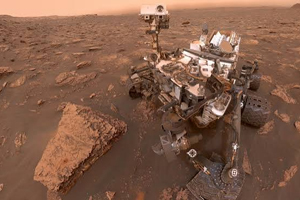
NASA Curiosity (Mars Science Laboratory) rover surpasses another full year of operations on Mars surface today; launched Nov 26, 2011 – landed Aug 5,...
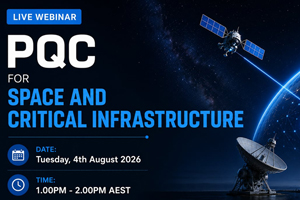
Virtual Series 2026 will offer deeper conversations on why PQC matters and the practical steps businesses should be taking; starts 1:00 pm AEST. Featuring:...
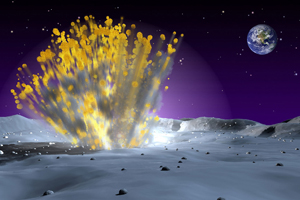
This international lunar science meeting has two objectives: to provide a platform for leading experts to review recent advances across lunar research, from the...
At CSIR International Convention Centre. Key topics are Earth Observation, Developing Space Tourism, Space Supply Manufacturing. Cultural tours are offered.
Participants will receive theoretical and hands-on training in electron imaging and X-ray spectroscopy for application to planetary samples. This training opportunity is targeted at...
"Leading Australia’s Space Future for Our Strategic Advantage". Southern Space 2026 brings together decision-makers who set the direction for Australia’s space sector. It is...

 = All times
 = All times for international terrestrial events in local time unless noted.
 = All times for space events, and…
 = All times for international space / astro events in Hawaii Standard Time unless noted. Add 10 hours to obtain UT (‘Universal Time;’ Greenwich, England).
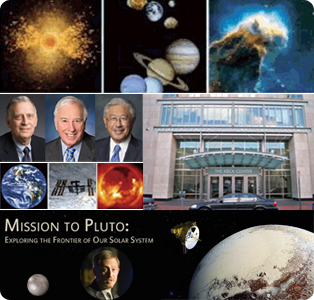 The National Academies of Sciences, Engineering, and Medicine in Washington DC is holding the Committee on Astrobiology and Planetary Science (CAPS) Meeting, and Space Science Week featuring a lecture by Alan Stern on New Horizons, Mission to Pluto: Exploring the Frontier of Our Solar System between March 29-31. Space Science week will include updates from Alvaro Gimenez (ESA), Chi Wang (CAS), Saku Tsuneta (JAXA), Pascale Ehrenfreund (DLR), Paul Hertz (NASA), Ames Ulvestad (NSF), Mike Gold (Bigelow), Frank Culbertson (Orbital ATK), and John Olson (Sierra Nevada). Alan Stern will discuss the dynamic world of Pluto and its 5 moons, its “active geology, exotic surface chemistry, a complex atmosphere, [and] puzzling interaction with the Sun.” The CAPS meeting will cover space-based and supporting ground-based planetary research within the Solar System, including planets, moons, small bodies, astrobiology, planetary astronomy and planetary protection. Future CAPS meetings are already scheduled to be held twice a year, March and September, through 2020. The National Academies produces around 200 reports each year, has a total membership of over 6,300 scientists, engineers, and health professionals, and was created by an Act of Incorporation in 1863 signed by Abraham Lincoln. (Image Credit: The National Academies, NASA) Pictured: Bottom: Alan Stern; Top L-R: Ralph Cicerone – President of National Academy of Sciences, C. Dan Mote Jr. – President of National Academy of Engineering, Victor Dzau – President of National Academy of Medicine.