International Space Station Developing 21st Century Solar System Competency
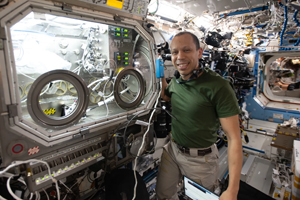
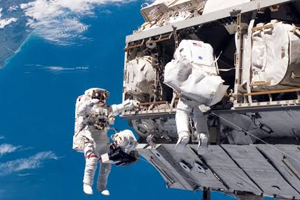
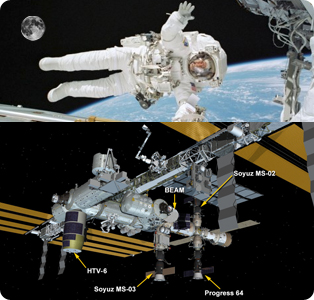
ISS Expedition 50 six member crew from France, Russia and USA continue operations, exploration and life in space as the station passes 6,611 days on orbit. There are 4 spacecraft docked at the station including HTV-6, Soyuz MS-02 and MS-03 crew vehicles and the Progress 64 resupply. Commander Shane Kimbrough is preparing for 2 spacewalks: Extravehicular Activity (EVA) 38 on January 6 with crewmate Peggy Whitson and EVA 39 on Jan 13 with crewmate Thomas Pesquet, both scheduled to begin 07:05 Eastern Time and last approximately 6.5 hours. The objective is to install 6 new Japan-made Li-Ion batteries at the S4 truss replacing old units and improving power efficiency in the system that provides photovoltaic power to the habitat. This will mark the 15th European EVA with Pesquet becoming the 11th ESA astronaut to walk in space. Expedition 50 which also includes, Sergey Ryzhikovrew, Andrey Borisenko and Oleg Novitskiy continue Phase Change HX, CUBERIDER-1, Area PADLES, AquaMembrane, Biochem Profile, Repository, Habitability, ESA-Active-Dosimeters, Fine Motor Skills, Lighting Effects, Multi-Omics, Neuromapping, Dose Tracker and Space Headaches investigations and experiments. ISS is a critical but tenuous toehold in space for humanity. To truly achieve Solar System Complete competence in the 21st Century humanity could strive to expand its permanent presence in space from ISS, to the Moon in the next 5-10 years, Mars in 10-20, Jupiter 30-40 and beyond. (Image Credit: NASA)
MONDAY
Ongoing… Dec 26 — ISS, 330-435-km LEO: Expedition 50 celebrate Holidays in Space video chatting with family & friends on Earth, working on cargo transfer from Japan HTV-6 & Russia Progress 64P, reviewing procedures for upcoming EVAs, verifying emergency equipment, small satellite deployments from NanoRacks Deployer may occur before end of year.
Dec 26 — Mars Reconnaissance Orbiter,Mars Orbit: NASA craft in its 11th year at Mars, providing data on “spider-like” geological features found radially patterned channels found only in south polar region of Mars which could be caused by thawing-carbon-dioxide processes; mission has returned ~296 terabits of data so far.
Dec 26 — Cassini, Saturn Orbit: Flyby scheduled today of Enceladus (88,000-km altitude), Mimas (41,000-km altitude), Aegaeon (32,000-km altitude); craft launched 1997, end of mission scheduled Sep 2017.
Dec 26 — Women on the Moon Space Priority Initiative,USA / Global: Incoming USA 2017 Administration could support putting 1st Woman on the Moon, returning Humans to Moon to advance space / Earth technologies, pioneer New Frontier at Moon South Pole, enhance Humanity as Multi World Species.
Dec 26 — ispace inc.,Tokyo, Japan: NewSpace company signs MOU with JAXA to develop frameworks for lunar resource mining, delivery and utilization; this year Japan adopted a 20-year space national policy to strengthen the development of the space resource industry with a focus on lunar resources.
Dec 26 — Tau Zero Foundation,Multiple Locations: Non-profit group of scientists & engineers sharing research related to interstellar travel, collaborating with Ohio Aerospace Institute to expand its graduate student program, founder Marc Millis; company blog Centauri Dreams run by Paul Gilster.
= All times
for terrestrial events in local time unless noted.
= All times for international terrestrial events in local time unless noted.
= All times for space events, and…
= All times for international space / astro events in Hawaii Standard Time unless noted. Add 10 hours to obtain UT (‘Universal Time;’ Greenwich, England).
American Astronomical Society Keeping Up with New Universe Discoveries in the New Year
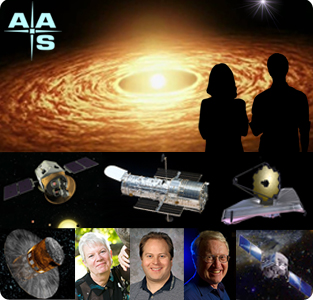
The American Astronomical Society (est. 1899) is starting off New Year 2017 with its 229th Meeting in Grapevine, Texas January 3-7. This year’s program will feature Jill Tarter of SETI speaking on “The 21st Century: The Century of Biology on Earth and Beyond”, William Bottke of SwRI on “Early Solar System Bombardment: Exploring the Echos of Planetary Migration and Lost Ice Giants” and Garth Illingworth of UC Santa Cruz on “Exploring for Galaxies in the First Billion Years with Hubble and Spitzer – Pathfinding for JWST”. Exoplanets, black holes, galaxies, intergalactic medium, molecular clouds, dark matter, AGN, blazars, supernova, planetary nebulae, stars, and methods and instruments to observe these phenomena will be discussed during 158 oral and poster sessions. There will be a 90-minute session on W. M. Keck Observatory with 6 speakers, presenting a broad array of science highlighting the scientific complementarity between NASA missions and Keck observations. NASA venerable Hubble Space Telescope continues to provide astounding high-res images, ESA Gaia is working on 3D mapping more than 1 Billions stars, ISRO Astrosat is collecting multi-wavelength data ranging from nearby solar system objects to distant stars, and the next scientific data release is expected in March from CNSA Chang’e-3 Lander Lunar-based Ultraviolet Telescope (LUT) operating from the surface of the Moon after 3 full years. Launching Dec 2017, Transiting Exoplanet Survey Satellite will monitor more than 200,000 stars to discover exoplanets. James Webb Space Telescope, to observe some of the most distant events and objects in the Universe, is scheduled to launch Oct 2018. (Image Credit: AAS, NASA, ISRO, ESA, JPL, Caltech, SSC, et al)
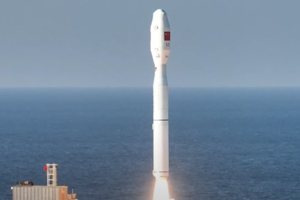
Dec 26 — CNSA, Launch Long March 2D / SuperView 1 & 2, Taiyuan Satellite Launch Center, China: Long March 2D rocket to launch SuperView 1 and 2 (GaoJing) Earth observation satellites for Beijing Space View Technology Co.
Dec 26 — Moon: 9.6° N of Antares, 14:00.
Continued from…
Oct 15 – Sep 4, 2017 — Peabody Essex Museum, Salem MA: Lunar Attraction Exhibit; featuring 60 Apollo memorabilia, paintings, sculptures, photographs, books, movies, jewelry that illustrate our profound connection to the Moon.
Dec 27 — Apollo Asteroid 2016 YR: Near-Earth Flyby (0.018 AU).
WEDNESDAY
Dec 28 — International Launch Services, Launch Proton / EchoStar 21,Baikonur Cosmodrome, Kazakhstan: Proton rocket with a Breeze M upper stage to launch EchoStar 21 communications satellite, formerly known as TerreStar 2.
Dec 28 — Moon: 1.8° N of Mercury, 19:00; New Moon, 20:53.
Dec 28 — Mercury: At inferior conjunction with Sun, 0.675 AU from Earth and 2.44° N of Sun, 09:00.
THURSDAY
Dec 29 — Cassini, Saturn Orbit: Start of revolution 255 around planet.
Dec 31 — XPRIZE Foundation, Santa Monica CA: Google Lunar XPRIZE Teams must submit launch contract by midnight tonight PST in order to stay in GLXP competition and attempt to win grand prize of US$20M after craft reach Moon surface, travel 500 meters and downlink HD video; SpaceIL verified with SpaceX, Moon Express with Rocket Lab, Synergy Moon with Interorbital, Team Indus with ISRO PSLV (carrying Team Hakuto), Part Time Scientists with SpaceX via Spaceflight Industries.
Dec 31 — Airbus, Boeing Co., Via Satellite, SES, Orbital ATK, Intelsat, et al, Online / Washington DC: Due: Satellite 2017 Startup Space submissions; winning participants will get chance to share business & technology ideas in front of a panel of experts during Satellite 2017 Awards Reception on March 8, 2017.
Dec 31 — Leap Second Addition, Global: At very end of this day a leap second to be added to World’s clocks – which will read 11:59:60 (23:59:60); will be 17th leap second gained since 1972.
SUNDAY
NET 2017 — International Lunar Observatory Association, Moon Express Inc., Canadensys Aerospace Corp., Launch ILO-1, TBD: Launch of ILOA multifunctional observatory to Moon South Pole; will conduct radio astronomy, scientific & commercial communications, serve as catalyst for lunar base build-out.
NET 2017 — ISRO, Launch GSLV Mark-2 / Chandrayaan-2, Satish Dhawan Space Center, Sriharikota, India: India 2nd robotic Moon Mission expected to launch orbiter, and lander / rover for polar mission; plans for Chandrayaan 3 and 4 are underway.
NET 2017 — ESA, Launch ESA CHEOPS, TBD: Launch of CHaracterising ExOPlanets Satellite (CHEOPS) to LEO; planned mission to last 3.5 years.
NET 2017 — ISRO, Bengaluru, India: ISRO plans for Astronaut-rated Orbital Vehicle environmental control and crew escape system to be completed by this year, first launch of humans planned for 2021 on GSLV Mk. 3.
NET Q1 2017 — Interorbital Systems Corp., Launch Neptune 5 (5 CPM) vehicle / 27-unit payload, Mojave CA: Planning to launch Neptune 5 Common Propulsion Module (CPM) to loft 27-unit Team Synergy Moon spacecraft on Ballistic Lunar Transfer to orbit the Moon.
NET Q1 — SpaceX, Launch Falcon 9 / Formosat 5 & Sherpa,Vandenberg AFS CA: SpaceX Falcon 9 rocket to launch Formosat 5 for Taiwan’s National Space Organization (NSPO) and Sherpa from Spaceflight Industries carrying ~90 small payloads & CubeSats.
NET Jan — ISRO, Launch GSLV Mk. 3 / GSAT 19E,Satish Dhawan Space Center, Sriharikota, India: First full orbital flight of Geosynchronous Satellite Launch Vehicle Mk.3 with GSAT 19E experimental communications satellite.
NET Jan — Eurockot, Launch Rockot / Sentinel 5p, Plesetsk Cosmodrome, Kazakhstan: Eurockot Rockot to launch Sentinel 5 Precursor Earth observation satellite for ESA & the European Commission to measure air quality, ozone, pollution, aerosols in Earth atmosphere.
NET Jan — SpaceX, Launch Falcon 9 / Iridium Next 1-10, Vandenberg AFB CA: SpaceX return to flight with attempted launch of 10 Iridium Next satellites aboard Falcon 9 for Iridium Communications Inc.
NET Jan — SpaceX, Launch Falcon 9 / SES 10,Vandenberg AFS CA: SpaceX recycled Falcon 9 rocket to launch SES 10 communications satellite for Luxembourg-based SES; typical launch cost for Falcon US$62M, company says usability could bring price down to $43M.
NET Jan – Nov — ExoMars 2016 Orbiter, Mars Orbit: ESA Trace Gas Orbiter scheduled to enter Aerobraking phase from Jan-Nov to enter 400-km orbit; set to adjust orbit inclination to 74° on Jan 17.
NET Jan — Hawaii Space Exploration Analog and Simulation (HI-SEAS), 2,500-meter Elevation, Mauna Loa HI: HI-SEAS 5 six-member ‘Lavanaut’ crew to begin 8-month space mission simulation.
Jan 1 — Deep Space: Farthest spacecraft from Earth, Voyager 1 and 2 exploring Interstellar Space and the Heliosphere (respectively), being powered by heat generated by radioactive decay, expected to operate until at least 2020s, may have to turn off gyroscopic operations in a year or two to preserve energy.
Jan 1 — Moon: 1.9° N of Venus, 23:20.
MONDAY
Jan 2 — Apollo Asteroid 226514 (2003 UX34): Near-Earth Flyby (0.049 AU).
Jan 3-7 — Indian Science Congress, Bharath Innovation Labs,Tirupati, Andhra Pradesh, India: 104th Indian Science Congress; at Sri Venkateswara University.
Jan 3 — Quadrantids Meteor Shower Peak: Appearing to radiate from constellation Quadrans Muralis; can produce up to 40 meteors per hour; visibility limited due to waning gibbous Moon; peak 04:00.
Jan 4-7 — U.S. National Committee of the International Union of Radio Science (URSI), IEEE Antennas and Propagation Society, Boulder CO:National Radio Science Meeting (NRSM).
Jan 4 — Earth: At perihelion (0.98331 AU), 04:17.
Jan 4 — Apollo Asteroid 2016 XK: Near-Earth Flyby (0.043 AU).
Jan 5 — Cassini, Saturn Orbit: NASA craft to enter Orbit 256 around planet today.
Jan 5 — Moon: 6.7° N of Saturn, 09:47.
FRIDAY
Jan 6 — ISS, Expedition 50 U.S. EVA # 38,LEO: Commander Shane Kimbrough and crewmate Peggy Whitson to perform first of two scheduled Extravehicular Activities to perform battery installation (+4 Contingency EVAs), 6.5-hour spacewalk to begin 07:05 EST.
Jan 6 — Apollo Asteroid 2016 XJ2: Near-Earth Flyby (0.072 AU).
SATURDAY
Jan 7 — Mauna Kea Astronomy Outreach Committee, Mauna Kea HI, 2,800-meter level: The Universe Tonight; presentation on current research & discoveries occurring on Mauna Kea 18:00, followed by stargazing program, at Mauna Kea Visitor Information Center.
Jan 7 — Apollo Asteroid 85990 (1999 JV6): Near-Earth Flyby (0.069 AU).
SUNDAY
NET Jan 8 — SpaceX, Launch Falcon 9 / EchoStar 23,Cape Canaveral AFS FL: SpaceX Falcon 9 rocket to launch EchoStar 23 communications satellite for EchoStar Corp to provide direct-to-home television broadcast services over Brazil.
Includes ~150 meetings covering the fields of COSPAR Scientific Commissions / Panels / Task Groups, such as SC B: The Earth-Moon System, Planets, and...
From 02 to 07 August 2026, a few thousand geoscientists across diverse disciplines will gather at the 23rd annual meeting of the Asia Oceania Geosciences...
2:45 pm EDT from Johnson Space Center, NASA astronaut Chris Williams will recap his recent eight-month mission aboard the International Space Station. Williams returned to...
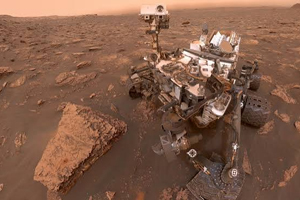
NASA Curiosity (Mars Science Laboratory) rover surpasses another full year of operations on Mars surface today; launched Nov 26, 2011 – landed Aug 5,...
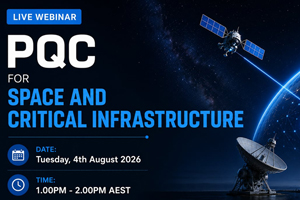
Virtual Series 2026 will offer deeper conversations on why PQC matters and the practical steps businesses should be taking; starts 1:00 pm AEST. Featuring:...
This international lunar science meeting has two objectives: to provide a platform for leading experts to review recent advances across lunar research, from the...
At CSIR International Convention Centre. Key topics are Earth Observation, Developing Space Tourism, Space Supply Manufacturing. Cultural tours are offered.
Participants will receive theoretical and hands-on training in electron imaging and X-ray spectroscopy for application to planetary samples. This training opportunity is targeted at...
"Leading Australia’s Space Future for Our Strategic Advantage". Southern Space 2026 brings together decision-makers who set the direction for Australia’s space sector. It is...
 Dec 26 —
  Dec 26 —
  Dec 26 — Women on the Moon Space Priority Initiative, USA / Global: Incoming USA 2017 Administration could support putting 1st Woman on the Moon, returning Humans to Moon to advance space / Earth technologies, pioneer New Frontier at Moon South Pole, enhance Humanity as Multi World Species.
 Dec 26 —
 = All times
 = All times for international terrestrial events in local time unless noted.
 = All times for space events, and…
 = All times for international space / astro events in Hawaii Standard Time unless noted. Add 10 hours to obtain UT (‘Universal Time;’ Greenwich, England).