China Set to Host GLEX 2017 in Beijing, Launch Tianzhou-1 and CE-5 from Hainan
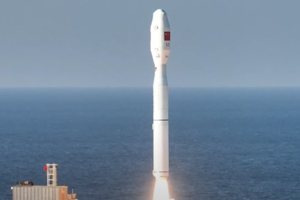
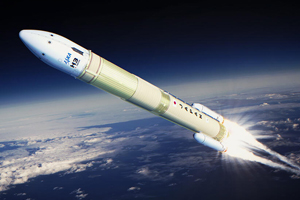
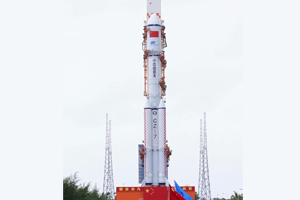
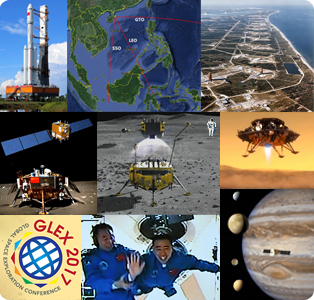
Pioneering China space activities are planned for 2017 including Tianzhou-1 cargo ship launching to Tiangong-2 space lab in April, Global Space Exploration Conference (GLEX) & ILOA Galaxy Forum (GF) in June, and China first lunar sample return mission Chang’e-5 launching November from Hainan Island. International Astronautical Federation and Chinese Society of Astronautics are hosting GLEX 2017 at Beijing International Convention Center June 6-8 to advance space technology and Human exploration planning and objectives. GF Beijing on June 5 will be themed Astronomy From The Moon and International Human Moon Missions. Wenchang Space Launch Center at Hainan ‘Moonport’ 19° N latitude is supporting China’s ambitious 21st Century space program with crew and cargo launches to its new Space Lab in LEO, next-generation rockets Long March 5 and 7, and progressively more advanced missions to the Moon while planning for Mars 2020 and Jupiter system ~2030. Chang’e-5 sample return mission, launching from Hainan Nov 2017, will attempt to dig 2 meters into the lunar surface and return at least 2 kg of regolith to Earth, landing in Siziwang Banner, Inner Mongolia. CE-4 orbiter and lander / rover are scheduled to reach Moon far side 2018. CE-6 may launch 2020 as the last robotic mission before Human Moon missions.(Image Credit: CNSA, CAS, NAOC, IAF, Xinhua, Zeng Tao, IC)
MONDAY
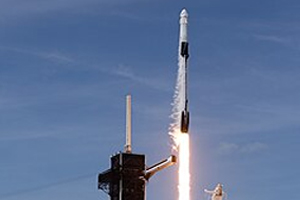
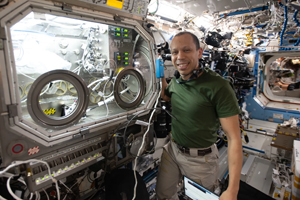
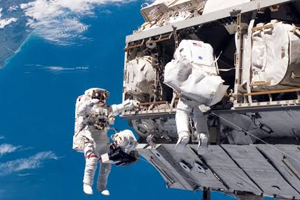
Ongoing… Feb 27 — ISS, 330-435-km LEO: Expedition 50 six-member crew transferring cargo from Dragon CRS-10 including 1st ISU Experiment in Space (MMARS1) and from Progress 66P carrying ~3,000 kg of supplies, training / testing Robonaut, working with Microgravity Science Glovebox experiment to cultivate human stem cells; external Alpha Magnetic Spectrometer analyzing cosmic ray events, has identified 9M electrons / positrons (antimatter).
Feb 27 — Fermi Gamma-ray Telescope, LEO: Gamma-ray signal at center of neighboring Andromeda galaxy (similar to one seen at center of Milky Way) could indicate presence of dark matter, lead scientist Pierrick Martin says “we expect dark matter to accumulate in the innermost regions of the Milky Way and other galaxies, which is why finding such a compact signal is very exciting.”
Feb 27 — Juno, Jupiter Orbit: Will stay in current 53-day orbit for remainder of mission allowing for exploration of far reaches of Jovian magnetosphere, next close flyby of gas giant at 4,100 km is planned March 27, mission planned through July 2018 with a total of 12 science orbits.
Feb 27 —Made in Space,Moffett Field CA: NewSpace company 3D printer at ISS produces first sculpture made in space – a representation of a human laugh’s sound waves, continues printing spare parts, tools, other gear for Astronauts; company is creating a system to produce high-value optical fibers in space; CTO Jason Dunn.
Feb 27 —Rocket Lab,Auckland, New Zealand: On track for first test launch of carbon composite Electron rocket (dubbed “It’s A Test”) from Mahia Peninsula site in April, has contracts with Moon Express for GLXP mission to Moon in Dec, and smallsat missions with Spire, Planet & NASA.
Feb 27 —UK Space Developments,United Kingdom: Department of Transport Spaceflight Bill to outline new laws allowing launch of satellites from UK, suborbital horizontal flights for science experiments; 6 sites still under study to establish spaceport; Reaction Engines developing SABRE engine, Orbital Access plans to design horizontal take off space launch systems.
= All times
for terrestrial events in local time unless noted.
= All times for international terrestrial events in local time unless noted.
= All times for space events, and…
= All times for international space / astro events in Hawaii Standard Time unless noted. Add 10 hours to obtain UT (‘Universal Time;’ Greenwich, England).
NASA Planetary Science Vision 2050 Workshop Focuses Long-Range, Solar System Complete
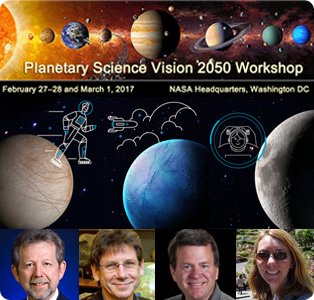
The Planetary Science Division (PSD) is planning to host a community workshop at NASA headquarters in Washington DC February 27 – March 1 to discuss space exploration on a 35-year scale containing one or multiple paths forward. Organizers include (L-R) James Green (PSD Director), Stephen Mackwell (USRA), Gregory Schmidt (ARC) and Dana Hurley (JPL). 2050 Workshop objectives involve planning over-arching planetary science themes for each decade leading to notional technologies and missions; identifying technology challenges / knowledge gaps that will need early investment to overcome; and considering cross-cutting opportunities with other disciplines in the larger context of international planetary science and human exploration. Five discussion themes are Solar Systems Origins, Workings, Life, Defense & Resources, and Policy, Pathways, Techniques and Capabilities. Also thinking ‘beyond Mars in 2030’ Robert Walker, U.S. Administration space policy advisor, notes a “stretch goal” which may be implemented is human exploration of the complete Solar System by the start of the 22nd Century to accelerate technology developments and deep space achievements. Planning for Jupiter and Beyond in 2040s, 50s could enable ground-breaking science and Human exploration of the Moon – its equatorial and polar regions in 2020s, Mars and its moons 2030s, and the Main Asteroid Belt 2035. (Image Credit: NASA, PDS, LPI, ARC, JPL Infographics / neomam)
Feb 27 — Loyola University Maryland, Baltimore MD: 2017 Grand Seminar featuring NASA Goddard Space Flight Center senior astrophysicist / 2006 Nobel Prize winner in Physics John Mather.
Feb 27 – Mar 1 — NASA Planetary Science Division, Washington DC: Planetary Science Vision 2050 Workshop; leading experts in solar system planetary science & space technologies to identify potential science goals and enabling technologies that can be implemented by the end of 2040s to support next phase of Solar System exploration.
Feb 27 – Mar 2 — Applied Technology Institute, Columbia MD: Space Systems Fundamentals; taught by Dr. Mike Gruntman, Professor of Astronautics at University of Southern California.
Feb 27 — Apollo Asteroid 2017 BM123: Near-Earth Flyby (0.027 AU).
Continued from…
Oct 15, 2016 – Sep 4 — Peabody Essex Museum, Salem MA: Lunar Attraction Exhibit; featuring 60 Apollo memorabilia, paintings, sculptures, photographs, books, movies, jewelry that illustrate our profound connection to the Moon.
Feb 28 — Apollo Asteroid 2017 DJ16: Near-Earth Flyby (0.010 AU).
WEDNESDAY
Mar 1 — Deep Space, KBO 2014 MU69 Trajectory: New Horizons set to arrive at first Kuiper Belt Object January 1, 2019 and flyby at 12,500 km or closer; if mission is extended it could explore ~20 more KBOs over its lifetime; New Horizons team asking IAU to change the definition of what a planet is.
Mar 1 — United Launch Alliance, Launch Atlas 5 / NROL-79, Vandenberg AFB CA: ULA Atlas 5 rocket, designated AV-068 to launch classified spacecraft payload for U.S. National Reconnaissance Office.
Mar 3-8 — Federal University of Espírito Santo, Abdus Salam International Centre for Theoretical Physics, Anchieta, Espirito Santo, Brazil: Quantum Summer 2017.
Mar 3 — Apollo Asteroid 2016 RZ17: Near-Earth Flyby (0.078 AU).
SATURDAY
Mar 4-11 — IEEE, AIAA, Prognostics and Health Management Society (PHM), Big Sky MT: IEEE Aerospace Conference; at Yellowstone Conference Center.
Includes ~150 meetings covering the fields of COSPAR Scientific Commissions / Panels / Task Groups, such as SC B: The Earth-Moon System, Planets, and...
From 02 to 07 August 2026, a few thousand geoscientists across diverse disciplines will gather at the 23rd annual meeting of the Asia Oceania Geosciences...
2:45 pm EDT from Johnson Space Center, NASA astronaut Chris Williams will recap his recent eight-month mission aboard the International Space Station. Williams returned to...
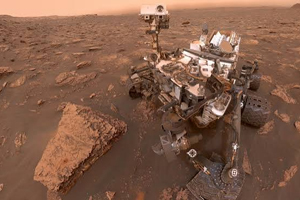
NASA Curiosity (Mars Science Laboratory) rover surpasses another full year of operations on Mars surface today; launched Nov 26, 2011 – landed Aug 5,...
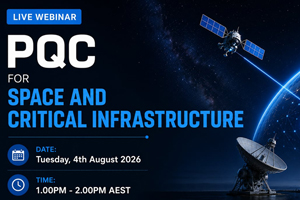
Virtual Series 2026 will offer deeper conversations on why PQC matters and the practical steps businesses should be taking; starts 1:00 pm AEST. Featuring:...
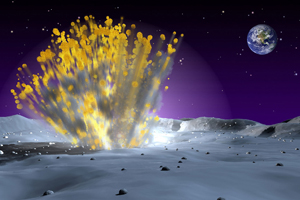
This international lunar science meeting has two objectives: to provide a platform for leading experts to review recent advances across lunar research, from the...
At CSIR International Convention Centre. Key topics are Earth Observation, Developing Space Tourism, Space Supply Manufacturing. Cultural tours are offered.
Participants will receive theoretical and hands-on training in electron imaging and X-ray spectroscopy for application to planetary samples. This training opportunity is targeted at...
"Leading Australia’s Space Future for Our Strategic Advantage". Southern Space 2026 brings together decision-makers who set the direction for Australia’s space sector. It is...
 Feb 27 —
  Feb 27 —
  Feb 27 —
  Feb 27 —
 = All times
 = All times for international terrestrial events in local time unless noted.
 = All times for space events, and…
 = All times for international space / astro events in Hawaii Standard Time unless noted. Add 10 hours to obtain UT (‘Universal Time;’ Greenwich, England).