ISRO Preparing to Launch Cost-Effective Chandrayaan-2 Lunar Lander in April to Moon South Pole Region
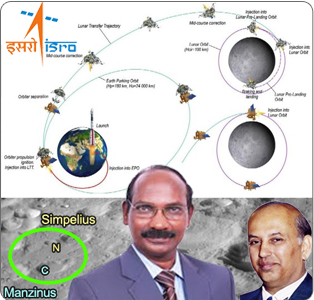
Indian Space Research Organization is aiming to launch its 8-billion rupee (US$123M) Chandrayaan-2 orbiter, lander, rover mission in early April, or in November if delayed. Dr. K. Sivan, ISRO chairman since January, says this is less expensive than the $165M Hollywood movie “Interstellar”. Taking over a month to reach the Moon after launch, Chandrayaan-2 lander and its 20-kg rover will operate on the lunar surface for 1 lunar day, or 14 Earth days. To maximize the operation time, ISRO will land the spacecraft right after the local dawn, resulting in ideal launch opportunity coming only once a month. With the Earth shadow casting on or near the Moon (lunar eclipse) around Jan / Feb and Jul / Aug this year, and again around Jan 2019, the best times to launch are early Apr and early Nov to avoid the shadow. Chandrayaan-2, weighing 3290 kg, will launch on heavy-payload lifter Geosynchronous Satellite Launch Vehicle (GSLV) Mark II from Sriharikota space port off India east coast. India would become the 4th country to soft-land spacecraft on the Moon, after USA, Russia, and China. ISRO is aiming to land on a high plateau between 2 craters, at ~70° south. The team is currently conducting landing simulations at Liquid Propulsion System Centre at Mahendra Giri in Tamil Nadu, soft-landing a prototype vehicle from 70-80 meter height. (Pictured: ISRO Chairman K. Sivan, former ISRO Chair U. R. Rao; Image Credit: ISRO, LRO)
MONDAY
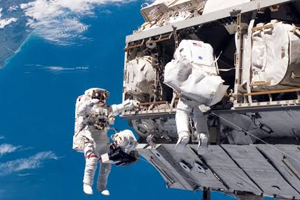
Ongoing… Feb 26 — ISS, 405-km LEO: Expedition 54 change of command ceremony today with Alexander Misurkin handing over ISS command to Anton Shkaplerov; start of Expedition 55 begins with Progress MS-06 and Misurkin, Vande Hei, Acaba returning to Earth tomorrow, live coverage available; science, experiments and cargo transfers continue.
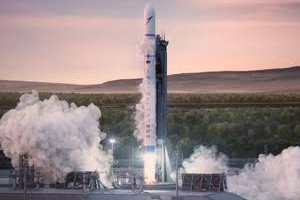
Feb 26 — NewSpace: Rocket Lab aiming for first full commercial Electron launch mid-March; Gilmour Space Technologies of Australia and Singapore to work with NASA for tech development / testing; Robert Bigelow announces new company Bigelow Space Operations for space habitats.
Feb 26 — Solar System: Further results from New Horizons indicate Pluto could have tar-like, gooey, organic layer beneath surface; Maven craft links dust storms to loss of gas in Mars atmosphere; Dawn at Ceres may run out of fuel mid year.
Feb 26 — Global: JAXA planning 8-person, 14-day, 13-night space station simulation at Tsukuba Space Center; China testing Ground Application System for Chang’e-4 lunar orbiter mission; Israel scientists discuss recent simulated Mars mission in Negev; UAE advances meteorites & space exploration initiative.
Feb 26 — USA: Findings from National Space Council last meeting expected to be announced, member names of NSC User’s Advisor Group become public; NASA analyzing data from recent SLS engine RS-25 hot fire.
Feb 26-28 — Danish Ministry for Science and Higher Education, ESO, European Organization for Nuclear Research (CERN), ESA,Copenhagen, Denmark:Big Science Business Forum 2018 (BSBF2018).
= All times
for terrestrial events in local time unless noted.
= All times for international terrestrial events in local time unless noted.
= All times for space events, and…
= All times for international space / astro events in Hawaii Standard Time unless noted. Add 10 hours to obtain UT (‘Universal Time’).
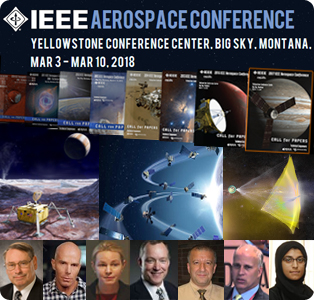
The 2018 Institute of Electrical and Electronics Engineers Aerospace Conference is being held in Big Sky, Montana on March 3-10 with cosponsors AIAA, AESS and PHM Society. Nearly 700 aerospace experts, academics, industry leaders and military personnel are expected to attend. The 6 days of presentations will host over 173 hours of technical sessions under 14 tracks, and 20 hours of technical networking events. Plenary Speaker Pete Worden (L-R) of Breakthrough Starshot will talk on The Search for Life in the Universe and Interstellar Probes. Stuart Stephens will present on Juno at Jupiter; Jennifer Dooley on Missions Concept for a Europa Lander; Tom Hoffman on InSight: Mars Geophysical Lander; Kourosh Rahnamai on Low-cost CubeSat Attitude Control System Testing Platform; and John Guidi’s Keynote will be NASA’s Human Exploration Plans. Space Science engineer at UAE Space Agency Heyam Al Blooshi will talk on Engaging Women to Study STEM through Empowerment: A Case from the United Arab Emirates. Other conference topics include Deep Space Gateway, SLS EM-2, NEOs, Establishment and Design of an Earth-Moon Communications Network in Lunar Polar Orbit, Mars Base, Cassini, and Venus Origins Explorer. IEEE est. 1963 now has more than 420,000 members in over 160 countries and works for technical and educational advancement of engineering and allied disciplines through publications, conferences, its industry Standards Association and multiple educational activities. (Image Credit: IEEE, BI, KISS, Jeffrey E Biteng / The National, WNE, NESAC)
Feb 26 – Mar 2 — Basic Sciences Development Program (PEDEClBA),La Plata, Argentina: 9th Planetary Science Workshop; focusing on physics, dynamics, formation, evolution and astrophysical observations in Planetary Science; as well as search, characterization & dynamics of extrasolar planets.
Feb 26 — Moon: 12.2° S of Castor, 05:00; 8.6° S of Pollux, 04:00.
Continued from…
Dec 19, 2017 – Mar 6 — CNSA, Online / Beijing, China: CNSA collecting 20,000 digital messages from public to be stored in Chang’e-4 relay satellite launching May-June to Earth-Moon L2 Lagrange Point to support Moon South Pole missions.
Feb 15 – Oct 15 / TBD — Hawaii Space Exploration Analog and Simulation (HI-SEAS), 2,500-meter Elevation, Mauna Loa HI: HI-SEAS 6 four-member ‘Lavanaut’ crew from Australia, Korea, Scotland and Slovakia 8-month space mission simulation postponed after crew medical issue.
Feb 25-27 — Space Exploration Alliance, NSS, AIAA, Moon Society, Federation of Galaxy Explorers, Planetary Society, SEDS, et al,Washington DC: SEA Legislative Blitz 2018; advocating for the exploration and development of Space.
Feb 27 – Mar 1 — Canaveral Council of Technical Societies, NASA Kennedy Space Center, Space Florida, Economic Development Commission of Florida Space Coast, Cape Canaveral FL: 45th Space Congress: The Journey: Future Exploration for Universal Opportunities; featuring Astronauts Robert “Bob” Cabana, Bob Crippen, Ellen Ochoa, Nicole Stott, Winston Scott.
Feb 27 – Mar 1 — NASA, Lunar and Planetary Institute, Universities Space Research Association (USRA), Denver CO: Deep Space Gateway Science Workshop; to actively engage the scientific community in early stages of determining ways Deep Space Gateway concept could be used to facilitate science.
Feb 27 — Moon: Moon at perigee (distance 363,938 km), 04:36; 2.0° S of Beehive Cluster, 07:00.
Feb 27 — Apollo Asteroid 2014 EY24: Near-Earth Flyby (0.038 AU).
WEDNESDAY
Feb 28 — Goddard Space Flight Center, NASA, Greenbelt MD:Colloquium: Origin of the Moon; Robin Canup of Southwest Research Institute, 15:30.
Feb 28 – Mar 1 — British Interplanetary Society,London, United Kingdom: Symposium: Mars in the Age of New Space Launchers; two-day symposium to explore emerging possibilities for human Mars exploration and settlement, as NASA SLS rocket approaches its first flight and as competing plans from private industry take shape.
Feb 28 – Mar 4 — MEXT, METI, JAXA, Space Generation Advisory Council, University of Tokyo, Tokyo, Japan: Second International Space Exploration Forum (ISEF2) ministerial-level meeting to build support for global cooperation in space exploration, and meetings Y-ISEF for young professionals. I-ISEF for industries and “Strategies for the Moon Base & Space Natural Resources” side event.
Feb 28 — Moon: 0.91° NNE of Regulus, 20:00.
Feb 28 — Apollo Asteroid 2015 BF511: Near-Earth Flyby (0.030 AU).
THURSDAY
NET Mar — KARI, Yuseong-gu, Daejeon, South Korea: Korea Aerospace Research Institute original date planned to have completed indigenous second-stage rocket.
Mar 1 — Deep Space: Deep Space Network spends 5-7 hours per day listening for Voyagers 1 and 2 signals being sent to Earth every day; in interstellar space and heliosheath, Voyagers collect data on surrounding environment magnetic fields and charged particles.
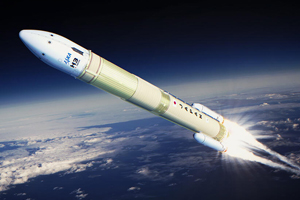
Mar 1 — United Launch Alliance, Launch Atlas 5 / GOES-S, Cape Canaveral AFS FL: ULA Atlas 5 rocket, designated AV-077, to launch GOES-S, the second next-generation geostationary weather satellite for NASA and NOAA.
Mar 3 — International Lunar Observatory Association, Space Age Publishing Company, Skyworld Indonesia, Singapore Space and Technology Association, Yogyakarta, Indonesia: Galaxy Forum Indonesia 2018: Yogyakarta; at Gadjah Mada University, expecting more than 250 attendees, free to public.
Includes ~150 meetings covering the fields of COSPAR Scientific Commissions / Panels / Task Groups, such as SC B: The Earth-Moon System, Planets, and...
From 02 to 07 August 2026, a few thousand geoscientists across diverse disciplines will gather at the 23rd annual meeting of the Asia Oceania Geosciences...
2:45 pm EDT from Johnson Space Center, NASA astronaut Chris Williams will recap his recent eight-month mission aboard the International Space Station. Williams returned to...
NASA Curiosity (Mars Science Laboratory) rover surpasses another full year of operations on Mars surface today; launched Nov 26, 2011 – landed Aug 5,...
Virtual Series 2026 will offer deeper conversations on why PQC matters and the practical steps businesses should be taking; starts 1:00 pm AEST. Featuring:...
This international lunar science meeting has two objectives: to provide a platform for leading experts to review recent advances across lunar research, from the...
At CSIR International Convention Centre. Key topics are Earth Observation, Developing Space Tourism, Space Supply Manufacturing. Cultural tours are offered.
Participants will receive theoretical and hands-on training in electron imaging and X-ray spectroscopy for application to planetary samples. This training opportunity is targeted at...
"Leading Australia’s Space Future for Our Strategic Advantage". Southern Space 2026 brings together decision-makers who set the direction for Australia’s space sector. It is...
 Indian Space Research Organization is aiming to launch its 8-billion rupee (US$123M) Chandrayaan-2 orbiter, lander, rover mission in early April, or in November if delayed. Dr. K. Sivan, ISRO chairman since January, says this is less expensive than the $165M Hollywood movie “Interstellar”. Taking over a month to reach the Moon after launch, Chandrayaan-2 lander and its 20-kg rover will operate on the lunar surface for 1 lunar day, or 14 Earth days. To maximize the operation time, ISRO will land the spacecraft right after the local dawn, resulting in ideal launch opportunity coming only once a month. With the Earth shadow casting on or near the Moon (lunar eclipse) around Jan / Feb and Jul / Aug this year, and again around Jan 2019, the best times to launch are early Apr and early Nov to avoid the shadow. Chandrayaan-2, weighing 3290 kg, will launch on heavy-payload lifter Geosynchronous Satellite Launch Vehicle (GSLV) Mark II from Sriharikota space port off India east coast. India would become the 4th country to soft-land spacecraft on the Moon, after USA, Russia, and China. ISRO is aiming to land on a high plateau between 2 craters, at ~70° south. The team is currently conducting landing simulations at Liquid Propulsion System Centre at Mahendra Giri in Tamil Nadu, soft-landing a prototype vehicle from 70-80 meter height. (Pictured: ISRO Chairman K. Sivan, former ISRO Chair U. R. Rao; Image Credit: ISRO, LRO)
  Feb 26 —
  Feb 26 — NewSpace:
  Feb 26 — USA: Findings from National Space Council last meeting expected to be announced, member names of
 = All times
 = All times for international terrestrial events in local time unless noted.
 = All times for space events, and…
 = All times for international space / astro events in Hawaii Standard Time unless noted. Add 10 hours to obtain UT (‘Universal Time’).