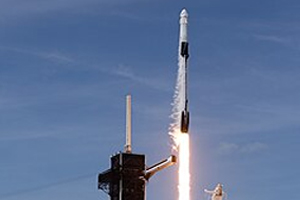
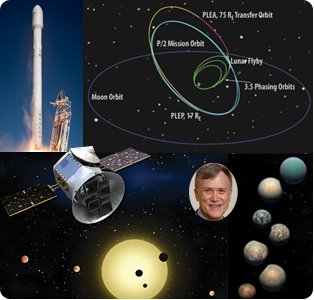
The next-gen exoplanet-hunting satellite by NASA, Transiting Exoplanet Survey Satellite (TESS), is planned to launch on SpaceX Falcon 9 from Cape Canaveral FL Space Launch Complex 40 on April 16 at 18:32. TESS is the first NASA Astrophysics satellite mission to launch with SpaceX. The craft will perform 2 months of maneuvering and at least 5 burns to place it in a lunar flyby orbit to achieve a final highly-elliptical HEO with a period of 13.65 days in 2:1 resonance with the Moon. TESS will monitor 500,000 stars in a 2-year survey of the solar neighborhood, searching for temporary drops in brightness caused by planetary transits. Four wide-field charge couple device cameras each with 7 stacked lenses will help observe thousands of exoplanets and determine the mass, size, density and orbit. The spacecraft will have a launch mass of 350 kg. Its solar arrays will produce 390 watts of electricity, and it will communicate with Earth at 8 ground stations in USA once every 2 weeks at 100 mbps. Likely to run out of fuel within the next few months, the significant Kepler and K2 mission is now in campaign 17 and has discovered more than 2,724 exoplanet candidates and 2,649 confirmed exoplanets. TESS will study stars 30-100 times brighter than those surveyed by Kepler, and is predicted to catalog >1,500 exoplanet candidates, including about 500 Earth-sized and ‘Super Earth’ planets with radii less than twice that of Earth. (Pictured: TESS PI George Ricker; Image Credit: NASA, JPL, Caltech, GSFC, MIT, STSci, CfA, SpaceX, Orbital ATK)
MONDAY
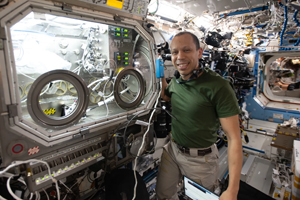
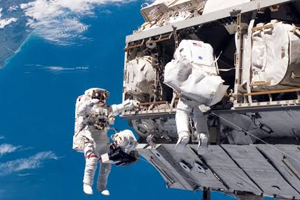
Ongoing… Apr 16 — ISS, 405-km LEO: Expedition 55 six-member crew performing 4 in-flight education activities with students this week, transferring cargo from Dragon CRS-14 and filling with return experiments / gear, working with genetic and tissue samples, rodents, fruit flies, and Advanced Combustion Microgravity Experiment involving 5 separate studies.
Apr 16 — NewSpace: SpaceX advancing BFR interplanetary ship; Asteroid Mining Corporation of UK aiming to advance space resource technologies and policies; Astra Space working toward suborbital launch of its Rocket 1 booster from Pacific Spaceport Complex in Alaska.
Apr 16 — Solar System: ESA Mars Express undergoing software updates to potentially extend life of mission past 2019; 3D infrared view of Jupiter north pole created from Juno flyby observations; scientists planning mission to asteroid Psyche which may be 200-km wide and 95% metal; Tiangong-1 safely reentered Earth Atmosphere over Pacific Ocean.
Apr 16 — Global: JAXA collecting submissions to name Mercury Magnetospheric Orbiter & send messages to Mars; China preparing for Chang’e-4 orbiter launch as early as May, lander / rover launch in Dec; India planning at least 4 additional launches this year, including Chandrayaan-2 Moon mission, after 3 successes in 2018; Ghana hopes to host the Africa Space Agency.
Three Mid-April Launches and Commercial Spaceflight Updates
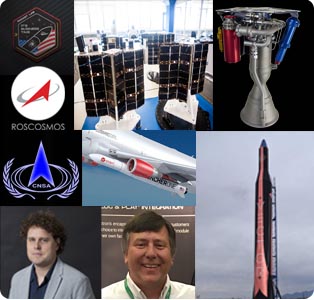
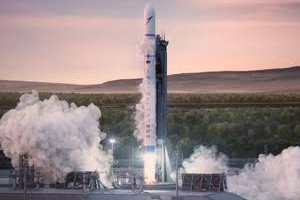
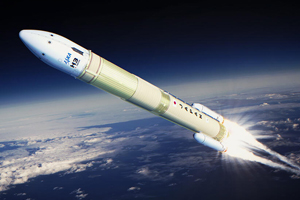
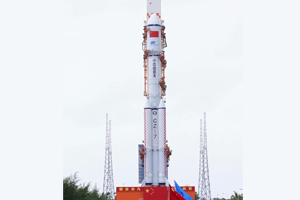
Rocket Lab is scheduled to launch the third flight of its Electron rocket on April 20 at Launch Complex 1 on Mahia Peninsula, New Zealand. “It’s Business Time” will be its first fully commercial mission and plans to carry two Lemur-2 CubeSats for Spire Global and one CICERO satellite for GeoOptics. Founder and CEO Peter Beck states “It’s Business Time represents the shift to responsive space” by having the capability to finish an Electron vehicle every week with use of 3D printers. Rocket Lab plans to produce 100 Rutherford engines this year; 30 have been completed and are currently being integrated to fill growing demands of commercial launches. The maximum payload is 225 kg on the 2-stage, 17 m tall rocket. In Russia, Roscosmos plans to launch Blagovest No. 12L satellite with Proton rocket and Breeze M upper stage on April 19 in Kazakhstan. China Long March 3B is scheduled to launch the Apstar 6C satellite on April 21. In USA, the 2-stage, LOX/RP-1 LauncherOne continues through final stages of testing before being air launched on Cosmic Girl, a 747-400 carrier aircraft. The carrier will reach over 10 km before LauncherOne is released and fires its single stage engine, followed by a single upper stage engine to boost it into orbit. The cofounder of Vector rocket company, James Cantrell, states his confidence in launching the 2-stage, 3 LP-1 engine Vector-R in 2018 from Kodiak Launch Complex in Alaska carrying 2 PocketQube satellites and an Alba Orbital deployer, after completing three initial test flights. (Image Credit: NASA, Rocket Lab, Roscosmos, CNSA, Vector, Virgin Orbit)
Apr 16 — SpaceX, Launch Falcon 9 / Transiting Exoplanet Survey Satellite (TESS), Cape Canaveral AFSFL: Launch of TESS to perform all-sky survey to discover transiting exoplanets in habitable zones around nearest and brightest stars in sky via SpaceX Falcon 9 rocket, 18:32 local time.
Apr 17-19 — United Nations Institute for Training and Research (UNITR) Operational Satellite Application Programme, Esri,Geneva, Switzerland: GIS for a Sustainable World Conference.
Apr 18 — ISPCS, Colorado Springs CO: International Symposium for Personal and Commercial Spaceflight Meet Up at 34th Space Symposium; Broadmoor Hotel South Tower Room 3316, 17:30-18:30.
Apr 18-20 — University of Aizu, Lunar and Planetary Institute, Universities Space Research Association (USRA),Fukushima, Japan: New Views of the Moon 2 — Asia.
Apr 18 — Moon: 8.8° SSE of Pleiades, 03:00; 1.0° NNW of Aldebaran, 19:00.
Apr 18 — Uranus: At conjunction with Sun, 04:00.
Apr 18 — Apollo Asteroid 2015 XE352: Near-Earth Flyby (0.070 AU)
THURSDAY
Apr 19 — Roscosmos State Corporation, Launch Proton / Blagovest No. 12L,Baikonur Cosmodrome, Kazakhstan: Proton rocket and Breeze M upper stage to launch Blagovest No. 12L communications satellite; 04:12 local time.
Apr 19 — Apollo Asteroid 2014 JG15: Near-Earth Flyby (0.050 AU)
Apr 19 — Apollo Asteroid 2015 HD10: Near-Earth Flyby (0.098 AU)
FRIDAY
Apr 20 — Rocket Lab, Launch Electron / “It’s Business Time” Multi-Payload, Launch Complex 1, Mahia Peninsula, New Zealand: Two-week launch window opens for first full commercial launch dubbed ‘It’s Business Time’ with two Spire Lemur 2 CubeSats and one GeoOptics CICERO satellite.
Apr 20 — Apollo Asteroid 2010 JO33: Near-Earth Flyby (0.060 AU)
SATURDAY
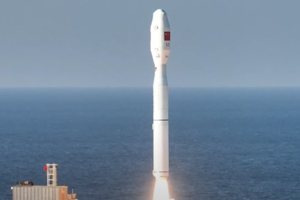
Apr 21 — CNSA, Launch Long March 3B / Apstar 6C, Xichang Satellite Launch Centre, Sichuan, China: Long March 3B rocket to launch Apstar 6C communications satellite.
Apr 21 — The Astronomical League,Global: Spring Astronomy Day 2018; astronomical societies, planetariums, museums, observatories sponsoring public viewing sessions, presentations, workshops.
Apr 21 — Moon: 11.8° S of Castor, 17:00; 8.2° S of Pollux, 21:00.
Apr 21 — Apollo Asteroid 2018 GR1: Near-Earth Flyby (0.047 AU)
SUNDAY
Apr 22 — Earth Day Network,Worldwide: Earth Day 2018; to broaden, diversify & activate the environmental movement worldwide; originally proposed to occur March 21 (first day of Spring) by creator John McConnell.
Apr 22 — Lyrid Meteor Shower Peak: Favorable due to Moon at first quarter, Lyrids derived from Comet C/1861 G1 Thatcher with period 415 years, are medium-swift (49 km/sec), often bright with persistent trains and can offer 15-20 per hour.
Apr 22 — Moon: At first quarter, 11:46; 1.6° S of Beehive Cluster, 20:00.
Apr 22 — Apollo Asteroid 2018 CY: Near-Earth Flyby (0.097 AU)
Includes ~150 meetings covering the fields of COSPAR Scientific Commissions / Panels / Task Groups, such as SC B: The Earth-Moon System, Planets, and...
From 02 to 07 August 2026, a few thousand geoscientists across diverse disciplines will gather at the 23rd annual meeting of the Asia Oceania Geosciences...
2:45 pm EDT from Johnson Space Center, NASA astronaut Chris Williams will recap his recent eight-month mission aboard the International Space Station. Williams returned to...
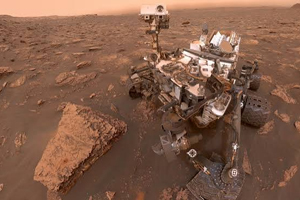
NASA Curiosity (Mars Science Laboratory) rover surpasses another full year of operations on Mars surface today; launched Nov 26, 2011 – landed Aug 5,...
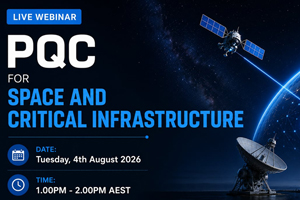
Virtual Series 2026 will offer deeper conversations on why PQC matters and the practical steps businesses should be taking; starts 1:00 pm AEST. Featuring:...
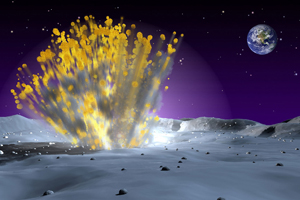
This international lunar science meeting has two objectives: to provide a platform for leading experts to review recent advances across lunar research, from the...
At CSIR International Convention Centre. Key topics are Earth Observation, Developing Space Tourism, Space Supply Manufacturing. Cultural tours are offered.
Participants will receive theoretical and hands-on training in electron imaging and X-ray spectroscopy for application to planetary samples. This training opportunity is targeted at...
"Leading Australia’s Space Future for Our Strategic Advantage". Southern Space 2026 brings together decision-makers who set the direction for Australia’s space sector. It is...
 The next-gen exoplanet-hunting satellite by NASA, Transiting Exoplanet Survey Satellite (TESS), is planned to launch on SpaceX Falcon 9 from Cape Canaveral FL Space Launch Complex 40 on April 16 at 18:32. TESS is the first NASA Astrophysics satellite mission to launch with SpaceX. The craft will perform 2 months of maneuvering and at least 5 burns to place it in a lunar flyby orbit to achieve a final highly-elliptical HEO with a period of 13.65 days in 2:1 resonance with the Moon. TESS will monitor 500,000 stars in a 2-year survey of the solar neighborhood, searching for temporary drops in brightness caused by planetary transits. Four wide-field charge couple device cameras each with 7 stacked lenses will help observe thousands of exoplanets and determine the mass, size, density and orbit. The spacecraft will have a launch mass of 350 kg. Its solar arrays will produce 390 watts of electricity, and it will communicate with Earth at 8 ground stations in USA once every 2 weeks at 100 mbps. Likely to run out of fuel within the next few months, the significant Kepler and K2 mission is now in campaign 17 and has discovered more than
  Apr 16 —
  Apr 16 — NewSpace:
  Apr 16 — USA:
 = All times
 = All times for international terrestrial events in local time unless noted.
 = All times for space events, and…
 = All times for international space / astro events in Hawaii Standard Time unless noted. Add 10 hours to obtain UT (‘Universal Time’).