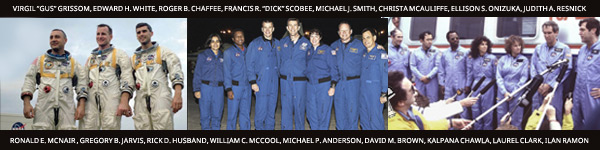
The space community gathers this week to reflect on profound sacrifices that shaped our journey to the stars. During Astronaut Memorial Week, we have the 59th observation of Apollo 1 loss of Virgil “Gus” Grissom, Edward H. White and Roger B. Chaffee (1/27/1967); the 40th of Challenger STS-51L loss of Francis R. “Dick” Scobee, Michael J. Smith, Christa McAuliffe, Ellison S. Onizuka, Judith A. Resnick, Ronald E. McNair and Gregory B. Jarvis (1/28/1986); and the 23rd of Columbia STS-107 loss of Rick D. Husband, William C. McCool, Michael P. Anderson, David M. Brown, Kalpana Chawla, Laurel Clark and Ilan Ramon (2/1/2003). Ceremonies at Arlington National Cemetery and Kennedy Space Center reflect on sacrifices propelling safer, bolder missions. Over 700 people have flown above the 100-km Kármán line, 12 men worked on the Moon, over 105 women completed spaceflights and citizens of 47 countries reached space—with diverse nations and private ventures expanding representation for aspiring spacefarers. NASA Artemis program advances to Artemis II, NET February 6, carrying four Astronauts on a circumlunar flight, testing systems for sustainable lunar presence. NASA day of remembrance coincides with Blue Origin New Shepard NS-38 launching private citizens on a suborbital adventure on the 22nd. SpaceX stands next in line to fly people to the Moon with its Starship Human Landing System under NASA Artemis program, advancing crewed lunar returns with enhanced astronaut safety at the forefront. (Image Credits: NASA, CNSA, ISS Partners)
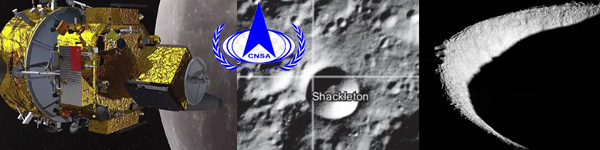 Chang’E-7 (CE-7) mission, launching NET August on Long March 5 from Wenchang, Hainan, China, aims to widely explore lunar South Pole environment / resources using orbiter, lander, rover and hopping probe, detecting water ice, mapping terrain and analyzing subsurface composition. Its instruments, indigenous and from 7 international partners, will lay groundwork for International Lunar Research Station planned to be fully operational in 2050. After orbiting ~2 Earth months, CE-7 lander will drop to Shackleton Crater area and send its hopper into permanently shadowed areas, while the rover investigates topography, composition and structure of the rim. Data will transmit to Earth via 1,200-kg relay satellite Queqiao-2 in highly elliptical lunar orbit. Others of the ~20 orbiter / lander / rover / hopper CE-7 payloads will detect moonquakes, measure magnetic fields, observe ions / particles / lunar dust. Mounted on the lander is ILO-C wide-field optical instrument planned to capture high-resolution images of Milky Way galactic center. ILO-C is developed in historic collaborative effort by International Lunar Observatory Association of Hawai’i, National Astronomical Observatories of China and Hong Kong University Laboratory for Space Research, with support from National Astronomical Research Institute of Thailand–which will co-host the 2nd ILO-C science workshop January 30 in Chiang Mai. The international collaboration could serve as harbinger for an Asian Treaty Organization for Astronomy, similar to European Southern Observatory, advancing 21st Century astronomy from the Moon. (Image Credits: CNSA, China Media Group, NASA GSFC / ASU, Yang Liu / Wang C., et al)
 International Space Station, ~415-km LEO: Expedition 74 operating with crew of 3, NASA Astronaut Chris Williams and Cosmonauts Sergey Kug-Sverchkof and Sergei Mikayev, until next crew arrival, likely February 15; portable ultrasound machine remains onboard after recent use prior to medical evacuation with crew expressing gratitude for feeling prepared during the medical emergency; ongoing science includes a blood pressure study and evaluation of small-crew team dynamics under stress; ongoing maintenance includes routine checks on life support and navigation systems; ongoing health activity includes fitness routines and nutritional management.
Tiangong Space Station, ~390-km LEO: Shenzhou-21 three-member crew using VR headsets and EEG equipment to analyze eye-brain coordination in microgravity, conducting studies on lithium-ion battery electrochemistry, drilling for medical emergencies and evacuation procedures, training on manually guiding docking of spacecraft, conducting routine inspections and maintenance of life-support and environmental-control systems as well as navigation aids, following a daily structured time schedule based on China Time of 07:00 wakeup, 08:00 mission-control conference, 13:30 hour-long rest period and 21:00 end of tasks.
 Lunar Enterprise News: Buzz Aldrin Begins 97th Trip Around the Sun │ Blue Origin On the Move with Endurance MK-1 Lander and New Glenn Booster Re-Use
 Near-Earth Objects Close Approaches – Mon Jan 26: Apollo Asteroid 2026 BJ1 (0.032 AU); Tue Jan 27: Apollo Asteroid 2025 YR1 (0.049 AU); Thu Jan 29: Apollo Asteroid 2026 AS2 (0.015 AU); Sat Jan 31: Apollo Asteroid 2022 OC3 (0.003 AU)