15th International Symposium for Personal and Commercial Spaceflight Focuses on an Industry on Cusp of Realization
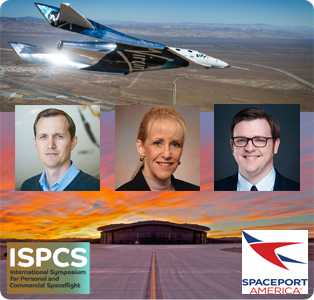
ISPCS 2019 will be held October 9-10 in Las Cruces, New Mexico with theme ‘Go use it, we’ll get you there’. The symposium features a robust schedule of important figures within the commercial human spaceflight movement: Virgin Galactic CEO George Whitesides (L), Coalition for Deep Space Exploration CEO Mary Lynne Dittmar (C), and Made In Space CEO Andrew Rush (R) are among those set to give keynote presentations. Benjamin Reed, SpaceX Director of Commercial Crew Mission, and Erika Wagner, Payload Director for Blue Origin, will represent their respective companies in panel discussions. SpaceX CEO Elon Musk has recently made the bold claim of an <6-month timeline for achieving commercial crewed spaceflight using Starship Mk1; Virgin Galactic now plans a 2020 implementation of their space tourism business on SpaceShipTwo, some 15 years after SpaceShipOne won the Ansari XPRIZE. This year the symposium is preceded by the NASA iTech Cycle II forum at Hotel Encanto de Las Cruces October 7-8. An initiative launched by Space Technology Mission Directorate, iTech Forum is the culmination of a yearlong competition to advance technology that is not currently receiving NASA support. Immediately following ISPCS, conference participants can register for an exclusive tour of the recently completed Spaceport America, the nearby facility built to accommodate commercial space launches in Truth or Consequences, New Mexico. (Image Credits: ISPCS, Spaceport America, VG, CDSE, MIS)
MONDAY
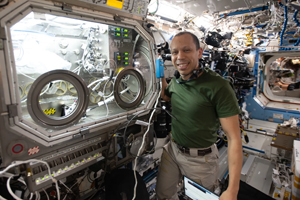
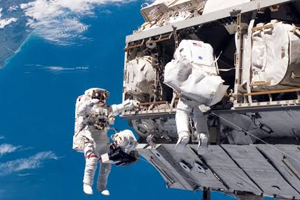
Highlights… Oct 7 — ISS, 405-km LEO: Expedition 61 six-member crew to perform post-EVA operations from planned spacewalk to replace ISS batteries, and work with studies on object manipulation in different gravitational environments, 56-day Veg-04B plant growth, microgravity crystals, time perception.
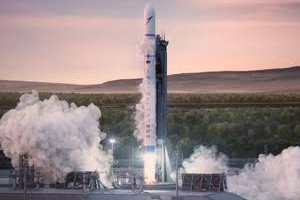
Oct 7 — NewSpace: Intuitive Machines signs with SpaceX to launch Nova-C lander to Moon 2021; Relativity Space announces US$140M in funding to build 3D-printed rockets; US$43.2M Tipping Point awards to be given to 14 commercial companies including Blue Origin.
Oct 7 — Galaxy: UK researchers suggest that hypothesized Planet 9 could be a black hole; Spitzer Space Telescope finds star-forming regions in constellation Aquila; CFHT and Keck telescopes make detailed observations of globular cluster Laevens 3.
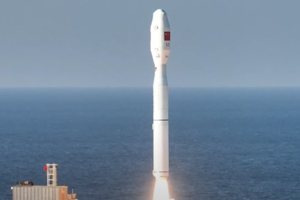
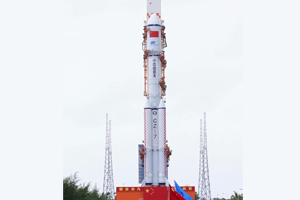
Oct 7 — Global: CAST reveals new crewed spacecraft to be launched on Long March 5 for missions to Earth orbit and Moon; ISRO Chairman K Sivan says SPADEX space docking experiment to launch in 2020; University of Philippines ULYS3ES facility provides capability to build small satellites.
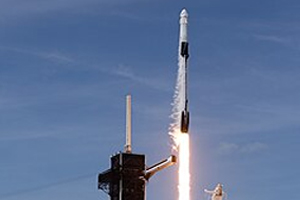
Oct 7 — USA: NASA issues call for Artemis Lunar Lander proposals with due date of Nov 1; Space Launch System core stage pathfinder at KSC practicing transport techniques; Boeing Starliner nears critical pad-abort test at White Sands, NM.
Oct 7 — Hawai’i: Mayor Harry Kim unveils proposed plan for Mauna Kea; observations from Keck, CFHT, and Gemini North telescopes reveal violent history of Andromeda Galaxy; Mauna Kea telescopes also combine observations to discover oldest known cluster of galaxies.
10th Moscow Solar System Symposium Talks About Moon Including Malapert Mountain
Space Research Institute of Russian Academy of Sciences hosts the Tenth Moscow Solar System Symposium October 7-11, an annual event. Main topics will include formation of the solar system, exoplanets, exploration of the solar system, and astrobiology. Opening remarks will be delivered by Lev Zelenyi (C) of the Space Research Institute and James Head (L) of NASA. Alexander Basilevsky (R) will talk about a potential lunar base on Mons Malapert, the 5-km mountain near the South Pole. Roscosmos and ESA are cooperating on the ExoMars 2020 rover mission. Luna-25, also known as Luna-Glob, is planned to land at Boguslavsky Crater in the South Pole region in 2021. Luna-26, known as the Lunar-Resurs Orbiter, will orbit the poles and cooperate with the Chang’e-7 polar landing in 2023-2024. Luna-27, the Luna-Resurs Lander, is projected to land in the South Pole-Aitken basin in 2025. Russian and Zhongguo are opening a Joint Data Center for Lunar and Deep Space Research. Roscosmos in partnership with new Moscow-based company Reusable Space Transport Systems (MTKS) will develop the Argo reusable launch vehicle to compete with SpaceX. Russia plans Luna-28 as a South Pole sample return in 2028 in preparation for crewed lunar missions in the 2030s. Roscosmos Head Dmitry Rogozin has also expressed interest in partnering with NASA human missions to the Moon. Three Russians are among the 9 people presently inhabiting ISS. (Image Credits: NASA, Energia, ESA, Roscosmos)
Oct 7 — Apollo Asteroid 2016 CW93: Near-Earth Flyby (0.081 AU)
Oct 7 — Aten Asteroid 2014 AE29: Near-Earth Flyby (0.099 AU)
Continued from…
Jan 2019 – Sep 2020 — New Horizons, Kuiper Belt: Full data from spacecraft 7 instruments during KBO Ultima Thule flyby to be transmitted to Earth over this time period.
NET Aug – Nov — Hayabusa2, Asteroid 162173 Ryugu: JAXA Hayabusa2 with 2 sample returns planned to remain at Asteroid for observations during this time period, then return to Earth.
Oct 4-10 — World Space Week Association, Global:World Space Week 2019 – The Moon: Gateway to the Stars; to celebrate international contributions of space science and technology to the betterment of the human condition; Oct 4 is 62nd observation of 1st Space mission Sputnik One launched by Soviet Union 1957; Oct 10 is 52nd observation of Outer Space Treaty going into effect 1967.
Oct 5-8 — Kavli Institute for Cosmological Physics, University of Chicago,Chicago IL: Conference: Cosmic Controversies; crisis in cosmological models including conflicting measurements of Hubble-LeMaitre value Ho and implications for theories of the universe; at Chicago Gleacher Center.
Oct 8 — Draconids Meteor Shower Peak: Appearing to radiate from constellation Draco, Draconids offer slow moving (20 km/s) meteors which appear faint and fragment easily, about 10-20 per hour; peak 14:00.
Oct 8 — Apollo Asteroid 2019 SB6: Near-Earth Flyby (0.020 AU)
Oct 8 — Apollo Asteroid 2019 TM: Near-Earth Flyby (0.024 AU)
Oct 8 — Apollo Asteroid 2019 RK: Near-Earth Flyby (0.043 AU)
Oct 8 — Apollo Asteroid 2019 TM: Near-Earth Flyby (0.088 AU)
WEDNESDAY
Oct 9 — Northrop Grumman, Launch Pegasus XL / ICON,L-1011, Skid Strip, Cape Canaveral AFS FL: Northrop Grumman ATK Pegasus XL rocket to launch NASA Ionospheric Connection Explorer (ICON) satellite into orbit; 21:25-22:55.
Oct 9 — Roscosmos State Corporation, Launch Proton / Eutelsat 5 West B & MEV 1,Baikonur Cosmodrome, Kazakhstan: Proton Rocket set to deliver Eutelsat 5 West B communications satellite and first Mission Extension Vehicle for Northrop Grumman Innovation Systems.
Oct 9-10 — Spain Center for the Development of Industrial Technology, Spanish Association of Defense Technologies (TEDAE), Beon Worldwide, ESA,Madrid, Spain: Space Congress 2019: Beyond the Limits.
Oct 9-11 — Italian Space Agency (ASI), Agency for the Promotion of the European Research (APRE),Rome, Italy: SPACE Week 2019: Beyond the Horizon.
Oct 9 — Apollo Asteroid 2019 SL7: Near-Earth Flyby (0.004 AU)
Oct 10 — Southern Taurids Meteor Shower Peak: Appearing to radiate from constellation Taurus, Taurids are associated with Comet Encke and offer about 7 meteors per hour and travel at ~28 km/s.
Oct 10 — Moon: At apogee (distance 405,906 km), 09:00; 3.4° SE of Neptune, 16:00.
Oct 10 — Comet P/2008 Y12 (SOHO): At perihelion, (0.066 AU)
Oct 10 — Apollo Asteroid 2019 SX5: Near-Earth Flyby (0.045 AU)
Oct 11 — Amor Asteroid 2010 SG15: Near-Earth Flyby (0.092 AU)
SATURDAY
Oct 12 — University of Kansas,Lawrence KS:NASA Eyes 2019, NASA 60th anniversary symposium with speakers on astronomy and space exploration, Integrated Science Building, University of Kansas.
Emanating from ~6km-wide comet with 5.3-year Solar orbit, visible in constellation Aquarius near star Delta Aquarii, fast, faint meteors peak on this night, best...
The International Research Conference is a federated organization dedicated to bringing together a significant number of diverse scholarly events for presentation within the conference...
Includes ~150 meetings covering the fields of COSPAR Scientific Commissions / Panels / Task Groups, such as SC B: The Earth-Moon System, Planets, and...
From 02 to 07 August 2026, a few thousand geoscientists across diverse disciplines will gather at the 23rd annual meeting of the Asia Oceania Geosciences...
2:45 pm EDT from Johnson Space Center, NASA astronaut Chris Williams will recap his recent eight-month mission aboard the International Space Station. Williams returned to...
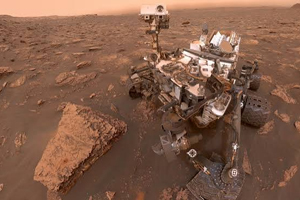
NASA Curiosity (Mars Science Laboratory) rover surpasses another full year of operations on Mars surface today; launched Nov 26, 2011 – landed Aug 5,...
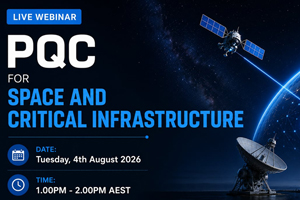
Virtual Series 2026 will offer deeper conversations on why PQC matters and the practical steps businesses should be taking; starts 1:00 pm AEST. Featuring:...
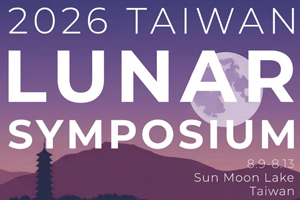
This international lunar science meeting has two objectives: to provide a platform for leading experts to review recent advances across lunar research, from the...
At CSIR International Convention Centre. Key topics are Earth Observation, Developing Space Tourism, Space Supply Manufacturing. Cultural tours are offered.
 Oct 7 —
  Oct 7 — NewSpace:
  Oct 7 — USA: NASA issues call for
 = All times
 = All times for international terrestrial events in local time unless noted.
 = All times for space events, and…
 = All times for international space / astro events in Hawaii Standard Time unless noted. Add 10 hours to obtain UT (‘Universal Time’).
 Space Research Institute of Russian Academy of Sciences hosts the Tenth Moscow Solar System Symposium October 7-11, an annual event. Main topics will include formation of the solar system, exoplanets, exploration of the solar system, and astrobiology. Opening remarks will be delivered by Lev Zelenyi (C) of the Space Research Institute and James Head (L) of NASA. Alexander Basilevsky (R) will talk about a potential lunar base on Mons Malapert, the 5-km mountain near the South Pole. Roscosmos and ESA are cooperating on the ExoMars 2020 rover mission. Luna-25, also known as Luna-Glob, is planned to land at Boguslavsky Crater in the South Pole region in 2021. Luna-26, known as the Lunar-Resurs Orbiter, will orbit the poles and cooperate with the Chang’e-7 polar landing in 2023-2024. Luna-27, the Luna-Resurs Lander, is projected to land in the South Pole-Aitken basin in 2025. Russian and Zhongguo are opening a Joint Data Center for Lunar and Deep Space Research. Roscosmos in partnership with new Moscow-based company Reusable Space Transport Systems (MTKS) will develop the Argo reusable launch vehicle to compete with SpaceX. Russia plans Luna-28 as a South Pole sample return in 2028 in preparation for crewed lunar missions in the 2030s. Roscosmos Head Dmitry Rogozin has also expressed interest in partnering with NASA human missions to the Moon. Three Russians are among the 9 people presently inhabiting ISS. (Image Credits: NASA, Energia, ESA, Roscosmos)