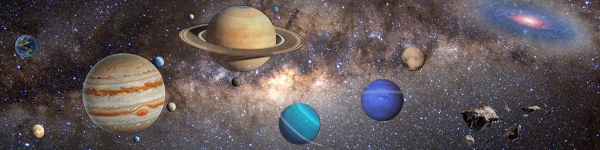
As Americans, Chinese, Indians and other Asian, African and European peoples, enterprises, organizations and nations advance toward mid / late 21st Century, pioneering national and international plans aim to explore and develop the Solar System outer zones—the gas giants (Jupiter, Saturn, Uranus, Neptune), their hundreds of satellite worlds, the 3rd Zone of the Kuiper Belt, and the Milky Way Galaxy beyond. These regions encompass 99% of the Solar System known planetary mass, and represent the next frontier enabled by Earth-Moon (CisLunar) baseline infrastructure, progressing through asteroids and Mars. Leveraging the Moon as an “8th Continent” launch pad will enable more efficient deep-space propulsion (lunar water ice deposits, Helium-3 mining, regolith processing) and permanent human-occupied outposts (Artemis base, International Lunar Research Center, Moon Village). As spacecraft JUICE, Europa Clipper and New Horizons prepare for Jupiter or Kuiper Belt exploration, missions such as Dragonfly, Tianwen-3, -4, -5, and others are under development—sparking a potential golden age of Solar System exploration. Wu Weiren (Chief Designer of the China lunar exploration program and President of the International Deep Space Exploration Association), and Narendra Modi (Prime Minister of India) are both championing ambitious Solar System exploration, focusing on deep space. Every planet, moon and small body holds insights into Solar System origins, potential of extraterrestrial life and habitability. Visions for the late 21st Century include crewed journeys to the outer planets, in-situ exploration of icy moons with subsurface oceans, and Kuiper Belt outposts as stepping stones toward interstellar aspirations. (Image Credits: ESO, NASA)
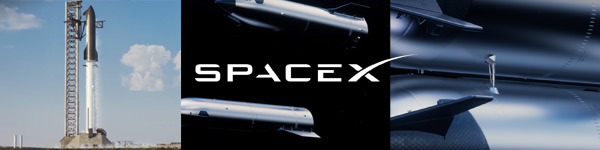
Scheduled for a Q1 2026 launch, Starship Integrated Flight Test 12 debuts the highly anticipated Block 3 vehicle at Starbase new Pad 2 in Texas. Booster 19 and Ship 39 feature taller structures when compared with Block 2, improved reusability elements, and powerful Raptor 3 engines that deliver higher thrust and greater overall efficiency. Equipped with 33 engines on Booster 19, Flight Test 12 aims to demonstrate upgrades paving the way for significantly increased payload capacity, with long-term target of Block 3 delivering up to 200 tons into LEO in reusable configurations. Pad 2 includes advanced cryogenic propellant lines and quick-disconnect arms, enabling parallel vehicle processing and supporting a much faster flight cadence. SpaceX advancements are bolstered by expanding infrastructure, including a new Starship site, Space Launch Complex 37 at Canaveral SFS, and the rising Gigabay facilities for high-volume stacking / refurbishment at both Starbase, Texas and Cape Canaveral, Florida. The flight profile now emphasizes a conservative, data-rich approach: anticipated separation velocity optimizations paired with controlled soft splashdowns for both booster and upper stage. Raptor engines have accumulated extensive test and flight runtime across hundreds of units, validating cold-start performance—critical for future in-space relights. These Block 3 upgrades intend to support future orbital refueling, boosting efficiency for ambitious Moon missions. These developments support NASA Artemis program in 2026 while laying groundwork for larger cargo deliveries and sustained lunar infrastructure in the longer term. (Image Credits: SpaceX)
 International Space Station, ~415-km LEO: Expedition 74 crew now split, 3 members remaining on ISS after Crew-11 departure of 4 in 1st medical evacuation in ISS 25-year history, with Cosmonaut Sergey Kud-Sverchkov commanding Flight Engineers Cosmonaut Sergei Mikayev and Astronaut Chris Williams; essential maintenance is prioritized, including on hoses and navigational aids; high-priority science continues, such as blood-pressure study and tests evaluating how small crews make decisions and work together under stress; weather / spacecraft readiness will determine launch date for Crew-12, whether February 15 or earlier.
Tiangong Space Station, ~390-km LEO: Shenzhou-21 crew Zhang Lu (张陆), Wu Fei (武飞), and Zhang Hongzhang (张洪章) filming Tiangong TV episodes, performing rendezvous / docking training on joysticks for velocity / attitude, practicing medical rescue / emergency evacuation in fire conditions, using brain-computer interface equipment, wearing sensors for muscle / tendon pressure and intuitive physical behavior, researching quantum dot batteries, replacing / cleaning / repairing science equipment, maintaining life support / exercise systems, having health tested using 4 diagnostic methods of Traditional Chinese Medicine.
 Lunar Enterprise News: Caves May Give Opening to Establishment of Moon Base │ 4 Artemis Astronauts Inspire Next Generation with 1st Human Lunar Exploration in 21st Century
 Near-Earth Objects Close Approaches – Tue Jan 20: Apollo Asteroid 2026 AK (0.029 AU); Wed Jan 21: Apollo Asteroid 2026 AG (0.027 AU); Wed Jan 23: Apollo Asteroid 2019 LZ4 (0.036 AU)