Artemis Program Extends More Branches Connecting Public-Private, Science-Commerce
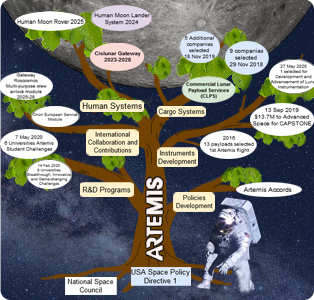
Newest expansion of Artemis Program includes due dates for Artemis Science white papers and Lunar Surface Technology Research (LuSTR) proposals, and the review of PRIME-1 contractor bids. Due on September 8 are White Papers proposing science to be conducted by 2-crew Artemis 3 at Moon South Pole in 2024. On Sep 9, LuSTR proposals are due from Universities to support sustainable Moon operations including advanced tech for ISRU and power. Winners could receive up to US$2M. The 14 CLPS contractors were asked to submit bids to fly drill & mass spectrometer Polar Resources Ice Mining Experiment (PRIME-1) to Moon South Pole Region by December 2022. The winning contractor could be announced before October. PRIME-1 is a precursor for TRIDENT drill and spectrometer being readied for South Pole VIPER rover flying on Astrobotic late 2023 via $199.5M contract. The nicknamed ‘19D contract’ for an equatorial mission should also be solicited before the end of the year. Artemis program reach is extending through various contracts for human and cargo systems, instrument developments, R&D programs, international collaborations and national policy developments including Artemis Accords. At its peak Apollo is reported to have employed 400,000 Americans – Artemis / International sustained Human Moon outpost goal envisions Millions living and working in cislunar space as the first step of Solar System expansion. (Image Credits: NASA, ESO, SPC, ILOA)
MONDAY
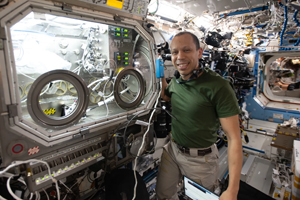
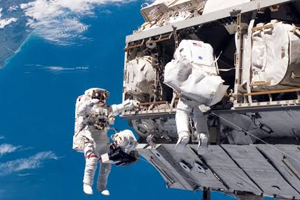
Highlights… Sep 7 — ISS, ~405-km LEO: Expedition 63 crew Cassidy, Ivanishin and Vagner working with plant habitat, Earth imagery camera, radiation sensors, food intake tracker studies and maintaining oxygen generators, carbon dioxide filters, plumbing systems.
Sep 7 — NewSpace: Rocket Lab awaiting final certification to launch from Virginia; Astrobotic to receive >US$1M to advance Moon CubeRovers; PLD Space of Spain closer to qualifying engine for flight of suborbital Miura.
Sep 7 — Solar System: Scientists propose using electron beams to rid Astronaut suits, items of clinging Moon dust; 4.2B year Venus modeling helps scientists hypothesize habitability periods; binary Solar System origin theory accounts for Oort cloud, predicts increase in dwarf planets discovery.
Sep 7 — Galaxy: Hubble Andromeda observations reveal its massive halo may be touching MWG halo; AIP researchers posit measurement discrepancies of galactic bar caused by spiral arm interaction; AI developed by NAOJ finds 80,000 out of 560,000 imaged galaxies have spiral structure.
SWF 2nd Annual Summit Champions Space Sustainability
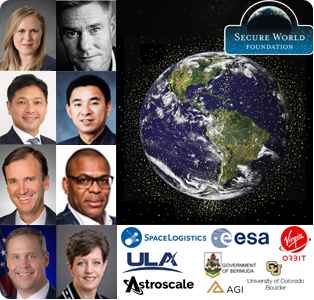
Secure World Foundation, with offices in Broomfield CO and Washington DC, is a nonprofit that aspires to leverage human space activities for protective purposes via informing, facilitation and promotion. For 2020 SWF moves its marquee event, Summit for Space Sustainability, to a virtual format September 9-11. Conference Chair (clockwise from TL) Krystal Azelton is optimistic about the potential of virtual conferences, telling Politico that VIP speakers have been more available and international participation more convenient in planning the Summit. Spotlight speakers include Einar Bjorgo of United Nations Institute for Training / Research, Li Shouping of China National Space Administration Space Law Center, Bermuda Deputy Premier Walter Roban and Rebecca Cowen-Hirsch of Inmarsat. 6 panel discussions will take place: on Wednesday, Space Sustainability Progress and Responsible Behavior in Space; Thursday topics are Space Force and Cis-Lunar / Lunar Sustainability; Friday focus is on Governmental Optimization and Space Arms Control. Keynote speakers are NASA administrator Jim Bridenstine, ULA VP Mark Peller, and Astroscale founder Nobu Okada. Interactive Sessions will allow attendees to participate in 4 subjects: Megaconstellations and Astronomy, Multilateral Diplomacy, US-China Engagement, and Next Steps On Orbital Debris. A fee of US$25 for entire conference will fund Space Sustainability Summit Student Essay Competition, open to undergraduate or graduate students internationally – 5 winners are to be announced on Sep 9, each receiving a $500 prize. (Image Credits: SFW, NASA, ULA, Astroscale, CU-Boulder, Space Logistics, AGI, Bermuda, Virgin Orbit, ESA)
Continued From…
Nov 2019 – Nov 2020 — Hayabusa2, Earth Trajectory: JAXA Hayabusa2 with two samples collected from C-type asteroid 162173 Ryugu on trajectory for Earth return.
Jul 29 – Oct 31 — CNSA, Ministry of Education, Ministry of Science and Technology, Chinese Academy of Sciences, Online / Beijing, China: Students to submit ideas for payloads for Chang’e-7 lunar south pole craft, and ZhengHe mission that will return samples from Asteroid 2016HO3 and visit Comet 133P.
Sep 8 — NASA Science Mission Directorate Planetary Science Division,Lunar and Planetary Institute, Universities Space Research Association, Online / Washington DC:Call for Artemis Science White Papers; 2-page science proposals for Artemis III Human lunar mission due.
Sep 8-10 — Ames Research Center, NASA, University of Birmingham, Flatiron Institute, University of New South Wales, Online / Moffett Field CA: TESS Science Meeting; international collaboration & co-working event focused on NASA exoplanet hunter Transiting Exoplanet Survey Satellite (TESS).
Sep 8 — Epsilon Perseid Meteor Shower Peak: Appearing to radiate from the constellation Perseid, September Epsilon Perseids can reach up to 5 per hour traveling at ~65 km per second; peak 12:00.
Sep 8 — Moon: 6.2° SE of Pleiades, 14:00.
Sep 8 — Apollo Asteroid 2020 PT4: Near-Earth Flyby (0.012 AU)
Sep 9 — SpaceBase, Canterbury Museum, Online / Christchurch, New Zealand: Presentation: Fly Me to the Moon; by Eric Dahlstrom and Emeline Paat-Dahlstrom of SpaceBase, 18:00-19:00.
Sep 9-11 — Secure World Foundation,Online / Washington DC: 2nd Summit for Space Sustainability 2020; featuring NASA Administrator Jim Bridenstine, ULA VP of Major Development Mark Peller, and 6 sessions including keynotes, panels, and interactive opportunities.
Sep 9 — Moon: 4.1° N of Aldebaran, 08:00; at last quarter, 23:27.
THURSDAY
Sep 10 — Astra Space, Launch Astra Rocket 3.1 / “2 of 3”, Pacific Spaceport Complex, Kodiak Island AK: Astra Space second attempt to launch Rocket 3 to LEO during this window.
Sep 10 — NASA, Science Committee of NASA Advisory Council (NAC),Online / Washington DC: NAC Meeting; soliciting scientific and technical information relevant to program planning; 13:00-17:00 EDT.
Sep 10 — AIAA San Francisco Section, Online / San Francisco CA: AIAA Spacecateers; discussion about the intersection of science fiction and science facts behind spacecraft, past, present and future, 18:30-20:30 PDT.
FRIDAY
Sep 11-21 — ESA,Online / Paris, France: First virtual Space App Camp 2020; bringing programmers together to develop creative and innovative apps that make Earth observation data accessible to a wide range of citizens.
Sep 11 — Moon: 0.47° ESE of M35 cluster, 04:00.
Sep 11 — Neptune: At opposition, magnitude 7.8, 10:00.
SATURDAY
Sep 12 — 58th Observation John F. Kennedy Moon Speech & 28th Observation 1st African-American Woman in Space,USA / Worldwide: As the World looks forward to the First Woman on the Moon and a Human Return to Moon, observations made today for 58th anniversary of Kennedy Moon speech (1962) and to celebrate the 28th anniversary of Astronaut Mae Jemison becoming first African-American Woman in Space (1992).
Sep 12-15 — Advanced Maui Optical and Space Surveillance Technologies Conference (AMOS), Space Generation Advisory Council (SGAC), Boeing, SWF, SAIC, Online:2020 EMER-GEN.
Sep 12 — Moon: 7.9° S of Castor, 14:00; 4.3° S of Pollux, 19:00.
Sep 12 — Apollo Asteroid 2012 RM15: Near-Earth Flyby (0.038 AU)
SUNDAY
Sep 13 — Moon: 2.11° NNE of Beehive Cluster, 19:00; with Venus and Beehive cluster within circle of diameter 4.36°, 20:00; 4.4° NNE of Venus, 21:00.
Sep 13 — Venus: 2.27° S of Beehive Cluster, 00:00.
Emanating from ~6km-wide comet with 5.3-year Solar orbit, visible in constellation Aquarius near star Delta Aquarii, fast, faint meteors peak on this night, best...
The International Research Conference is a federated organization dedicated to bringing together a significant number of diverse scholarly events for presentation within the conference...
Includes ~150 meetings covering the fields of COSPAR Scientific Commissions / Panels / Task Groups, such as SC B: The Earth-Moon System, Planets, and...
From 02 to 07 August 2026, a few thousand geoscientists across diverse disciplines will gather at the 23rd annual meeting of the Asia Oceania Geosciences...
2:45 pm EDT from Johnson Space Center, NASA astronaut Chris Williams will recap his recent eight-month mission aboard the International Space Station. Williams returned to...
NASA Curiosity (Mars Science Laboratory) rover surpasses another full year of operations on Mars surface today; launched Nov 26, 2011 – landed Aug 5,...
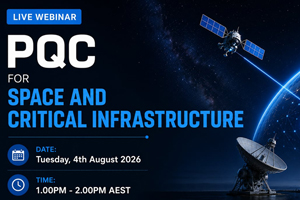
Virtual Series 2026 will offer deeper conversations on why PQC matters and the practical steps businesses should be taking; starts 1:00 pm AEST. Featuring:...
This international lunar science meeting has two objectives: to provide a platform for leading experts to review recent advances across lunar research, from the...
 Sep 7 —
  Sep 7 — NewSpace:
  Sep 7 — USA:
 = All times
 = All times for international terrestrial events in local time unless noted.
 = All times for space events, and…
 = All times for international space / astro events in Hawaii Standard Time unless noted. Add 10 hours to obtain UT (‘Universal Time’).