IAC Cyberspace 2020 and Associated Events Embrace Resiliency by Connecting @ll Space People
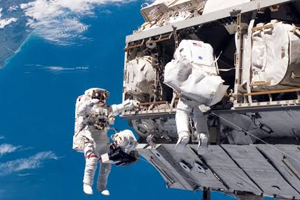
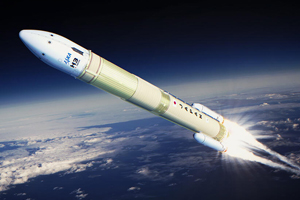
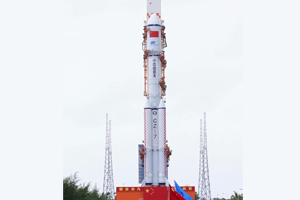
International Astronautical Federation, led by President Pascale Ehrenfreun, is holding 71st International Astronautical Congress (IAC 2020) October 12-14. As a Cyberspace Edition under the motto “IAF Connecting @ll Space People”, IAC will be free of charge to reach new communities. With over 3,000 registered, there will be 3 Plenaries, 2 Highlight Lectures, 6 GNF Sessions, 2 Special Sessions, 14 Technical Keynotes, a Networking Session and a virtual gallery with 1,600 video lectures divided into 32 Symposia. Preliminary to IAC, the IPC Steering Group, IAF Technical Committees and TAC Meetings will converge October 6-9, followed by NextGen Summit Oct 10, and IPMC Younger Professionals Workshop & Technical Gallery Oct 11. There will be opening and closing ceremonies, IAF 3G Diversity Award (given to ESA this year), and talks featuring an Astronaut Panel, Head of Space Agencies, Chang’e-4 mission leaders, Artemis mission + Artemis Accords, and the Launch of Worldwide Missions to Mars. Announcements will be made by DLR, Lockheed Martin, ESA, Northrop Grumman, Blue Origin, Arianespace, Dragonfly Aerospace and Thales Alenia Space. The IAF General Assembly will be held Oct 15. IAA Academy Day is reset to take place on Oct 24, 2021 on the eve of the 72nd IAC which will be held in Dubai, UAE Oct 25-29. IAC 2022 is set for France, and IAC 2023 in Azerbaijan. (Image Credits: IAF, IAA, IISL, SGAC, DLR, ESA, NASA, NG, et al)
MONDAY
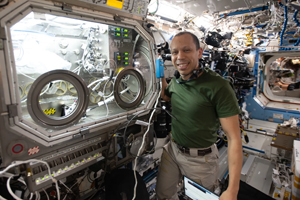
Highlights… Oct 5 — ISS, ~405-km LEO: Expedition 63 crew of 3 expecting CRS-14 Antares Cygnus cargo arrival, maintaining EMU suits, continuing leak detection activities in Zvezda module, inspecting BEAM module and planning for arrival of Soyuz MS-14 with Rubins, Ryzhikov, Kud-Sverchkov next week.
Oct 5 — Solar System: At least 4 lakes beneath 1.5-km of ice could exist at Mars south pole; citizen scientists continue search for trans-neptunian objects, discover unusually close (350-km) binary TNO; LND instrument on Chang’e-4 measures 60 mSv/day of cosmic radiation, 2.6x amount of ISS exposure.
Oct 5 — Galaxy:India multiwavelength AstroSat with 6 instruments surpasses 5 years in space, sharing galaxy data with >1,500 users in 43 countries; EHT data shows ring surrounding first imaged black hole Powehi (M87*) is oscillating over time; ESA CHEOPS nears 1 year in space, reveals ultrahot Jupiter WASP-189b exoplanet reaching 3,162° C.
Oct 5 — Global:UAE aims for indigenous-built rover to land on Moon by 2024; Russia moves toward reusability with Krylo-SV rocket 1st launch late 2021; China / Zhongguo preparing for Nov 24 Chang’e-5 launch sample return, 3 Space Station module launches and crewed launch in 2021.
Oct 5 — Hawai’i: NSF grant to support UH Astronomers mapping outer regions of Milky Way Galaxy in 3D, and a summer program for Native Hawaiian college students; CFHT data provides clues on densities of galaxies.
Oct 5-6 — Abdus Salam International Centre for Theoretical Physics, African Regional Centre for Space Science and Technology Education, Boston College, International Committee on Global Navigation Satellite Systems, Online:African Workshop on GNSS and Space Weather.
= All times
for terrestrial events in local time unless noted.
= All times for international terrestrial events in local time unless noted.
= All times for space events, and…
= All times for international space / astro events in Hawaii Standard Time unless noted. Add 10 hours to obtain UT (‘Universal Time’).
Hawai’i Forges Ahead with Groundbreaking Astrophysics and Space Science
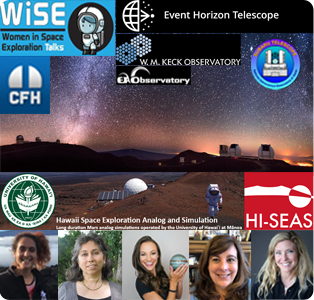
Widely known for being a global leader in scientifically productive astrophysical observations, Hawaii Island has also fostered a growing community geared towards 21st Century science. Pacific International Space Center for Exploration Systems (PISCES) supported by HI State Department of Business, Economic Development & Tourism, has programs ranging from off-world habitat analogs on the slopes of Mauna Loa (in conjunction with HI-SEAS) to sintered basalt feasibility study, and a virtual lecture series Women in Space Exploration (WiSE) set for October 5–10. Connecting aspiring female space students with inspirational, established professionals in the space field, a panel of 7 women – scientists, engineers, communicators and entrepreneurs – are to speak over the 5-day event. Astronomically, Hawaii continues contributing to humankind’s understanding of the universe through its complex of observatories: as part of the Event Horizon VLBI array, Submillimeter Array and East Asian Observatory / JCMT took part in the historic first black hole imaging of Powehi, named in Olelo Hawaiʻi. Keck, CFHT, Subaru and Gemini continue groundbreaking optical observation on Earth. International Lunar Observatory Association aims to pioneer the next step of advancement in astrophysics by conducting astronomy from the Moon NET October 2021, with data studied remotely here in Hawaii. The next major astronomy facility on Hawaii, utilizing exosphere spectroscopy, may shed light on perhaps the most pondered topic of our species: whether we occupy the universe alone. (Image Credits: W.M. Keck, PISCES, HI-SEAS, CFHT, Gemini, Subaru, EAO)
Oct 5-9 — Space Research Institute (IKI), Russian Foundation for Basic Research, Vernadsky, Brown University, Sternberg Astronomical Institute, et al, Online / Moscow, Russia:11th Moscow Solar System Symposium; with emphasis on missions: Mars Express, Venus Express, Luna-Glob, Luna-Resource, ExoMars 2016, ExoMars 2020.
Oct 5-9 — ESA, ArianeGroup, MOOG, CNES, ASI, Bradford Space, DLR, Estoril, Portugal:7th Space Propulsion 2020 Conference; international forum supporting the preparation of space propulsion future activities and roadmaps; expecting 700 professionals from over 30 countries; reset to February 8-12, 2021.
Oct 5-10 — Pacific International Space Center for Exploration Systems (PISCES), Microsoft, Hawaii Science and Technology Museum, Online / Hawaii Island: Women in Space Exploration (WiSE) Talks; featuring 7 inspiring women who work in space careers exploring Mars, life support systems, Saturn and even extraterrestrial habitats; 09:00-11:00 HST daily.
Oct 5 — Apollo Asteroid 2020 RV2: Near Earth Flyby (0.038 AU)
Continued From…
Nov 2019 – Nov 2020 — Hayabusa2, Earth Trajectory: JAXA Hayabusa2 with two samples collected from C-type asteroid 162173 Ryugu on trajectory for Earth return.
Jul 29 – Oct 31 — CNSA, Ministry of Education, Ministry of Science and Technology, Chinese Academy of Sciences, Online / Beijing, China: Students to submit ideas for payloads for Chang’e-7 lunar south pole craft, and ZhengHe mission that will return samples from Asteroid 2016HO3 and visit Comet 133P.
Oct 4-10 — World Space Week Association, Global:World Space Week 2020; to celebrate international contributions of space science and technology to the betterment of the human condition; Oct 4 is 63rd observation of 1st Space mission Sputnik One launched by Soviet Union 1957; Oct 10 is 53rd observation of Outer Space Treaty going into effect 1967.
Oct 6 — SETI Institute, Online / Mountain View CA: SETI Talks: Who is the SETI Institute? featuring Nathalie Cabrol, Simon Steel, Pamela Harman, Andrew Siemion; 15:00 PDT.
Oct 6 — Space & Satellite Professionals International, Online: 15th annual SSPI Future Leaders Celebration; “20 Under 35” young space and satellite professionals to watch in the years ahead to be recognized.
Oct 6-8 — Maxar, AVL Technologies, CPI, Hughes, Hogan Lovells, et al, Online: 2020 Satellite Innovation.
Oct 6 — Moon: 4.4° N of Aldebaran, 14:00.
Oct 6 — Mars: Nearest to Earth, distance 0.415 AU, 04:00.
Oct 6 — Amor Asteroid 2020 RR2: Near Earth Flyby (0.042 AU)
WEDNESDAY
Oct 7 — Tesla Roadster, Mars Closest Approach: SpaceX launched Tesla Roadster with Starman onboard predicted to fly by Mars today at 0.049 AU (7.3M km).
Oct 7 — Apollo Asteroid 2020 RK2: Near Earth Flyby (0.025 AU)
THURSDAY
Oct 8 — Space and Satellite Professionals International (SSPI) Mid-Atlantic, Online / Washington DC: Webinar: How to Launch a Career in the Space Industry; with Giuseppe Cataldo and Iban Ibanez of NASA, 17:30-19:00 EDT.
Oct 8-9 — Alba Orbital, Glasgow Convention Bureau, UK Sciences and Technologies Facilities Council, Online / United Kingdom:PocketQube Workshop 2020.
Oct 8-9 — LLR Observatory Grasse, Géoazur, CNRS, Saint Vallier de Thiey, France: 1st Lunar Laser Ranging Meeting; reset to 2021.
Oct 8 — Draconids Meteor Shower Peak: Appearing to radiate from constellation Draco, Draconids offer slow moving (20 km/s) meteors which are faint and fragment easily, about 10-20 per hour.
Oct 8 — Moon: 0.15° E of M35 cluster, 11:00.
Oct 8 — Apollo Asteroid 2020 SX3: Near Earth Flyby (0.011 AU)
Oct 8 — Aten Asteroid 2020 SR6: Near Earth Flyby (0.018 AU)
Oct 9 — Aviation Week Network (AWN), Online / Washington DC: NASA Administrators Panel: Where We’ve Been, Where We’re Going; featuring Former NASA Administrators Dan Goldin, Sean O’Keefe and Charlie Bolden, moderated by Irene Klotz of AWN, 13:00 EDT.
Oct 9 — Southern Taurids Meteor Shower Peak: Appearing to radiate from constellation Taurus, Taurids are associated with Comet Encke and offer about 7 meteors per hour and travel at ~28 km/s.
Oct 9 — Moon: At last quarter, 14:40; 7.7° S of Castor, 23:00.
Oct 9 — Apollo Asteroid 2020 RO1: Near Earth Flyby (0.045 AU)
SATURDAY
Oct 10 — Moon: 4.0° S of Pollux, 04:00.
SUNDAY
Oct 11 — International Academy of Astronautics, Online:IAA Academy Day Dubai; reset to 2021 with 72nd IAC in Dubai, UAE.
Oct 11 — Moon: 2.35° NNE of Beehive Cluster, 05:00.
Emanating from ~6km-wide comet with 5.3-year Solar orbit, visible in constellation Aquarius near star Delta Aquarii, fast, faint meteors peak on this night, best...
The International Research Conference is a federated organization dedicated to bringing together a significant number of diverse scholarly events for presentation within the conference...
Includes ~150 meetings covering the fields of COSPAR Scientific Commissions / Panels / Task Groups, such as SC B: The Earth-Moon System, Planets, and...
From 02 to 07 August 2026, a few thousand geoscientists across diverse disciplines will gather at the 23rd annual meeting of the Asia Oceania Geosciences...
2:45 pm EDT from Johnson Space Center, NASA astronaut Chris Williams will recap his recent eight-month mission aboard the International Space Station. Williams returned to...
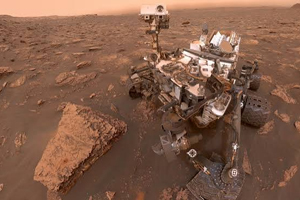
NASA Curiosity (Mars Science Laboratory) rover surpasses another full year of operations on Mars surface today; launched Nov 26, 2011 – landed Aug 5,...
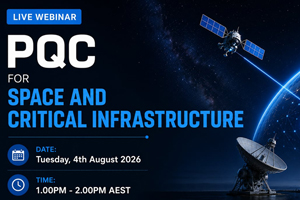
Virtual Series 2026 will offer deeper conversations on why PQC matters and the practical steps businesses should be taking; starts 1:00 pm AEST. Featuring:...
This international lunar science meeting has two objectives: to provide a platform for leading experts to review recent advances across lunar research, from the...
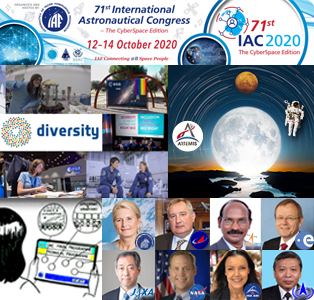 International Astronautical Federation, led by President Pascale Ehrenfreun, is holding 71st International Astronautical Congress (IAC 2020) October 12-14. As a Cyberspace Edition under the motto “IAF Connecting @ll Space People”, IAC will be free of charge to reach new communities. With over 3,000 registered, there will be 3 Plenaries, 2 Highlight Lectures, 6 GNF Sessions, 2 Special Sessions, 14 Technical Keynotes, a Networking Session and a virtual gallery with 1,600 video lectures divided into 32 Symposia. Preliminary to IAC, the IPC Steering Group, IAF Technical Committees and TAC Meetings will converge October 6-9, followed by NextGen Summit Oct 10, and IPMC Younger Professionals Workshop & Technical Gallery Oct 11. There will be opening and closing ceremonies, IAF 3G Diversity Award (given to ESA this year), and talks featuring an Astronaut Panel, Head of Space Agencies, Chang’e-4 mission leaders, Artemis mission + Artemis Accords, and the Launch of Worldwide Missions to Mars. Announcements will be made by DLR, Lockheed Martin, ESA, Northrop Grumman, Blue Origin, Arianespace, Dragonfly Aerospace and Thales Alenia Space. The IAF General Assembly will be held Oct 15. IAA Academy Day is reset to take place on Oct 24, 2021 on the eve of the 72nd IAC which will be held in Dubai, UAE Oct 25-29. IAC 2022 is set for France, and IAC 2023 in Azerbaijan. (Image Credits: IAF, IAA, IISL, SGAC, DLR, ESA, NASA, NG, et al)
 Oct 5 —
  Oct 5 — NewSpace:
  Oct 5 — USA:
 = All times
 = All times for international terrestrial events in local time unless noted.
 = All times for space events, and…
 = All times for international space / astro events in Hawaii Standard Time unless noted. Add 10 hours to obtain UT (‘Universal Time’).