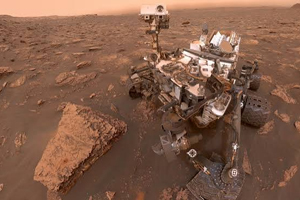
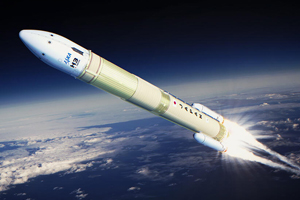
As Parker Solar Probe zooms closer to the Sun surface (8.5M km) than any human-made object before – other spacecraft work to advance our understanding of Sun-Earth-Moon system and its complex interactions. There are an estimated 7,000 satellites around Earth (half being active), the majority of which observe Earth or provide communications and internet. The Solar and Heliospheric Observatory (SOHO) at Earth-Sun L1 (~0.99 AU from Sun) will surpass 26 full years of operations on December 2 and remains a major source of data for near-real-time space weather, affecting satellite operations and Astronaut safety. A total solar eclipse as seen from Earth will be visible on December 3 largely from Antarctica, the “7th continent”, where cold, dark, high-altitude, dry and remote conditions are excellent for astronomy. On the Moon, the “8th Continent”, Chang’e-5 will complete its first full year Dec 1 at Oceanus Procellarum43°N, while CE-3 lander surpasses its 8th year Dec 14 at Mare Imbrium 44.12°N, and CE-4 Lander and Yutu-2 rover will reach 3 full years Jan 3 near Moon South Pole–Aitken Basin 45.5°S. Future cislunar infrastructures and observation instruments from the Moon surface are proposed to monitor and respond to climate change / natural disasters, prepare for detecting life on Earth-like exoplanets, produce more precise values of Earth precession, and enable sustainable development into the Solar System and Galaxy beyond. (Image Credits: NASA, GSFC)
MONDAY
Nov 29 — ISS, ~405-km LEO: Seven-member Expedition 66 working to integrate and test Prichal Node on Earth-facing side of Nauka module, adding 4 expansion ports; Kayla Barron and Thomas Marshburn prepare for EVA to swap broken antenna on P1 truss Nov 30.
Nov 29 — Tiangong Space Station, ~370-km LEO: Three-member crew of Shenzhou 13 maintaining health with treadmill / Tai chi, Wang Yaping transmitting stunning high-def Earth imagery including Qinghai Lake; Shenzhou-12 crew receive Space Medals.
Highlights…
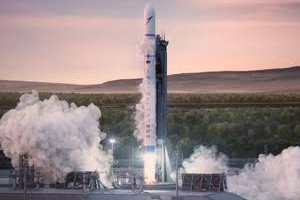
NewSpace: Sierra Space raises US$1.4B for space plane and habitat; Rocket Lab preps for first mid-air Electron recovery via helicopter.
Galaxy: India astronomy team identifies filament structure between arms of MWG, dubbed ‘Gangotri wave’; Solar system with orthogonal planetary orbits may be first of kind.
Global: Nature Editors advocate for internationalist approach to fulfilling Astro2020 science goals; ISRO chair K Sivan details space tech research including satellites that self-destruct.
Laser Communications Relay Demonstration Advancing Space-based Networking Capabilities around Earth and Moon
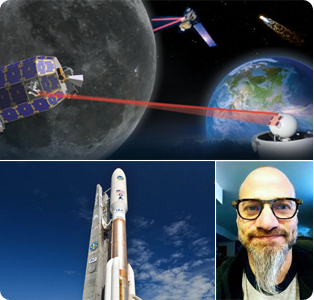
Set for lift-off NET December 4 within 2-hour launch window (04:04-06:04 EST) from Cape Canaveral Space Launch Complex 41 on an Atlas V rocket with 551 configuration (5 m payload fairing / 5 SRBs / 1 RL10-powered Centaur upper stage), Laser Communications Relay Demonstration (LCRD) is latest iteration of optical / infrared laser data transfer for space applications. Building on technologies developed for legacy Tracking and Data Relay Satellite System (which utilizes S, Ku, and Ka RF bands for spacecraft / ground station communication) and Lunar Laser Communications Demonstration (LLCD, 2013) which achieved 622Mbps downlink from lunar orbit to Earth ground station, LCRD mission planners including self-described “space internetworking guy” PI Dave Israel of GSFC hope to achieve 1.2Gbps downlink – a 2x improvement over LLCD and 10-100x faster than RF. LCRD is housed on USSF Space Test Program 3 payload craft, STPSat-6, along with primary payload SABRS-3 (Space and Atmospheric Burst Reporting System, a nuclear detonation detection instrument) and 7 additional Space Force payloads. Infrared lasers are to establish communication links with ground stations in Table Mountain, California, and Haleakalā, Hawaii from geosynchronous orbit. NASA is hosting remote launch viewing through ‘virtual guest program’ featuring extensive additional related content, with live coverage beginning T-35 minutes on NASA TV and social media. (Image Credits: NASA, ULA)
Nov 30 — ISS,U.S. EVA #78,~405-km LEO: Thomas Marshburn and Kayla Barron to perform 6.5-hour spacewalk to replace Port 1 Truss S-Band communications antenna starting 07:10 EST; live coverage available.
Nov 30 — Arianespace,Launch Soyuz / Galileo 27 & 28,Sinnamary, French Guiana: Arianespace Soyuz rocket, designed VS26, to launch 2 Galileo satellites for Europe Galileo navigation constellation.
Dec 1 — Chang’e-5,Mons Rümker, Oceanus Procellarum, Moon (43° N, 51.9° W): CE-5 lander as part of sample return mission reaches 1 full year / enters 2nd year on lunar surface, having landed on this day in 2020, with sample return launching from the Moon 2 days later.
Dec 1 — SpaceX, Launch Falcon 9 / Starlink 4-3, LC-40, Cape Canaveral SFS FL: SpaceX to launch Falcon 9 with next batch of Starlink satellites.
Dec 2 —Solar and Heliospheric Observatory (SOHO),LEO: ESA / NASA craft studying sun, reaches 26 full years / begins 27th year of operations in space today, launched 1995; has discovered more than 3,000 comets.
Dec 2 — Mercury: At aphelion, 0.4667 AU from Sun, 14:00.
FRIDAY
Dec 3 — Griffith Observatory, Online / Los Angeles CA: All Space Considered Remote; GO curatorial staff examine and explain the most-talked-about subjects in astronomy and space science; 19:30-21:00 PST.
Dec 3 — Eclipse of the Sun: Total solar eclipse visible from Antarctica, with parts of southern Africa will seeing partial solar eclipse; full eclipse begins 21:00:04 HST, maximum 21:33:26, full eclipse ends 22:06:32.
Dec 3 — Moon: 3.8° NNE of Antares, 19:00; New Moon, 21:43.
SATURDAY
Dec 4 — ULA, Launch Atlas 5 / STP-3,SLC-41, Cape Canaveral SFS FL: Atlas 5 to launch USSF STP-3 mission including several smallsats, and STPSat 6 satellite which hosts Space and Atmospheric Burst Reporting System-3 (SABRS-3) and NASA Laser Communications Relay Demonstration (LCRD) experiment; 04:04-06:04 EST.
Emanating from ~6km-wide comet with 5.3-year Solar orbit, visible in constellation Aquarius near star Delta Aquarii, fast, faint meteors peak on this night, best...
The International Research Conference is a federated organization dedicated to bringing together a significant number of diverse scholarly events for presentation within the conference...
Includes ~150 meetings covering the fields of COSPAR Scientific Commissions / Panels / Task Groups, such as SC B: The Earth-Moon System, Planets, and...
From 02 to 07 August 2026, a few thousand geoscientists across diverse disciplines will gather at the 23rd annual meeting of the Asia Oceania Geosciences...
NASA Curiosity (Mars Science Laboratory) rover surpasses another full year of operations on Mars surface today; launched Nov 26, 2011 – landed Aug 5,...
This international lunar science meeting has two objectives: to provide a platform for leading experts to review recent advances across lunar research, from the...
At CSIR International Convention Centre. Key topics are Earth Observation, Developing Space Tourism, Space Supply Manufacturing. Cultural tours are offered.
Participants will receive theoretical and hands-on training in electron imaging and X-ray spectroscopy for application to planetary samples. This training opportunity is targeted at...
"Leading Australia’s Space Future for Our Strategic Advantage". Southern Space 2026 brings together decision-makers who set the direction for Australia’s space sector. It is...
 NewSpace:
  Solar System: Planetary Science Institute characterizes
  USA:
USA: 
 = All times for terrestrial events in local time unless noted.
 = All times for international terrestrial events in local time unless noted.
 = All times for space events, and…
 = All times for international space / astro events in Hawaii Standard Time unless noted. Add 10 hours to obtain UT (‘Universal Time’).
 Set for lift-off NET December 4 within 2-hour launch window (04:04-06:04 EST) from Cape Canaveral Space Launch Complex 41 on an Atlas V rocket with 551 configuration (5 m payload fairing / 5 SRBs / 1 RL10-powered Centaur upper stage), Laser Communications Relay Demonstration (LCRD) is latest iteration of optical / infrared laser data transfer for space applications. Building on technologies developed for legacy Tracking and Data Relay Satellite System (which utilizes S, Ku, and Ka RF bands for spacecraft / ground station communication) and Lunar Laser Communications Demonstration (LLCD, 2013) which achieved 622Mbps downlink from lunar orbit to Earth ground station, LCRD mission planners including self-described “space internetworking guy” PI Dave Israel of GSFC hope to achieve 1.2Gbps downlink – a 2x improvement over LLCD and 10-100x faster than RF. LCRD is housed on USSF Space Test Program 3 payload craft, STPSat-6, along with primary payload SABRS-3 (Space and Atmospheric Burst Reporting System, a nuclear detonation detection instrument) and 7 additional Space Force payloads. Infrared lasers are to establish communication links with ground stations in Table Mountain, California, and Haleakalā, Hawaii from geosynchronous orbit. NASA is hosting remote launch viewing through ‘virtual guest program’ featuring extensive additional related content, with live coverage beginning T-35 minutes on NASA TV and social media. (Image Credits: NASA, ULA)