May 18-24, 2026 | Vol 45, Week 20 | Hawai`i Island, USA
SMILE Sun, You'll Soon Be on Camera!
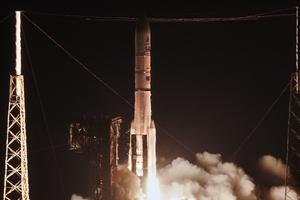
The first mission to observe Earth’s magnetosphere in X-ray light, SMILE (Solar wind Magnetosphere Ionosphere Link Explorer), is prepared to launch May 19 via Vega-C rocket from Guiana Space Center. SMILE is a collaboration between the European Space Agency and the Chinese Academy of Sciences to provide a complete view of how the Sun affects Earth’s space environment. It was proposed and selected in 2015, with studies beginning in 2016 and implementation in 2019. The satellite is ~2,300 kg (wet), and is equipped with a 490-newton main engine, 2 deployable solar arrays, Li-ion batteries and 4 science instruments: SXI (Soft X-ray Imager), a 33-kg camera with lobster-eye micropore optics (0.2–2.5 keV) to make X-ray observations of Earth’s magnetic field; UVI (Ultraviolet Imager), a 15.5 kg imager (160-180 nm) to image auroras; MAG (Magnetometer), two sensors on a 3-m deployable boom to measure the magnetic field; and LIA (Light Ion Analyzer), two 3 kg sensors (5 eV-25 keV) to monitor solar wind plasma. SMILE is intended for a Highly Elliptical Orbit with ~5,000 km perigee × 121,000 km apogee, at 70° or 98° inclination. (Image Credits: ESA, CAS, NSSC)
NASA's Psyche Spacecraft Executes Critical Mars Gravity-Assist Flyby
On May 15 the Psyche spacecraft successfully came within 2,800 miles (4,500 km) of the Martian surface flying at 12,000+ mph (approximately 19,840 km/h). This planned gravity-assist maneuver used the Red Planet’s gravitational pull as a natural slingshot to gain speed and refine its trajectory without expending propellant. Launched aboard a SpaceX Falcon Heavy in October 2023, Psyche has been cruising through the inner Solar System toward the metal-rich asteroid 16 Psyche in the Main Asteroid Belt. The spacecraft relies primarily on solar electric propulsion using Hall-effect thrusters. It carries four SPT-140 xenon thrusters (~922 kg total propellant). The solar arrays generate 21 kW near Earth, dropping to 2.3–3.4 kW at the asteroid. This low-thrust, high-efficiency system enables gradual acceleration over the multi-year cruise—its arrival at the target asteroid is expected in 2029. This 2026 Mars encounter also offers a valuable opportunity for instrument testing and additional science. The spacecraft had already captured images of Mars from afar, and the mission teams are using the flyby to calibrate systems ahead of the primary science phase at 16 Psyche. (Image Credits: NASA/JPL-Caltech/ASU)
Humans in Space
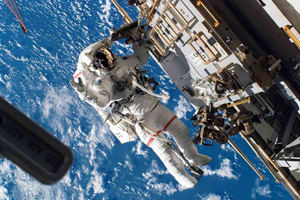
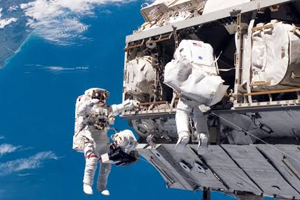
☆ International Space Station, ~415-km LEO: Expedition 74 seven members transferring ~2,950 kg of cargo from recently arrived SpaceX Dragon CRS-34, while working with alfalfa plants, seed germination studies, artery ultrasound scans for cardiovascular health, DNA-inspired research, exercise device testing, and life support system maintenance. Next crew includes Soyuz MS-29 in July and SpaceX Crew-13 in September, which will rotate personnel and transition toward Expedition 75.
☆ Tiangong Space Station, ~390-km LEO: Shenzhou-21 three-member crew are planned to conduct 27 scientific experiments during their 7-month stay and return to Earth in June in order to further to test long-term habitation technologies and manage supplies delivered by the Shenzhou-22 craft, which is currently docked to the Tianhe forward port. 7,000 kg of cargo / 220 items delivered by Tianzhou-10 are being stowed and utilized. The crew completed their third spacewalk in April and may perform a fourth. Zhang Lu has completed seven EVAs in total, setting a new record for most Chinese spacewalks.
◐ Lunar Enterprise News: Announcement of Artemis III crew members expected ‘soon’ as mission is now set to launch NET late 2027 (Artemis II crew announced Apr 2023 for originally projected late 2024 mission). | Blue Moon Mk 1 Lunar Lander, dependent on New Glenn, could face launch delay beyond 2026 after the rocket’s failure. | Lunar Outpost raised US$30 million to aid its reconfiguration plans to comply with new Artemis architecture. | Rocket Lab (RKLB) stock spiked 34%+ following record Q1 earnings. | Prof. Joe Silk discusses future observatories on the Moon with IAU members and the public.
Near-Earth Objects Close Approaches –Mon May 18: Apollo Asteroid 2026 JH2 (0.0006 AU) | Fri May 22: Apollo Asteroid 2026 JE1 (0.007 AU) | Sat May 23: Apollo Asteroid 2026 JM (0.013 AU) | Sun May 24: Aten Asteroid 2023 KH4 (0.014 AU)
Loading Moon data for your location...
Loading planet data...
Land your name on the Moon!
Have your name sent to the Moon for FREE on the ILO-1 lunar mission via Astrolab FLEX rover (NET 2027). You will automatically be signed up for our weekly Space Calendar.
Online short course on Rendezvous and Proximity Operations (RPO), critical for crew transfer, in-space assembly and space debris removal, among other uses. Instructor is Pradipto Ghosh; 12 classroom hours / 2.4 CEU-PDH; online via Zoom with replays available. Students will receive Certificates of Completion from both AIAA and Johns Hopkins […]
Galactic Center of the Milky Way is instrumental in mapping and understanding galaxies since it is the closest galactic nucleus to us. At Brno Observatory and Planetarium, Kraví hora 522/2. Despite many detailed, multiwavelength studies of the central regions of our Galaxy, we still have many open questions concerning its […]
At University of Turku; expecting up to 200 participants. Look at events page for the welcome reception on Monday and the Astronomy on Tap event on Tuesday, and at the “things to do while in Turku” page for other ways to spend your time.
Ariane Launch Area 1 (ELV), Guiana Space Centre, ~5°N, French Guiana
Set for 00:52 French Guiana Time UTC-3 | 17:52 HST May 18 to send astrophysics satellite to elliptical orbit. Joint mission between the European Space Agency and the Chinese Academy of Sciences to investigate the interaction between Earth’s protective shield – the magnetosphere – and the supersonic solar wind.
Prof. Joe Silk to discuss the Moon as the next great frontier for astronomy. Terrestrial telescopes are facing a crisis as our night skies become increasingly crowded and bright. The solution? Looking upward—and staying there. Join IAU Commission C2 (Communicating Astronomy with the Public) on 19 May 2026 for a fascinating […]
Offshore Launch Platform near Jeju Island, South Korea
South Korea's solid‑fuel space launch vehicle, commonly abbreviated GYŪB (Korean: Goche Yeonlyo Uju Balsache or 고체연료 우주발사체), is an orbital booster developed by the state-run Agency for Defense Development (ADD). It is based on solid propellant stages, with a liquid-fuel post‑boost stage (PBS), designed to deploy small satellites—particularly synthetic aperture […]
Commercial Space Policy Summit runs concurrently with ASCEND visionary sessions, inspiring speakers, and a community spirit that welcomes everyone who loves space. Emphasis on 5 space areas: economy, law, exploration, technology, security. At the Washington Hilton, 1919 Connecticut Ave NW. This year's Policy and Law programming is more relevant than […]
Annual international conference dedicated to cybersecurity for space and satellite systems, bringing together satellite operators, space agencies, manufacturers, cybersecurity experts, and policymakers to discuss threats, regulations, and best practices for securing space infrastructures. Expecting 1,000+ attendees this year with 80+ speakers and 60+ exhibitors. The event focuses on practical, operational […]
China Queqiao “bridge of magpies” satellite reaches 8 full years in space today, launched 2018 to provide far side communications to Earth from Chang'E-4 lander / rover.
Satish Dhawan Space Center, ~14°N, Sriharikota, India
Launch window 08:45-12:45 India Time | HST 17:15-21:15 May 20 for Earth-observing satellite to geostationary orbit above India. Expected to be 5th successful launch of GSLV Mk II.
To be held Jan 11-15 2027 in Orlando FL, USA, expecting 6,000+ attendees from 46+ countries. Presentations and papers can be an effective way to hone scientific and technical ideas, introduce your work to aerospace colleagues, and refine your research questions. Present at AIAA SciTech Forum to gain expert feedback […]
29 satellites for broadband internet going to LEO on this launch, part of planned 7,000+ to be in 98 orbital planes in three altitudes, 590 / 610 / 630 kilometers. Atlas V rocket first stage uses RD-180 engine built by Russia that burns kerosene / liquid oxygen, and RL10 engine […]
Launch window open 17:30-19:00 CDT | 12:30-14:00 HST | 22:30 UTC for 12th flight overall of 2-stage Starship vehicle and 1st of bigger / more-powerful Version 3 / V3, with higher thrust utilizing new Raptor 3 engines. Launch date subject to final final vehicle testing, site readiness (including the new […]
At the Spokane Convention Center. The meeting will have a broad scope, with a wide-ranging program of science and workforce topics, and celebrating planetary...
Convene, connect, and collaborate at the 19th annual von Braun Space Exploration Symposium! This year’s event will spotlight how bold ideas, emerging technologies, and...
Themes include: Space & the Arctic; Space & AI; Space & International Collaboration. There is a Student Session, a Technical Session, a Frontier Session,...
Oslo Spaceport Norway offers monthly a knowledgeable speaker and opportunity for networking, 17:00-20:00 local time; free entry but registration required. Ground Control is for...
45 satellites to launch for Amazon Leo, formerly named Project Kuiper. This LEO mega constellation will offer broadband internet access with 3,276 satellites.
Occurring 31 October from 09:00-11:00 local time (16:00-18:00 HST, 19:00-21:00 PDT, 22:00-24:00 EDT on 30 October), this Galaxy Forum will be in hybrid format...
Originally planned around this date for Wenchang, China -- TBC (to be confirmed); As the only professional association for astronauts, ASE supports the advancement of...
Coordinating Division Division C Education, Outreach and Heritage The IAU Symposium on Innovative Research and Techniques in Astronomy Communication will take place from November...
Change clocks back 1 hour from Daylight Saving to Standard Time; does not include Hawai’i, Arizona (except the Navajo Nation), American Samoa, Guam, Northern...
ESWW is the main annual event in the European Space Weather and Space Climate calendar. It is an international meeting organised annually within the...
IAU Symposium: IAUS409 - A Journey Towards Effective Astronomy Communication; online and at National Astronomical Observatory of Japan, 2-21-2 Osawa Mitaka, Tokyo. Topics include:...
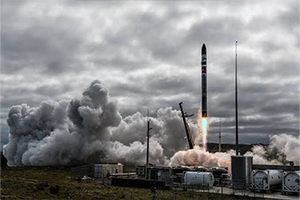
Launch Complex 1, ~39°S, Mahia Peninsula, New Zealand
iQPS Launch 9, an Earth observation satellite with Synthetic aperture radar for Japan-based imaging company iQPS, to launch on "The Sea God Surveys" mission...
Launch window 10:34am - 2:34pm local time for the 15th batch of classified satellites for a reconnaissance constellation built by SpaceX and Northrop Grumman...
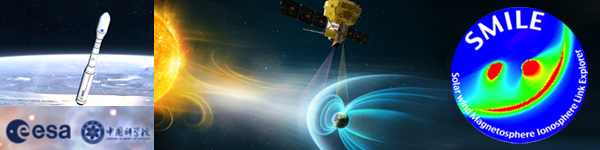 The first mission to observe Earth’s magnetosphere in X-ray light, SMILE (Solar wind Magnetosphere Ionosphere Link Explorer), is prepared to launch May 19 via Vega-C rocket from Guiana Space Center. SMILE is a collaboration between the European Space Agency and the Chinese Academy of Sciences to provide a complete view of how the Sun affects Earth’s space environment. It was proposed and selected in 2015, with studies beginning in 2016 and implementation in 2019. The satellite is ~2,300 kg (wet), and is equipped with a 490-newton main engine, 2 deployable solar arrays, Li-ion batteries and 4 science instruments: SXI (Soft X-ray Imager), a 33-kg camera with lobster-eye micropore optics (0.2–2.5 keV) to make X-ray observations of Earth’s magnetic field; UVI (Ultraviolet Imager), a 15.5 kg imager (160-180 nm) to image auroras; MAG (Magnetometer), two sensors on a 3-m deployable boom to measure the magnetic field; and LIA (Light Ion Analyzer), two 3 kg sensors (5 eV-25 keV) to monitor solar wind plasma. SMILE is intended for a Highly Elliptical Orbit with ~5,000 km perigee × 121,000 km apogee, at 70° or 98° inclination. (Image Credits: ESA, CAS, NSSC)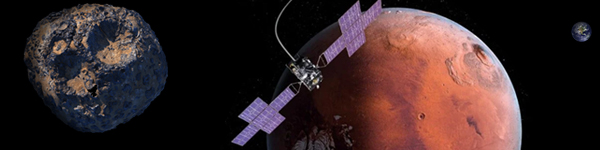
 Near-Earth Objects Close Approaches – Mon May 18: Apollo Asteroid 2026 JH2 (0.0006 AU) | Fri May 22: Apollo Asteroid 2026 JE1 (0.007 AU) | Sat May 23: Apollo Asteroid 2026 JM (0.013 AU) | Sun May 24: Aten Asteroid 2023 KH4 (0.014 AU)