American Institute of Aeronautics and Astronautics hosts AIAA SciTech Forum 2026 on January 12–16 at Hyatt Regency Orlando, Florida, with theme Breaking Barriers Together: Boundless Discovery. Forum expects more than 6,000 attendees from 48 countries advancing aerospace research, development and technologies across civil, commercial and national security sectors. Program includes nearly 3,000 technical presentations spanning 65+ topics — aerodynamic measurement technology, applied aerodynamics, fluid dynamics, guidance, navigation, control, hypersonics, intelligent systems, spaceflight mechanics, propellants, combustion and more — plus plenary sessions, Forum 360 panels, and 100+ exhibitors showcasing innovations. Plenary speakers include Astronaut Peggy Whitson of Axiom Space, delivering opening remarks; Jonathan Arenberg, Fellow Chief Mission Architect Science Robotic Exploration, Northrop Grumman, sharing NASA James Webb Space Telescope insights; Arbi Karapetian, Director Innovation Technology, Formula 1, exploring cross-industry performance fuels. New Career Accelerator Program on January 12 equips university students with leadership tools, career strategies from experts including Hillary Coe, Vast; Amy Medina Jorge, Blue Origin commercial Astronaut; and others. Rising Leaders programming, speed mentoring, and Expo Hall HUB talks target young professionals building networks for 2030 lunar outposts, 2040 cislunar economy growth. Forum sets 2026 innovation pace toward sustained Moon presence, nuclear propulsion, quantum computing and autonomy. (Image Credits: AIAA)
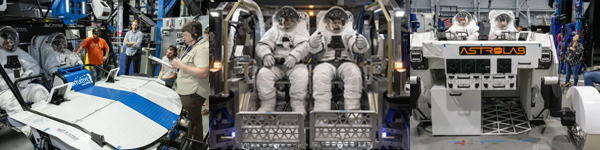 As 2026 dawns, lunar specialists await the NASA decision for primary provider of US$4.6B Lunar Terrain Vehicle (LTV) Services contract. LTV Project Manager Steve Munday, Extravehicular Activity / Human Surface Mobility Program Manager Lara Kearney, Chief Exploration Scientist Jacob Bleacher and NASA Johnson Director Vanessa Wyche may all weigh in, with possible input from Lunar Exploration Analysis Group. The LTV program marks a shift toward service-based mobility – renting – beginning with Artemis V mission NET 2029. Industry leaders—Intuitive Machines (IM), Lunar Outpost (LO), and Venturi Astrolab (Astrolab)—have spent a year refining prototypes with initial US$30M awards. Astrolab FLEX rover has Swiss-developed hyper-deformable wheels, lunar-night-surviving batteries, and will benefit from its Mona Luna European rover development and precursor FLIP rover launching NET July 2026. LO Eagle rover leverages automotive expertise from GM and Goodyear. IM Moon RACER, developed with input from Apollo veterans, demonstrates breakthrough power-beaming capabilities with Star Catcher Industries, transferring 2.78 kWh via laser. It is expected the chosen LTV will serve as cornerstone for sustained South Pole operations through 2039, able to transport Astronauts safely, carry ~1,000 kg of tools and samples. The new era of crewed mobility reflects legacy of Lunar Roving Vehicle (LRV) and Apollo “Moon Buggy.” (Image Credits: NASA)
 International Space Station, ~415-km LEO: 3 members of Expedition 74 seven-member crew will handle all ISS operations for a time as the 4 members of Crew-11 return early in 1st-ever ISS medical evacuation; Kud-Sverchkov, Mikayev and Williams will remain; Cardman, Fincke, Yui and Platonov prepare their Dragon pressure suits, pack personal belongings; departure date and possible updated Crew-12 launch date not yet set.
Tiangong Space Station, ~390-km LEO: Shenzhou-21 three-member crew [Zhang Lu, Wu Fei, Zhang Hongzhang] advances key ongoing project: in-situ electrochemical and optical study of lithium-ion batteries, led by payload expert Zhang Hongzhang, conducting precise optical adjustments for real-time observation of lithium dendrite growth in microgravity to improve battery safety and performance; performing routine station maintenance, daily ~2-hour exercise, and regular health monitoring (bone density, ECG, blood pressure, pulmonary function).
 Lunar Enterprise News: 2026 Proposed Moon Missions to Advance Science, Prepare for Human Landings │ Artemis Human Landings Anticipated with Preparatory FLIP, then FLEX Rovers
 Near-Earth Objects Close Approaches – Mon Jan 12: Apollo Asteroid 2025 YR7 (0.023 AU); Wed Jan 14: Apollo Asteroid 2022 OB5 (0.0004 AU); Wed Jan 14: Apollo Asteroid 2025 XN1 (0.023 AU); Sat Jan 17: Apollo Asteroid 2025 BL (0.017 AU)

