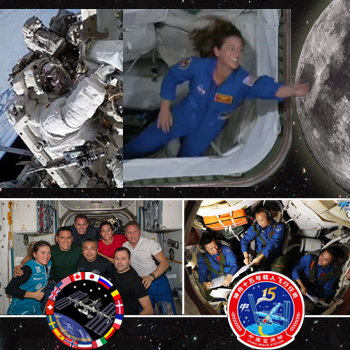
ISS Activities Honor 1st EVA by 1st Native American Woman in Space, Looks Toward 1st Woman on the Moon
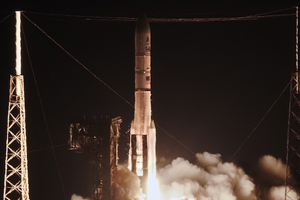
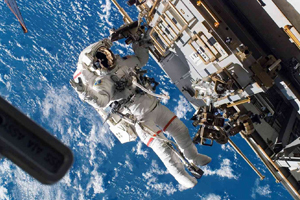
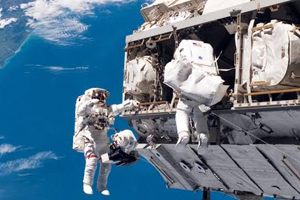
In its 23rd year of permanent occupation, International Space Station partners are celebrating the first EVA from Nicole Mann (the first Native American woman in space) by hosting a number of in-flight activities with Indigenous groups in USA. On January 31, she will connect with House Indian Affairs Committee and the Senate Native American Affairs Committee, followed by February 7 discussion with the Choctaw Nation of Oklahoma, having already spoken with the Boys and Girls Club of the Flathead Reservation and Lake County in Ronan, Montana on Jan 26. Currently Mann and Anna Kikina of Roscosmos are the only women aboard ISS Expedition 68 with 5 other international crew members: Sergey Prokopyev, Dmitry Petelin, Francisco Rubio, Josh Cassada and Koichi Wakata – while Tiangong Space Station houses Shenzhou 15 Taikonauts Fei Junlong, Deng Qingming and Zhang Lu. NASA Astronaut corps has 41 active Astronauts available for flight assignments – 16 of which are women. One, or more, of these 16 will be chosen to be part of Artemis 2 crew flying to the Moon NET May 2024, and Artemis 3 mission touching down on the surface. With NASA striving to be more inclusive, the Artemis program has committed to also landing the first Person of Color on the Moon no later than July 4, 2026, as Japan, China, and Russia aspire for human Moon landings before 2030. (Image Credits: NASA, ISS Partners, CMSA)
MONDAY
☆ Jan 30 — ISS,~415-km LEO: Expedition 68 seven-member crew working with experiments including ‘Suture in Space’ skin / vein samples, bone health, passive cooling techniques, flame growth and extinction, Plant Habitat-03 (arabidopsis) and Veg-05 (tomatoes).
☆ Jan 30 — Tiangong Space Station, ~390-km LEO: Shenzhou 15 three-member crew continue Earth imaging along with robotic arm cameras viewing sky and Earth in high resolution.
Highlights…
o NewSpace: Astrobotic Peregrine lunar lander on display at Moonshot Space Museum awaiting ULA readiness following successful thermal-vacuum testing; In-space manufacturing satellite built by Rocket Lab for Varda Space being prepared for launch by SpaceX on Transporter-8 launching NET June; Intuitive Machines to deploy asteroid prospecting craft Brokkr-2 for AstroForge during IM-2 Moon mission NET Q4.
☆ Solar System: December Juno flyby of volcanic Jupiter moon Io may shed light on plasma torus observed in fall of 2022 while Johns Hopkins APL-led Io Volcano Observer works toward NET 2029 launch; Analysis of earthquake-generated seismic waves at Peking University indicates inner core of Earth stopped rotating circa 2009, may be reversing spin direction.
☆ Galaxy: Life ‘building blocks’ may be common product of stellar formation as Center for Space and Habitability-led study of interstellar molecular cloud Chameleon 1 utilizing JWST finds evidence of complex organic molecules e.g. CH3OH; IllustrisTNG simulation finds MWG unusually larger relative to its surrounding cosmological wall with 1:1,000,000 likelihood.
o Global: CASC plans to launch LM-6C variant in 2023, LM-5DY / 921 now designated LM-10 may launch crewed Moon mission before 2030; NASA and CSA working to determine cause of comms disruption which affected JWST Near Infrared Imager and Slitless Spectrograph (NIRISS); 1 of 6 Belarus women candidates to be cosmonaut on Soyuz mission to ISS in Fall.
●USA: NASA and DARPA to collaborate on nuclear thermal Demonstration Rocket for Agile Cislunar Operations (DRACO) program with X-NTRV launch expected NET 2027; Starliner Crew Flight Test on track for April launch of Barry Wilmore and Sunita Williams to ISS following recent NASA / Boeing mission rehearsal, crew / service module integration.
● Hawai’i: NOIRLab-compiled Dark Energy Camera Plane Survey, containing 3.32B stars observed via Cerro Tololo Inter-American Observatory in Chile and Pan-STARRS in Maui will serve as reference for astronomers globally; University of Hawaii investigating extent of 2 ethylene glycol coolant leaks from UH88.
● = Terrestrial and… o = International terrestrial events
☾ = Moon activity
★ = Space and… ☆ = International space / astro events in Hawaii Standard Time unless noted. Add 10 hours to obtain UT (‘Universal Time’).
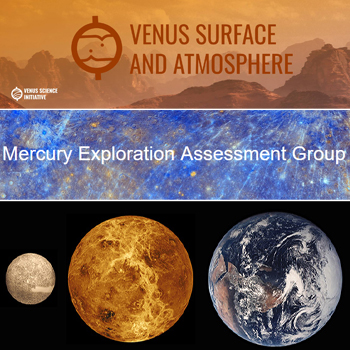
Inner Solar System Exploration is Subject of Mercury Exploration Assessment Group and LPI Venus Planetary Science Gatherings This Week
Terrestrial (rocky) planets, being similar in composition to Earth, are a major focus of planetary scientists. Venus, known as ‘Earth’s Twin’ at 12,104-km diameter, has been the world targeted by the most missions, with 23 successes (47 attempts) between USSR, USA, EU and JAXA. 6 new missions are in the works, with Rocket Lab’s Venus probe (a partnership between Rocket Lab and MIT) slated to launch NET May 2023, ISRO Shukrayaan-1 NET Dec 2024, NASA DAVINCI NET 2029, Roscosmos Venera-D NET 2029, ESA EnVision NET 2031, and NASA VERITAS NET 2031. Research relevant to these undertakings will be discussed at Venus Surface and Atmosphere Conference in Houston TX Jan 30 – Feb 1, hosted by Lunar and Planetary Institute’s Venus Science Institute. Mercury has been less studied, perhaps due to the long-held notion that Mercury lacks volatiles (now disproven). Just 2 missions have reached the smallest (4,879-km diameter) planet in the Solar System, both from NASA: Mariner 10 (1974) and MESSENGER (2008). BepiColombo, a collaborative mission of ESA and JAXA, consists of 3 modules launches together in 2018 which will separate upon Mercury orbital insertion, currently slated December 2025. Roscosmos is also in early planning stages of Mercury-P, tentatively scheduled for launch in 2031. NASA Mercury Exploration Assessment Group will consider these efforts at MExAG 2023 Meeting in Washington DC Feb 1-3. (Image Credits: LPI, NASA)
● Jan 30 – Feb 2 — Space Technology Series, Online / Colorado Springs CO: Space Domain Awareness Course; with Pamela Magee, Moriba Jah, and Wiley Larson; US$1,400.
o Jan 30 – Feb 3 — United Nations Open-Ended Working Group, Geneva, Switzerland: OEWG Reducing Space Threats.
☆ Jan 30 — Moon: 2.21° SE of Pleiades, 00:00; 0.28° E of Mars, 19:00.
☆ Jan 31 — ISS, In-Flight Education Event, ~415-km LEO and Online: Expedition 68 In-Flight Event with the House Indian Affairs Committee and the Senate Native American Affairs Committee and NASA Flight Engineer Nicole Mann; starts 10:20, live coverage available.
★ Jan 31 — SpaceX, Launch Falcon 9 / Starlink 5-3, LC-39A, Kennedy Space Center FL: Falcon 9 to launch next batch of Starlink internet satellites for SpaceX, 03:27 EST.
● Jan 31 — Explorer 1 65th Observation, Nationwide USA: American Artemis Return to the Moon For Good is underway, Mars attention and planning advancing, Outer Solar System search for life ongoing, and Interstellar craft on outgoing trajectories while first USA satellite launch on this day in 1958 ‘Explorer 1’ is celebrated and remembered.
o Jan 31 – Feb 4 — 100 Year Starship, Travelling Telescope, Gearbox, GoDown Arts Centre, African Speculative Fiction Society, Hybrid / Nairobi, Kenya and Online:NEXUS 2023: When Space, Purpose, and Culture Collide; hosted by Dr. Mae Jemison, at Trademark Hotel.
☆ Jan 31 — Apollo Asteroid 2023 AS1: Near-Earth Flyby (0.030 AU)
☆ Jan 31 — Apollo Asteroid 2022 YB4: Near-Earth Flyby (0.079 AU)
☆ Jan 31 — Apollo Asteroid 2023 AE2: Near-Earth Flyby (0.096 AU)
WEDNESDAY
☆ NET Feb — ISRO, Launch GSLV Mk III (LVM3) / OneWeb 36, Satish Dhawan Space Centre, India: ISRO to launch next batch of 36 communication satellites for OneWeb constellation.
☆ Feb 1 — Deep Space, Jupiter Orbit: JunoCam continues in recovery / testing mode after image degradation occurred during Io flyby, while ESA JUICE is heading to French Guiana for April 14 launch on Ariane 5, and China plans Tianwen-4 for Jupiter system exploration.
● Feb 1 — Columbia STS-107 20th Observation, Nationwide USA: Annual international conferences and events take place to further space exploration efforts in remembrance of Columbia 7 loss: Commander Richard D. Husband, Mission Specialist Laurel Clark, Payload Specialist Ilan Ramon (the ‘1st Israeli astronaut’) and Astronauts: William C. McCool, Michael P. Anderson, David M. Brown and Kalpana Chawla (the ‘1st Indian American astronaut’ and ‘1st Indian woman in space’).
☆ Feb 1 — Comet C/2022 E3 (ZTF): Long period comet (the ‘green comet’) from Oort cloud discovered by Zwicky Transient Facility closest approach to Earth (0.028 AU)
☆ Feb 1 — Amor Asteroid 2016 BW80: Near-Earth Flyby (0.093 AU)
THURSDAY
o Feb 2 — Open Cultural Astronomy Forum (OCAF), Online:OCAF Seminar: What’s in a name? by Dr. Mia de los Reyes of Stanford, 23:00 UTC.
☆ Feb 2 — Aten Asteroid 2017 DU34: Near-Earth Flyby (0.033 AU)
FRIDAY
☆ Feb 3 — Hubble Space Telescope Visible Pass, ~530-km LEO: Hubble Space Telescope to make visible pass over Hawai’i Islands from WNW to SSW starting 05:59:16 HST, brightest magnitude 0.7.
☆ Feb 3 — Moon: 5.3° S of Castor, 05:00; 1.89° S of Pollux, 11:00; at apogee (distance 406,480 km), 23:00.
☆ Feb 3 — Apollo Asteroid 367789 (2011 AG5): Near-Earth Flyby (0.012 AU)
SATURDAY
☆ Feb 4 — Moon: 3.7° NNE of Beehive Cluster, 15:00.
☆ Feb 4 — Apollo Asteroid 2020 OO1: Near-Earth Flyby (0.012 AU)
SUNDAY
★ Feb 5 — SpaceX, Launch Falcon 9 / Amazonas Nexus,SLC-40, Cape Canaveral FL: Falcon 9 to launch Amazonas Nexus communications satellite for Hispasat of Spain.
At the Spokane Convention Center. The meeting will have a broad scope, with a wide-ranging program of science and workforce topics, and celebrating planetary...
Convene, connect, and collaborate at the 19th annual von Braun Space Exploration Symposium! This year’s event will spotlight how bold ideas, emerging technologies, and...
Themes include: Space & the Arctic; Space & AI; Space & International Collaboration. There is a Student Session, a Technical Session, a Frontier Session,...
Oslo Spaceport Norway offers monthly a knowledgeable speaker and opportunity for networking, 17:00-20:00 local time; free entry but registration required. Ground Control is for...
45 satellites to launch for Amazon Leo, formerly named Project Kuiper. This LEO mega constellation will offer broadband internet access with 3,276 satellites.
Occurring 31 October from 09:00-11:00 local time (16:00-18:00 HST, 19:00-21:00 PDT, 22:00-24:00 EDT on 30 October), this Galaxy Forum will be in hybrid format...
Originally planned around this date for Wenchang, China -- TBC (to be confirmed); As the only professional association for astronauts, ASE supports the advancement of...
Coordinating Division Division C Education, Outreach and Heritage The IAU Symposium on Innovative Research and Techniques in Astronomy Communication will take place from November...
Change clocks back 1 hour from Daylight Saving to Standard Time; does not include Hawai’i, Arizona (except the Navajo Nation), American Samoa, Guam, Northern...
ESWW is the main annual event in the European Space Weather and Space Climate calendar. It is an international meeting organised annually within the...
IAU Symposium: IAUS409 - A Journey Towards Effective Astronomy Communication; online and at National Astronomical Observatory of Japan, 2-21-2 Osawa Mitaka, Tokyo. Topics include:...
Launch Complex 1, ~39°S, Mahia Peninsula, New Zealand
iQPS Launch 9, an Earth observation satellite with Synthetic aperture radar for Japan-based imaging company iQPS, to launch on "The Sea God Surveys" mission...
Launch window 10:34am - 2:34pm local time for the 15th batch of classified satellites for a reconnaissance constellation built by SpaceX and Northrop Grumman...
Expecting senior government and executives from NASA, Firefly, Blue Origin to discuss innovation, competitive advantages and a "space industrial revolution in LEO". Capped at...
Launch Complex 1, ~39°S, Mahia Peninsula, New Zealand
iQPS Launch 10, an Earth observation satellite with Synthetic aperture radar for Japan-based imaging company iQPS, to launch on “The Mountain God Rises” mission...
Promoting the New Space Economy: The first major national meeting of the space, technology and scientific industries. Three days to connect science, industry and...