Science Preparations Underway for Artemis 3 Human Landing Mission Launching NET 2025
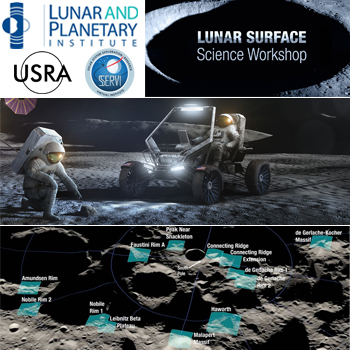
Lunar and Planetary Institute of Houston TX will be gathering scientists to consider the areas within 6° of the Moon South Pole, termed ‘Artemis Exploration Zone’, at the 19th virtual Lunar Surface Science Workshop. Titled The First Steps in a Bold New Era of Human Discovery: Candidate Artemis III Landing Sites, abstracts are being accepted until March 1, with 2-day meeting held April 4-5. Papers will be divided into sections addressing exploration value and regional geological properties. Identified regions under consideration are 13 ~225-900 km2 areas, from which 100m2 landing sites will eventually be selected. They are: Faustini Rim A, Peak Near Shackleton, Connecting Ridge, Connecting Ridge Extension, de Gerlache Rim 1, de Gerlache Rim 2, de Gerlache-Kocher Massif, Haworth, Malapert Massif, Leibnitz Beta Plateau, Mons Mouton (formerly Nobile Rim 1), Nobile Rim 2 and Amundsen Rim. Design and implementation of science operations within the selected site will be determined by the Artemis Science Team including NASA’s internal science operations and external proposals through Artemis III Geology Team, Artemis Deployed Instruments, and Artemis III Participating Scientist Program (TBA). Research Opportunities in Space and Earth Sciences – 2023 (ROSES-2023), issued Feb 14, includes Artemis Deployed Instruments Program payloads opportunities during the first and second Artemis landings, on Lunar Terrain Vehicle, on CLPS landers vis PRISM, and on a stand-alone basis. Geology Team Step-2 proposals are due April 25, ROSES-2023 proposals are due NET May 16. (Image Credits: NASA, LPI, USRA, SSERVI)
MONDAY
☆ Feb 27 — ISS,~415-km LEO: Expedition 68 expected to be 11-member crew with arrival of Crew 6 (Bowen, Hoburg, Alneyadi, Fedyaev); transferring return cargo to Crew 5 craft which may depart early March with 4 members.
☆ Feb 27 — Tiangong Space Station, ~390-km LEO: Shenzhou 15 three-member crew continue science, station configuration and communications with Earth; Shenzhou 14 crew emerge from quarantine & recuperation for press conference.
Highlights…
o NewSpace: Terran Orbital subsidiary Tyvak to build 300 satellites, deploy 288 for Rivada Networks via US$2.4B contract; Launcher to continue development of Orbiter space tug, E-2 rocket engine under new owner Vast Space; Intuitive Machines (NASDAQ: LUNR) share price soars up to 800% over initial $10 share offering following SPAC merger.
☆ Solar System: Enceladus probe effort Moonraker, led by Aix-Marseille University, striving for $1.06B ESA award / NET 2038 launch; CNSA Zhurong Mars rover may have power issues following MRO confirmation vehicle is stationary since Sep 2022; Solsys Mining of Norway leading ESA Discovery project investigating lunar regolith treatment to produce fertilizer.
☆ Galaxy: University of Hawaii-led study finds observational evidence that black holes may be responsible for producing dark energy equal to the expansion constant of universe; NAOJ study suggests JWST high redshift galaxy detection which challenges conventional galaxy formation theory may be skewed by dust.
o Global: 2 uncrewed ISRO Gaganyaan missions to occur in 2023, one with Vyommitra robot, Chandrayaan-3 on track for June 2023 launch following successful EMI / EMC testing; Infrastructure for Resilience, Interconnectivity and Security by Satellite (IRIS²) constellation to be deployed NET 2024 under $2.5B EU Parliament budget.
●USA: NASA Aerospace Safety Advisory Panel recommends Artemis management centralization, attention to launch cadence, fostering safety culture; NRAO, GBO, Raytheon collaboration ngRADAR may aid detection of NEOs such as 454-kg meteorite which exploded over Texas.
● Hawai’i: NASA Infrared Telescope Facility being utilized by Heidelberg University team to catalogue new water-containing asteroid class in Main Belt; UH Mānoa alumn Heidi Hammel is Achievement Rewards for College Scientists Foundation Hall of Fame 2023 inductee; Yale group monitoring SMBH escaping Dwarf Galaxy RCP 28 into interstellar space via Keck data.
● = Terrestrial and… o = International terrestrial events
☾ = Moon activity
★ = Space and… ☆ = International space / astro events in Hawaii Standard Time unless noted. Add 10 hours to obtain UT (‘Universal Time’).
2023 Next Gen Suborbital Researchers Conference Highlights Latest Flight Providers, Spaceports, Payload Opportunities
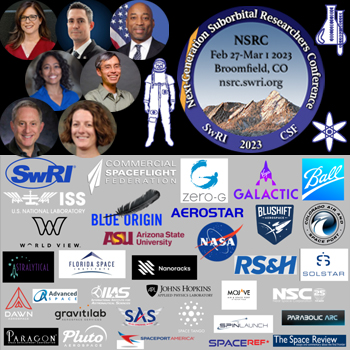
Broomfield, Colorado will once again host the Next Generation Suborbital Researchers Conference 2023 from February 27 to March 1, with main sponsors Southwest Research Institute and Commercial Spaceflight Federation Suborbital Applications Researchers Group. This will be the 8th meeting overall, held since 2010, and is supported by 32 other organizations. The program includes >20 keynote / confirmed talks, 2 opening and 12 regular sessions, 5 networking breaks, 4 panels, 2 poster sessions and a tour of Ball Aerospace (with up to 30 participants). There will be updates from (TL-BR) Karina Drees of CSF, Chris Baker of NASA, Kelvin Coleman of FAA, Sirisha Bandla of Virgin Galactic, Gary Lai of Blue Origin, and representatives from World View, CASIS, Zero Gravity Corp., Dawn Aerospace, Paragon Space Dev. Corp., Nanoracks, and Commercial Space Technologies. Alan Stern of SwRI and Addie Dove of CSF will chair the 2 opening sessions, and to follow are sessions titled Balloons, Commercial Partners, Technology Testing and Rockets, Bioastronautics and Human Factors, Flight Opportunities, Commercial Crew, and Markets & Policy. Sciences, education, public outreach, human-tended experiments, and training are also main topics. NASA solicitation for Suborbital/Hosted Orbital Flight and Payload Integration Services remains open until March 11 for providers of rocket-powered vehicles, high-altitude balloons, parabolic flights, orbital platforms, or entry, descent and landing testbeds. (Image Credits: SwRI, CSF, CASIS, Blue Origin, et al)
● Feb 27 – Mar 1 — Southwest Research Institute, Commercial Spaceflight Federation Suborbital Applications Researchers Group, Broomfield CO: Next Generation Suborbital Researchers Conference; at Omni Interlocken Hotel and Resort.
● Feb 27 – Mar 3 — Gemini Observatory, NOIR Lab, TMT, Maunakea Observatories, National Center for Earth and Space Science Education, Department of Education Hilo-Waiakea, Hilo HI: Journey Through the Universe (Journey 2023); including in-person classroom presentations and career panels.
☆ Feb 28 — ISS, Crew 6 Rendezvous & Docking, ~415-km LEO: Crew Dragon spacecraft with Astronauts Stephen Bowen, Warren “Woody” Hoburg, UAE Astronaut Sultan Al Neyadi, Russia Cosmonaut Andrey Fedyaev to dock at ISS 2:38 EST, live coverage available.
☆ Feb 28 — Apollo Asteroid 2006 BE55: Near-Earth Flyby (0.023 AU)
WEDNESDAY
★ Mar 1 — New Horizons, Kuiper Belt: NASA spacecraft to awaken today from hibernation which began June 1, 2022; will work to observe distant KBOs, and Uranus & Neptune for sunlight reflection studies.
★ Mar 1 — SpaceX, Launch Falcon 9 / OneWeb 17, LC-40, Cape Canaveral SFS FL: Falcon 9 to launch 40 satellites for OneWeb constellation.
In celebration of the 25th anniversary of the creation of the Astrophysics Group at the University of Exeter, we are pleased to announce the international...
Emanating from ~6km-wide comet with 5.3-year Solar orbit, visible in constellation Aquarius near star Delta Aquarii, fast, faint meteors peak on this night, best...
The International Research Conference is a federated organization dedicated to bringing together a significant number of diverse scholarly events for presentation within the conference...
Includes ~150 meetings covering the fields of COSPAR Scientific Commissions / Panels / Task Groups, such as SC B: The Earth-Moon System, Planets, and...
From 02 to 07 August 2026, a few thousand geoscientists across diverse disciplines will gather at the 23rd annual meeting of the Asia Oceania Geosciences...
NASA Curiosity (Mars Science Laboratory) rover surpasses another full year of operations on Mars surface today; launched Nov 26, 2011 – landed Aug 5,...
This international lunar science meeting has two objectives: to provide a platform for leading experts to review recent advances across lunar research, from the...
At CSIR International Convention Centre. Key topics are Earth Observation, Developing Space Tourism, Space Supply Manufacturing. Cultural tours are offered.
Participants will receive theoretical and hands-on training in electron imaging and X-ray spectroscopy for application to planetary samples. This training opportunity is targeted at...