Robotic Missions Probing Inner and Outer Solar System Ahead of Eventual Human Exploration
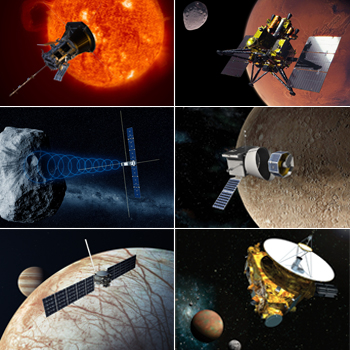
The first quarter of the 21st century has seen leaps in robotic space activity. The first asteroid sample returned by NASA is currently being analyzed at JSC, while OSIRIS-Rex (now OSIRIS-APEX) is on trajectory to Apophis, a potentially hazardous object with orbit extending from near that of Venus to near that of Earth anticipated to pass <31,600-km from Earth in 2029. NASA Psyche spacecraft set to launch October 12 via SpaceX Falcon Heavy to investigate metallic outer main belt asteroid 16 Psyche, the 10th most massive asteroid in the solar system, after 6-year transit. NASA Lucy mission will enter the third year of its 12-year mission Oct 16, and perform 450-km altitude flyby of 700-m Dinkinesh inner main belt asteroid. Further out, NASA JPL Europa Clipper set for Oct 10, 2024 launch to the icy Galilean moon. CNSA Tianwen-2 to investigate Earth quasi satellite Kamoʻoalewa and main belt comet 311P/PanSTARRS planned to launch in May 2025. Towards the inner solar system, NASA Parker Solar Probe to continue its obit of Sun until 26th perihelion in 2025, ESA Solar Orbiter nominal mission runs to 2026, with extended operations possible until 2030. ESA Hera Didymos / Dimorphos observation to launch in Oct 2024, JAXA MMX Phobos sample return planned for Sep 2024 launch, and ESA / JAXA BepiColombo to make 4th Mercury flyby Sep 5, 2024. ISRO planning 2025 Venus mission Shukrayaan-1 Chairman Somanath stating Shukrayaan-1 payloads ready. Rocket Lab also to launch to Venus in 2025, carrying MIT instruments. (Image Credits: NASA, JAXA, ESA, JHUAPL, SwRI)
MONDAY
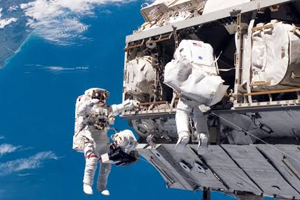
☆ Oct 9 — International Space Station,~415-km LEO: Expedition 70 seven-member crew planning for 2 USA EVAs over next 2 weeks, working with ESA-Roscosmos Complex Plasmas experiment, checking BEAM sensors, maintaining potable water filters.
☆ Oct 9 — Tiangong Space Station, ~390-km LEO: The fourth month of Shenzhou 16 mission being noted with CCTV / CNSA video, highlighting science, installation, and education achievements.
Highlights…
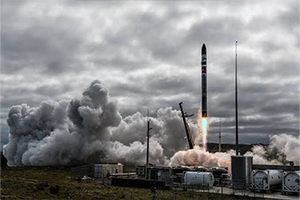
o NewSpace: Active Debris Removal by Astroscale demonstrator craft on route to Rocket Lab Launch Complex 1 in NZ, Japan government to subsidize company with US$80M through March 2028; Axiom partnering with Prada on Axiom Extravehicular Mobility Unit development; Intuitive Machines Nova-C lunar lander ready to be shipped to KSC pending SpaceX launch availability.
☆ SolarSystem: JAXA SLIM on low-energy lunar transfer following 4,992-km Moon flyby, landing NET Jan 2024; Similar mounds on Arrokoth KBO compared via New Horizons observation in SwRI study may shed light on planetesimal formation; ISRO developing 4 science payloads for Mangalyaan-2 Mars orbiter.
o Global: ESA Vega-C inaugural launch now set for late 2024 to accommodate rocket nozzle redesign; Roscosmos may move up Luna-26/7 timeline following identification of accelerometer fault which caused Luna-25 crash; Working group of Artemis Accords signatories identifies information sharing needs for lunar surface cooperation.
● Hawai’i: Hawai‘i Space Exploration Analog and Simulation (HI-SEAS) accepting applications for 1 and 2 week missions in 2024; ILOA Hawai’i updates on lunar missions / goals; UH Hawaiʻi Space Flight Laboratory technology demonstration of Hyperspectral Thermal Imager supported by $8M NASA award, will launch in 6U cubesat NET March 2024.
● = Terrestrial and… o = International terrestrial events
☾ = Moon activity
★ = Space and… ☆ = International space / astro events in Hawaii Standard Time unless noted. Add 10 hours to obtain UT (‘Universal Time’).
Malaysia Hosts 3 Major Space Conferences Back-to-Back with AOSWA, APSCC and ICONSPACE
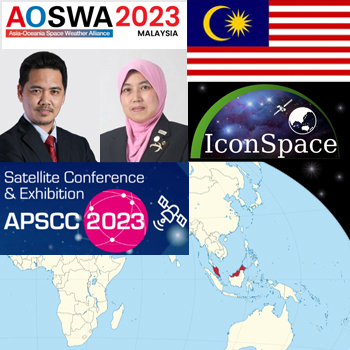
6th Asia-Oceania Space Weather Alliance Workshop (AOSWA 2023) is being held October 9-11 in Selangor. It will focus on sharing recent development in space weather observation, modeling and forecasting. The first Keynote Speech “Space Weather Forecast: Malaysia’s Distinctive Insight” is presented by Tuan Haji Azlikamil bin Napiah (Malaysia Space Agency Director General), and chaired by Mardina Abdullah (UKM Professor). The conference will see 8 sessions and representatives from Indonesia, Thailand, India, Australia, South Korea, China, Taiwan, Japan, Germany and USA. AOSWA is sponsored by Space Science Centre (ANGKASA), Institute of Climate Change (IPI), Universiti Kebangsaan Malaysia (UKM) and National Institute of Information and Communications Technology (NICT). The same hosts held 8th International Conference on Space Science and Communication (ICONSPACE 2023) on Oct 3-4 in Penang – which had an international advisory committee of 26 members from 13 countries and Taiwan. The Asia-Pacific Satellite Communications Council (APSCC) Satellite Conference themed “Re-Uniting Space in Asia” is being held in Kuala Lumpur on Oct 10-12. It will convene about 500 attendees, 130 speakers and 150 companies for CEO panel discussions, case studies, interviews, awards ceremony, networking events and private tours. The main topics will focus on geostationary satellite and the New Space market as well as regulatory and other industry issues. (Image Credits: AOSWA, MYSA, UKM, IPI, NICT, APSCC, et al)
☾ Oct 9 — Moon: At apogee, distance 405,459 km, 18:00.
☆ Oct 9 — Venus: 2.29° SSW of Regulus, 06:00.
☆ Oct 9 — Apollo Asteroid 2023 TL: Near-Earth Flyby (0.021 AU).
Ongoing…
☾ Sep 6 – NET Jan/March — Smart Lander for Investigating Moon (SLIM), Lunar Landing Trajectory: SLIM Moon mission 4-6 month trajectory to soft land east of Shioli crater (13.2°S, 25.2°E) on Moon near side equatorial region.
☆ Sep 6 – NET Mar — X-Ray Imaging and Spectroscopy Mission (XRISM), ~550-km LEO: XRISM undergoing 6 month check out testing phase before start of science operations to study galactic plasma.
★ NET Q4 — ULA, Launch Vulcan Centaur / Astrobotic Peregrine Lander,SLC-41, Cape Canaveral SFS FL: Astrobotic Peregrine lander to attempt to touchdown near Gruithuisen Domes, with 14 NASA payloads for Artemis Program, CMU Iris Lunar Rover, total 90 kgs of customer payloads from commercial companies and international space agencies, institutions.
☆ NET Oct 1 — ISRO, Launch GSLV L40 / Gaganyaan Test Vehicle Demonstration 1, Satish Dhawan Space Center, Sriharikota, India: Gaganyaan uncrewed capsule to be launched to 11 km for high altitude abort test; capsule should reach 15-16 km testing separation from the rocket, trajectory and parachute deployment.
TUESDAY
● Oct 10 — NASA, Washington DC and Online: News conference for OSIRIS-REx asteroid sample reveal; starts 11:00 EDT, live coverage available.
● Oct 10-11 — Lunar Surface Innovation Consortium (LSIC), Hybrid / Pittsburgh PA and Online: 2023 LSIC Fall Meeting; focusing on NASA and Space Tech vision for enabling development of lunar infrastructure at Moon South Pole for Artemis missions.
☆ Oct 11 — Apollo Asteroid 2022 UX1: Near-Earth Flyby (0.008 AU).
THURSDAY
☆ Oct 12 — International Space Station, Expedition 70 / USA EVA #89,~415-km LEO: Two members of Expedition 70 to perform ~6-hour spacewalk to collect microorganism samples and install a new high definition camera on ISS truss; starts 10:00 EDT, live coverage available.
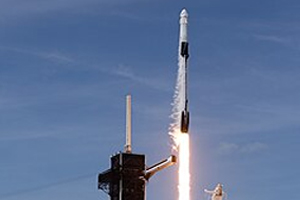
★ Oct 12 — SpaceX, Launch Falcon Heavy / Psyche Mission,LC-39A, Kennedy Space Center FL: Falcon Heavy to launch (10:16 EDT) NASA, JPL, Caltech mission to investigate all-metal asteroid Psyche for 2029 arrival; launch window open until October 25.
☆ Oct 13 — Apollo Asteroid 2021 NT14: Near-Earth Flyby (0.047 AU).
SATURDAY
☆ Oct 14 — Chinese H-alpha Solar Explorer (CHASE), 517-km SSO: First solar observatory for China known as CHASE or Xihe / 羲和 reaches 2nd full year / enters 3rd year in space since launching on this day via Long March 2D in 2021.
☾ Oct 14 — Moon: 0.65° S of Mercury, 00:00; New Moon, 07:54; 2.12° NNE of Spica, 15:00.
☆ Oct 14 — Apollo Asteroid 2008 TF: Near-Earth Flyby (0.082 AU).
SUNDAY
★ Oct 15 — Juno, Perijove 55 / 54th Science Flyby,Jupiter Orbit: NASA craft to perform Jupiter flyby during Perijove 55, its 55th close flyby of Jupiter and 54th science flyby with instruments turned on.
☾ Oct 15 — Moon: 0.94° S of Mars, 06:00.
☆ Oct 15 — Mars: with Jupiter at heliocentric opposition, 02:00.
☆ Oct 15 — Apollo Asteroid 2011 GA: Near-Earth Flyby (0.015 AU).
☆ Oct 15 — Apollo Asteroid 2007 SQ6: Near-Earth Flyby (0.049 AU).
At the Spokane Convention Center. The meeting will have a broad scope, with a wide-ranging program of science and workforce topics, and celebrating planetary...
Convene, connect, and collaborate at the 19th annual von Braun Space Exploration Symposium! This year’s event will spotlight how bold ideas, emerging technologies, and...
Themes include: Space & the Arctic; Space & AI; Space & International Collaboration. There is a Student Session, a Technical Session, a Frontier Session,...
Oslo Spaceport Norway offers monthly a knowledgeable speaker and opportunity for networking, 17:00-20:00 local time; free entry but registration required. Ground Control is for...
45 satellites to launch for Amazon Leo, formerly named Project Kuiper. This LEO mega constellation will offer broadband internet access with 3,276 satellites.
Occurring 31 October from 09:00-11:00 local time (16:00-18:00 HST, 19:00-21:00 PDT, 22:00-24:00 EDT on 30 October), this Galaxy Forum will be in hybrid format...
Originally planned around this date for Wenchang, China -- TBC (to be confirmed); As the only professional association for astronauts, ASE supports the advancement of...
Coordinating Division Division C Education, Outreach and Heritage The IAU Symposium on Innovative Research and Techniques in Astronomy Communication will take place from November...
Change clocks back 1 hour from Daylight Saving to Standard Time; does not include Hawai’i, Arizona (except the Navajo Nation), American Samoa, Guam, Northern...
ESWW is the main annual event in the European Space Weather and Space Climate calendar. It is an international meeting organised annually within the...
IAU Symposium: IAUS409 - A Journey Towards Effective Astronomy Communication; online and at National Astronomical Observatory of Japan, 2-21-2 Osawa Mitaka, Tokyo. Topics include:...
Launch Complex 1, ~39°S, Mahia Peninsula, New Zealand
iQPS Launch 9, an Earth observation satellite with Synthetic aperture radar for Japan-based imaging company iQPS, to launch on "The Sea God Surveys" mission...
Launch window 10:34am - 2:34pm local time for the 15th batch of classified satellites for a reconnaissance constellation built by SpaceX and Northrop Grumman...
Expecting senior government and executives from NASA, Firefly, Blue Origin to discuss innovation, competitive advantages and a "space industrial revolution in LEO". Capped at...
Launch Complex 1, ~39°S, Mahia Peninsula, New Zealand
iQPS Launch 10, an Earth observation satellite with Synthetic aperture radar for Japan-based imaging company iQPS, to launch on “The Mountain God Rises” mission...
Promoting the New Space Economy: The first major national meeting of the space, technology and scientific industries. Three days to connect science, industry and...