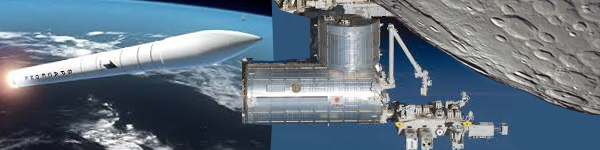
 On February 25 Space One of Japan is aiming to launch the Kairos 4-stage all-solid-fuel vehicle, taking 4 satellites to SSO. This is a critical 3rd flight to achieve orbit and prove commercial viability. So far, Kairos has not had a successful orbital insertion yet, though the company has made major progress in private Japanese launch infrastructure and technology development. Japan’s commercial space sector includes other startups and established players such as: ispace (lunar exploration and landers), Astroscale (orbital debris removal and satellite servicing), Synspective (SAR satellite imaging), GITAI (space robotics), Axelspace (microsatellites), and Japan LEO Shachu (commercial LEO modules). JAXA continues its space leadership exemplified by it being one of 5 major entities involved with the ISS, providing the Kibo (translation “Hope”) science module and commitment through 2030. Japan also accomplished the first successful asteroid sample return (Hayabusa/Hayabusa2) and was the fifth nation to soft-land on the Moon (2024 SLIM mission). It continues to advance space robotics, sustainable innovations (Lignosat), reliable launch vehicles such as H3, and was one of the original 8 signers of the Artemis Accords. The HTV-X is the only ISS cargo craft that can operate as an independent orbital satellite for up to 18 months after undocking, useful for equipment testing, before re-entry burn-up. (Image Credits: Space One, JAXA, ISS Partners, ispace)
 As an overview: Lunar Surface Innovation Consortium (LSIC) is actively recruiting experts in any of its 4 focus areas to help NASA keep the USA at the forefront of lunar exploration after forming in 2020 to harness creativity, energy and resources among academia, industry, government and nonprofits. It operates in collaboration with the NASA Space Technology Mission Directorate under the Lunar Surface Innovation Initiative and fosters communications and collaborations. This week, the Surface Power (SP) Group holds its monthly telephone conference; the other 3 groups are: In Situ Resource Utilization (ISRU), Excavation / Construction (E&C), and Crosscutting Capabilities (CC). The latter includes Extreme Environments, Extreme Access, Dust Mitigation, Lunar Simulants, and Interoperability. SP topics include solar, fuel cells, fission, low-temperature batteries, wireless and long-distance transmission, electronics and storage. ISRU – material found or manufactured on the Moon – looks at processes for collecting / purifying water, extracting oxygen / metals, and ways of achieving industrial scale for ISRU. E&C evaluates technologies to build and repair landing / launch pads, roads and habitats, including autonomous construction. These and the many CC focus areas leave room for any knowledgeable enthusiast or seasoned scientist to share ideas, understandings and proposals for human success on the Moon. (Image Credits: NASA, LSIC, JHUAPL)
 International Space Station, ~415-km LEO: Expedition 74 now has the full complement of 7 members after arrival of Dragon Crew-12. Onboard are NASA’s Chris Williams, Jessica Meir and Jack Hathaway, Roscosmos’ Sergey Kud-Sverchkov (current Station Commander), Sergei Mikaev and Andrey Fedyaev, and ESA’s Sophie Adenot of France. The crew continues to unpack cargo from Dragon capsule. Specific tasks include: wearing acoustic sensors to record respiration in microgravity; scanning veins with ultrasound; doing medical training and an emergency drill; practicing with emergency respirators; monitoring nighttime photography of Earth in near-ultraviolet wavelengths; readying a body temperature study; working with computer hardware to support medicine-manufacturing research; exploring the use of AI tools to boost crew efficiency.
Tiangong Space Station, ~390-km LEO: Shenzhou-21 crew of 3, Taikonauts Zhang Lu, Wu Fei and Zhang Hongzhang, continue celebrating Spring Festival following Chinese New Year, enjoying traditional foods such as dumplings, char siu pork, tea and apples, along with freshly baked cake from an air fryer. They have entertained themselves, their families and the public with elaborate decorations around the station, calligraphy, poetry, chants, harmonica, karaoke and flying stuffed animals. They each have 2 scheduled rest days during the festival. Naturally, they continue various science experiments, station maintenance, physical electronic monitoring, and vital exercise routines with treadmill, bicycle and resistance equipment.
 Lunar Enterprise News: Artemis 2 Launch Director Judith Charlene “Charlie” Blackwell-Thompson reports that its 4 Astronauts now re-enter soft quarantine ahead of planned March 6 launch after 2nd Wet Dress Rehearsal completes successfully, headed to Flight Readiness Review Process.
 Near-Earth Objects Close Approaches – Tue Feb 24: Apollo Asteroid 2018 RB1 (0.021 AU); Tue Feb 24: Aten Asteroid 2022 EZ6 (0.029 AU); Thu Feb 26: Apollo Asteroid 2026 CU1 (0.008 AU); Sat Feb 28: Apollo Asteroid 2007 DG8 (0.025 AU)