Countdown to 500: Long March Rocket Nears Significant Achievement
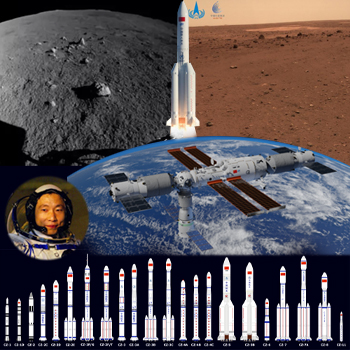
Honored as China National Space Day on April 24 is the launch of Long March 1 carrying China’s first satellite, Dong Fang Hong 1, to space in 1970. The success rate of the 498 Long March ‘Chang Zheng’ launches to date is 96.4% (480 successes, 8 partial & 10 full failures). China may reach its 500th LM launch with various satellite missions and the first flight of LM 6C variant before the end of the year. Of the LM 1-11 family, retired are LM 1, 1D, 2A, 2E, 3, 3B and 4A. The main workhorse has been LM 2 having launched 186 times. LM 2 also launched the first Taikonaut from China, Yang Liwei, into space in October 2003. The first heavy-lift rocket for China, LM 5, has launched some of the most inspiring missions including: next-generation crewed spacecraft test; Tianwen-1 Mars orbiter, lander and rover; Chang’E-5 lunar sample return; and all 3 modules for the Tiangong Space Station. Under development for a 2027 liftoff, the super-heavy LM 10 will carry crewed missions to the lunar surface and become the second human-rated launch vehicle after LM 2F. The newer LM rocket engines use more environmentally friendly, non-toxic propellants (kerosene and hydrogen). Orbital launches occur in China from four locations on land: Taiyuan, Xichang, Jiuquan, and Wenchang Space Launch Center (WSLC), and sea launches of LM 11 commenced in 2016 from a converted barge positioned in the Yellow Sea. (Image Credits: Xinhua, Li Gang, CNSA, CCTV)
MONDAY
☆ Dec 4 — International Space Station,~415-km LEO: Expedition 70 seven-member crew working with cargo from newly arrived Progress 86P, planning event to mark the 25th anniversary of the mating of the Zarya and Unity Modules.
☆ Dec 4 — Tiangong Space Station, ~390-km LEO: China releases video of Shenzhou-16 returning to Earth, and image containing full view of TSS with all 3 modules (Tianhe, Wentian, Mengtian).
Highlights…
o NewSpace: Antares 330 progressing toward mid-2025 launch following Firefly Aerospace hot fire of Miranda first stage engine; Astra Space keeps operations running with US$2.7M in new funds as long-term financing sought; mu Space working out of head office and 3 factory locations for Thailand satellite development.
☆ SolarSystem: JHUAPL-led Dragonfly mission to Titan now working toward July 2028 launch following NASA Phase C authorization; Thales to build Multi-Purpose Habitat for Italian Space Agency and Artemis Program; India developing craft for Venus (Shukrayaan) and Mars (Mangalyaan-2), as well as Gaganyaan and other satellite missions.
☆ Galaxy: Rare harmonic resonance of 6-planet system around HD110067, 100 ly from Earth observed with TESS and Cheops advances formation theory; Ultrahigh-energy cosmic ray ‘Amaterasu’ may have originated in Centaurus A per new international study published in Science; First extragalactic accretion disc discovered via ALMA being studied by international team.
o Global: ESA Ariane 6 on track for 2024 inaugural launch from Kourou, French Guiana after 426-second launch pad hot fire of Vulcain 2.1 main stage engine; Taikonauts, China aerospace experts deepen cooperation in space exploration with Hong Kong, Macao visits; JAXA launching full investigation into extent of network breach following summer cyberattack.
●USA: Starship integrated flight test 3 from TX to HI may occur in late Dec as SpaceX works on V2 successor prototype; USA and Saudi Arabia to hold technical discussion on space science and exploration per joint statement; Defense Innovation Unit soliciting second round of proposals for Hybrid Space Architecture allowing access to commercial infrastructure.
● Hawai’i: Hawaii Space Flight Laboratory spinoff company Mahina Aerospace offering 0.9-kg Hoku Sat 1U cubesat platform; NOIRLab aiming to reduce carbon footprint of Arizona, Chile & Hawai‘i facilities 50% by 2027 through increasing PV power and limiting travel; Cosmologist Michael Turner urges NSF to select either GMT or TMT proposed extremely large telescopes due to cost.
● = Terrestrial and… o = International terrestrial events
☾ = Moon activity
★ = Space and… ☆ = International space / astro events in Hawaii Standard Time unless noted. Add 10 hours to obtain UT (‘Universal Time’).
Japan Forges Ahead with Ongoing Moon, Mercury and Venus Missions; Participation in MVA and ALMA Conferences
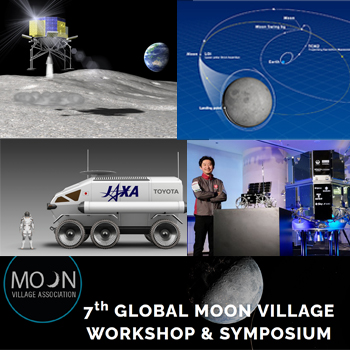
JAXA / ISAS Smart Lander for Investigating Moon (SLIM) on lunar transfer trajectory, having reached the furthest point from Earth (1,380,000 km) of its journey to the Moon in early November, now targeting lunar orbit insertion in late December and landing within 100-m of site near Shioli crater NET January 2024. Precision vision-based technology to be verified during SLIM is planned to be used during future lunar exploration such as ‘Lunar Cruiser’ crewed pressurized rover being developed with Toyota for late 2020s human missions. JAXA also is conducting Venus and Mercury planetary missions – Venus Climate Orbiter ‘Akatsuki’ begins its 9th year operating from an elliptic Venus orbit on Dec 7, while Mercury Magnetospheric Orbiter ‘Mio’, part of ESA / JAXA missions BepiColombo launched in 2018, is slated to reach 480 x 1,500 km Mercury orbit Dec 5, 2025. ispace of Japan is pressing on with its commercial HAKUTO-R lunar lander series with Mission 2 ‘Resilience’ scheduled for late 2024. Moon Village Association of Vienna is hosting its 7th Global Moon Village Workshop and Symposium in Kurashiki city and Tottori prefecture Dec 6-10. Representatives of cislunar communications company WarpSpace, rover manufacturer Dymon, Human Spaceology Center and JAXA are among scheduled participants. Several researchers from Japan will also participate in ALMA at 10 Years: Past, Present, and Future conference Dec 6-10 in Puerto Varas, Chile. NAOJ represents the East Asia division of ALMA, contributing 25% of budget with Academia Sinica and KASI. (Image Credits: JAXA, ISAS, MVA)
☾ Dec 4 — Moon: At apogee (distance 404,375 km), 09:00; at last quarter, 19:51.
☆ Dec 4 — Apollo Asteroid 2013 VX4: Near-Earth Flyby (0.013 AU).
Ongoing…
☾ Sep 6 – NET Jan/March — Smart Lander for Investigating Moon (SLIM), Lunar Landing Trajectory: SLIM Moon mission 4-6 month trajectory to soft land east of Shioli crater (13.2°S, 25.2°E) on Moon near side equatorial region.
☆ Sep 6 – NET Mar — X-Ray Imaging and Spectroscopy Mission (XRISM), ~550-km LEO: XRISM undergoing 6 month check out testing phase before start of science operations to study galactic plasma.
o Dec 3-12 — National Space Foundation, NOIRLab, International Dark-Sky Association, AURA, Online / Global: Globe at Night December Campaign; campaign to raise awareness of light pollution by inviting citizen-scientists to measure & submit night sky brightness observations.
☆ NET Dec 3-4 — China Aerospace Science and Technology, Launch Long March 2C, Jiuquan Satellite Launch Center, China: Long March rocket with unconfirmed payload to launch from Jiuquan (would be Long March 499th rocket launch).
TUESDAY
☆ Dec 5 —China Rocket, China Aerospace Science and Technology, Launch Jielong-3, Converted Barge in Yellow Sea: Second flight of solid-fuel sea launch rocket, may be carrying Xianggang satellite, 17:30 UTC.
★ Dec 5 — SpaceX, Launch Falcon 9 / Starlink Group 6-32, SLC-40 Cape Canaveral SFS FL: Next batch of Starlink satellites to launch to LEO; first stage Autonomous Spaceport Drone Ship ‘Just Read The Instructions’.
☆Dec 6— LandSpace, Launch Zhuque-2, Jiuquan Satellite Launch Center, China: LandSpace third flight of methane-fueled rocket Zhuque-2, set for 23:30 UTC.
o Dec 6 — The Andy Thomas Space Foundation, Australian Space Agency, South Australian Space Industry Centre, Sydney, New South Wales, Australia: 16th Australian Space Forum.
☆ Dec 7 — Akatsuki, Venus Orbit: JAXA first successful planetary orbiter imaging Venus atmosphere, monitoring weather changes reaches 8 full years / enters 9th year at Venus today, reached Venus 2015.
★ Dec 7 — SpaceX, Launch Falcon Heavy / X-37B Spaceplane,LC39-A, Kennedy Space Center FL: Seventh mission of X-37B, designated USSF-52, to undergo new orbital regimes, experiment with space domain awareness tech, and investigate radiation effects on materials provided by NASA.
● Dec 7 — Apollo 17, 51st Observation, Nationwide USA: Eleventh and final crewed Apollo mission, Astronauts Ronald E. Evans, Harrison H. Schmitt and Eugene A. Cernan – the “Last Man on the Moon” – are honored today as international and commercial efforts for lunar return are well underway.
☆Dec 9 — 1P / Halley’s Comet: At aphelion, 35.14 AU; comet is ~5×8 kilometers, with albedo of 0.03; closest approach to Sun will occur Jul 27, 2061.
☆ Dec 9 — Roscosmos, Launch Soyuz-2 / Ionosfera-M 1 & 2, Vostochny Cosmodrome, Russia: Soyuz rocket to launch Ionosfera ionospheric and magnetospheric research satellites for Roscosmos.
● Dec 9 —AIAA San Francisco Section, Oakland CA: 2023 AIAA Banquet; featuring Shannah Withrow-Maser speaking on Mars Ingenuity helicopter; at Oakland Aviation Museum.
☆ Dec 10 — XMM-Newton, VeryEccentric Elliptical LEO: ESA craft studying X-ray emissions, star-forming regions, galaxy clusters, environment of supermassive black holes, mapping dark matter, reaches 24 full years / begins 25th year in space today, launched 1999.
☆ Dec 10 — Apollo Asteroid 2020 HX3: Near-Earth Flyby (0.025 AU).
At the Spokane Convention Center. The meeting will have a broad scope, with a wide-ranging program of science and workforce topics, and celebrating planetary...
Convene, connect, and collaborate at the 19th annual von Braun Space Exploration Symposium! This year’s event will spotlight how bold ideas, emerging technologies, and...
Themes include: Space & the Arctic; Space & AI; Space & International Collaboration. There is a Student Session, a Technical Session, a Frontier Session,...
Oslo Spaceport Norway offers monthly a knowledgeable speaker and opportunity for networking, 17:00-20:00 local time; free entry but registration required. Ground Control is for...
45 satellites to launch for Amazon Leo, formerly named Project Kuiper. This LEO mega constellation will offer broadband internet access with 3,276 satellites.
Occurring 31 October from 09:00-11:00 local time (16:00-18:00 HST, 19:00-21:00 PDT, 22:00-24:00 EDT on 30 October), this Galaxy Forum will be in hybrid format...
Originally planned around this date for Wenchang, China -- TBC (to be confirmed); As the only professional association for astronauts, ASE supports the advancement of...
Coordinating Division Division C Education, Outreach and Heritage The IAU Symposium on Innovative Research and Techniques in Astronomy Communication will take place from November...
Change clocks back 1 hour from Daylight Saving to Standard Time; does not include Hawai’i, Arizona (except the Navajo Nation), American Samoa, Guam, Northern...
ESWW is the main annual event in the European Space Weather and Space Climate calendar. It is an international meeting organised annually within the...
IAU Symposium: IAUS409 - A Journey Towards Effective Astronomy Communication; online and at National Astronomical Observatory of Japan, 2-21-2 Osawa Mitaka, Tokyo. Topics include:...
Launch Complex 1, ~39°S, Mahia Peninsula, New Zealand
iQPS Launch 9, an Earth observation satellite with Synthetic aperture radar for Japan-based imaging company iQPS, to launch on "The Sea God Surveys" mission...
Launch window 10:34am - 2:34pm local time for the 15th batch of classified satellites for a reconnaissance constellation built by SpaceX and Northrop Grumman...
Expecting senior government and executives from NASA, Firefly, Blue Origin to discuss innovation, competitive advantages and a "space industrial revolution in LEO". Capped at...
Launch Complex 1, ~39°S, Mahia Peninsula, New Zealand
iQPS Launch 10, an Earth observation satellite with Synthetic aperture radar for Japan-based imaging company iQPS, to launch on “The Mountain God Rises” mission...
Promoting the New Space Economy: The first major national meeting of the space, technology and scientific industries. Three days to connect science, industry and...