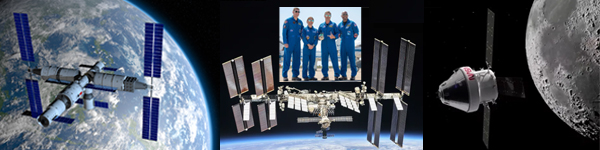
Artemis II four Astronauts are spending 9+ days on a trip around the Moon, while the International Space Station has been continuously occupied by other Astronauts for 9,000+ days. Taikonauts have been uninterruptedly on the Tiangong Space Station for 1,800+ days. For the first time in 53 years, humans are traveling to the distance of the Moon, coming back to Earth on a free-return trajectory to a Pacific Ocean splashdown on April 10, even if the Orion propulsion system doesn’t perform as planned. Although Artemis II went directly toward the Moon after launching from Earth and completing a short orbital period, Madhu Thangavelu reports results from University of Southern California’s Astronautical Engineering Studio that speculate on using the ISS to get to the Moon. Thangavelu says the ISS initial concept was to serve as a human-tended platform to integrate large vehicles for missions to the Moon and deep space. He notes the ISS orbit makes for advantageous lunar departure 3+ times per month with fully fueled upper stages, circumventing the need for orbital fueling, and that US$50M for each of 48 tourist visits yearly to the ISS in Orion or Crew Dragon, some going on to the Moon and back, would provide US$2-4B in revenue. (Image Credits: CNSA, NASA, NASA-John Kraus, ESA)
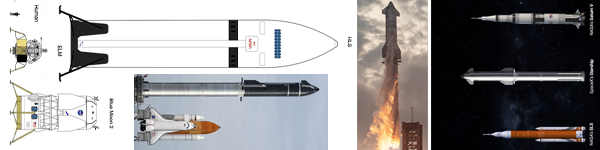
As SpaceX is preparing for its Initial Public Offering of stock, President and Chief Operating Officer Gwynne Shotwell discussed Starship. As well as humans, Starship will carry satellites for an AI system. Shotwell believes flights for the system will be similar to launches for Starlinks that rode aboard Falcon 9s on ~74% of the 165 uses of the rocket in 2025. She states, “The more consistent the operation, the safer,” which is vital for human travel. A NASA OIG report last month called-out shortcomings in SpaceX’s Starship lunar lander, requesting: landing demonstrations that simulate full-scale crewed missions, more Starship manual control, stability of its tall body during touchdown, and elevator redundancy. NASA ASAP noted in its recent report, “the physics of landing a six-to-one height-to-width ratio vehicle on the uneven, poorly lit polar lunar surface seems questionable at best,” referring to 52m-tall Starship (14-story-building height). Starship Flight 12 atop new V3 Super Heavy Booster tripling payload capacity is now NET late this month from the new Pad 2 at Starbase. The test flight, featuring Booster 19 and Ship 39, will focus on testing the advanced Raptor 3 engines and refined thermal protection, continuing the flight profile of earlier missions with a planned, non-orbit-insertion, splashdown-focused trajectory. (Image Credits: SpaceX)
☆ International Space Station, ~415-km LEO: This week Expedition 74 seven-members training for and planning to dock Cygnus XL supply mission, delivering the latest microgravity quantum physics research gear, stem-cell-therapy tests and food, water and other supplies; filling and flushing spacesuit water systems that regulate Astronaut body temperature on spacewalks; testing new ways to quickly download large amounts of data; conducting an emergency drill to practice cardiopulmonary resuscitation and other medical responses.
☆ Tiangong Space Station, ~390-km LEO: Shenzhou-21 three-member crew are cleaning and maintaining spacesuits after spacewalk that continued installation of space debris protection; are collecting samples for vestibular dynamics project involving the inner ear mechanism responsible for balance, spatial orientation, and coordinating eye movements with head motion; carried out a system-wide-pressure-emergency drill, coordinating with ground control; tested cabin air for cleanliness including level of volatile organic compounds.
◐ Lunar Enterprise News: Scientists are looking forward to working with Artemis 2 crew for observations of the Moon with human eyes during closest lunar approach, for near-real-time, nuanced value which is complementary to sharper images available from orbiters. The Astronauts may see an eclipse of the Sun by the Moon. They will wear radiation, sleep and movement monitors. There is also an “organs on a chip” experiment using cells from the four astronauts to study effects of radiation and microgravity.
 Near-Earth Objects Close Approaches – Mon Apr 6: Apollo Asteroid 2021 GN6 (0.014 AU); Tue Apr 7: Apollo Asteroid 2011 FT9 (0.008 AU); Tue Apr 7: Apollo Asteroid 2024 TB7 (0.012 AU); Sat Apr 11: Apollo Asteroid 2026 FE7 (0.022 AU