“Mountain on the Moon” Challenges ISDC / NewSpace America, Asia Commercial Landers
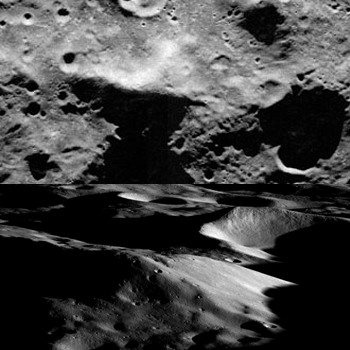
Malapert Summit high ground, chosen as 1 of the 13 potential landing sites for the Artemis III Human Return to the Moon, at about 5,000-meters altitude is located within ~4 degrees latitude of the lunar South Pole. The potential of the “Mountain on the Moon” includes well known assets and advantages such as extended power / solar energy availability, relatively favorably thermal environment, 24/7 direct sight of Earth for continuous observation and communication, oversight of lunar South Pole large areas, including possibly Shackleton Rim, and southern sky galaxy / stellar astronomy superlatives — amongst other advantages. Recent research from the 55th LPSC has provided further analysis of Malapert Mountain crater morphology / PSR locations, maximum average temp of 193.3K / minimum 46.4K, and importance / feasibility of EVAs to collect regolith from temperature ranging 35-50K. No national government or independent organization to date has projected a single Malapert Summit landing mission — except for International Lunar Observatory Association of Hawai’i with its ILO-1 flagship mission aiming for a 2026 landing and pursuing interest from landing providers, international partners and payloads. NASA and visionary bold American New Space enterprise/s may declare and mount such a Malapert Summit mission before one/s from corresponding national space agencies or NewSpace enterprises in China, India or Japan, which are quite likely sooner rather than later. (Image Credits: NASA, GSFC, Arizona State University, M. Robinson)
MONDAY
☆ May 20 — International Space Station,~415-km LEO: Expedition 71 seven-member crew replacing Cold Atom Lab science module 4, confirming fit of SpaceX Dragon Contingency Suit; may become 9-member crew with Starliner CST-100 launch if launch happens this week.
☆ May 20 — Tiangong Space Station, ~390-km LEO: Shenzhou 18 three-member crew now one month into 6-month mission, continue to work with Tianzhou-7 which include >260 supply items among the ~5,600 kg of cargo.
Highlights…
o NewSpace: Vast CEO Max Haot to update on Haven-1 artificial gravity commercial space station at 42nd ISDC; The Exploration Company advancing Nye capsule / Mission Bikini precursor on Ariane 6 with hire of Blue Origin human spaceflight director Mark Kirasich; Sierra Space preparing to ship Dream Chaser spaceplane to KSC following successful thermal and vibration testing at Stennis Space Center.
☆ SolarSystem: Juno visible-light cameras JunoCam and Stellar Reference Unit reveal structure of Europa ice shell from 355-km flyby; John Deere distributor Landmark Implement looking for space weather prediction service following ‘historic’ geomagnetic storm-caused tractor GPS malfunction.
☆ Galaxy: Exoplanet WASP-193b identified by WASP survey is second-least dense known planet at 0.059 g / cm, to be further characterized via JWST; Project Hephaistos analysis of Gaia, 2MASS and WISE data finds 7 Dyson sphere techno-signature candidates.
o Global: Humanoid robot named ‘Taikobot‘ undergoing final tests at National University of Defence Technology in Changsha China prior to TSS deployment; International law experts call for UN parliament to regulate space resource extraction; USA Ambassador to India indicates Vyomanaut has been selected to participate in ISS mission this year.
●USA: Voyager Space commissioned by MSFC to adapt Bishop airlock for crewed NASA Deep Space Transport concept under code ‘Red Knight’; Starliner launch to ISS dependent on helium leak investigation; USAF to fine Boeing / Lockheed consortium ULA for delay of Vulcan Centaur 2nd flight, required for DoD certification.
● Hawai’i: High-redshift merging quasars being studied through Hyper SuprimeCam (HSC) Subaru Strategic Program (SPP) survey; Pan-STARRS being used to characterize largest known protoplanetary disk IRAS 23077 dubbed ‘Dracula’s Chivito’ 100 ly distant; MIT study using Magellan telescopes in Chile and NASA Infrared Telescope Facility on Maunakea suggests SPECULOOS-3b lacks atmosphere.
● = Terrestrial and… o = International terrestrial events
☾ = Moon activity
★ = Space and… ☆ = International space / astro events in Hawaii Standard Time unless noted. Add 10 hours to obtain UT (‘Universal Time’).
Rocket Lab Continues Pioneering NewSpace Launch Services While Laying Groundwork for Interplanetary Missions
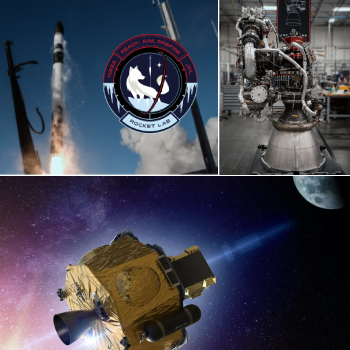
Electron launch vehicle is being prepared for May 22 (07:15 UTC) launch from Rocket Lab Launch Complex 1 on Māhia Peninsula, Aotearoa (New Zealand). The 47th launch attempt of small-lift (300kg to LEO) Electron will carry NASA / JPL Polar Radiant Energy in the Far-InfraRed Experiment (PREFIRE) 1, the first of two 6U cubesats equipped with miniaturized IR spectrometers to be inserted into 82°-98°, near polar inclinations with 470 – 650 km altitude to provide definitive measurement of polar warming. Prefire-1 is the 6th orbital mission Rocket Lab is launching in 2024, with ~20 slated for the remainder of the year. Frequent launch cadence along with satellite bus manufacture (including US$515M / 18 craft SDA contract) at 3,716 m2 Long Beach facility give credibility to the public company’s (NASDAQ: RKLB) revenue projection of $105-110M in Q2. Rocket Lab is currently testing its methane / liquid oxygen-fueled Archimedes engine set to power medium-lift (13,000 kg to LEO) Neutron rocket, planned to make inaugural flight from Mid-Atlantic Regional Spaceport (MARS) at NASA Wallops Flight Facility NET 2025. Farther out, Venus Life Finder (VLF) mission with MIT is to send a 38-diameter, 20.4 kg probe with aerosol photometer fitted in search of organic molecules in the Venusian atmosphere NET January 2025. VLF will be the second use of the Photon Explorer interplanetary stage first utilized on CAPSTONE, which remains in 1,500 x 70,000 km halo orbit around Moon since Nov 2022 insertion. (Image Credits: Rocket Lab, NASA)
● May 20 — National Academies of Sciences, Engineering and Medicine, Committee on Astrobiology and Planetary Sciences (CAPS) of Space Studies Board, Washington DC: CAPS Meeting on New Frontiers Mission List Review.
☾ May 20 — Moon: 1.28° NE of Spica, 02:00.
☆ May 20 — Apollo Asteroid 2015 WO1: Near-Earth Flyby (0.019 AU)
TUESDAY
★ May 21 — United Launch Alliance, Boeing, Launch Atlas V / CST-100 Starliner Crew Flight Test, SLC-41, Cape Canaveral SFS FL: Boeing to launch Astronauts Sunita Williams and Butch Wilmore to ISS on first crewed flight of Starliner.
☆ May 22 — Rocket Lab, Launch Electron / PREFIRE 1, Launch Complex, Mahia Peninsula, New Zealand: Launch of mission dubbed “Ready, Aim, PREFIRE” the first of 2 NASA polar energy monitoring satellites.
★ May 22 — SpaceX, Launch Falcon 9 / Starlink 6-63, SLC-40, Cape Canaveral SFS: Next batch of Starlink satellites to launch for SpaceX constellation.
☆ May 24 — Venus: Jupiter and Pleiades within circle of diameter 4.82°, 09:00.
☆ May 24 — Apollo Asteroid 2017 BH30: Near-Earth Flyby (0.063 AU)
SATURDAY
● May 25 — 63rd Observation John F. Kennedy 1st Moon Speech,USA / Worldwide: NASA Artemis program to land 1st Woman and Person of Color on Moon is well underway as today is recognized for Kennedy declaring to congress “I believe that this Nation should commit itself to achieving the goal, before this decade is out, of landing a man on the Moon and returning him safely to Earth” (1961).
☆ May 25 — Amor Asteroid 2024 HP2: Near-Earth Flyby (0.014 AU)
SUNDAY
☆ May 26 — Apollo Asteroid 2024 JY1: Near-Earth Flyby (0.044 AU)
At the Spokane Convention Center. The meeting will have a broad scope, with a wide-ranging program of science and workforce topics, and celebrating planetary...
Convene, connect, and collaborate at the 19th annual von Braun Space Exploration Symposium! This year’s event will spotlight how bold ideas, emerging technologies, and...
Themes include: Space & the Arctic; Space & AI; Space & International Collaboration. There is a Student Session, a Technical Session, a Frontier Session,...
Oslo Spaceport Norway offers monthly a knowledgeable speaker and opportunity for networking, 17:00-20:00 local time; free entry but registration required. Ground Control is for...
45 satellites to launch for Amazon Leo, formerly named Project Kuiper. This LEO mega constellation will offer broadband internet access with 3,276 satellites.
Occurring 31 October from 09:00-11:00 local time (16:00-18:00 HST, 19:00-21:00 PDT, 22:00-24:00 EDT on 30 October), this Galaxy Forum will be in hybrid format...
Originally planned around this date for Wenchang, China -- TBC (to be confirmed); As the only professional association for astronauts, ASE supports the advancement of...
Coordinating Division Division C Education, Outreach and Heritage The IAU Symposium on Innovative Research and Techniques in Astronomy Communication will take place from November...
Change clocks back 1 hour from Daylight Saving to Standard Time; does not include Hawai’i, Arizona (except the Navajo Nation), American Samoa, Guam, Northern...
ESWW is the main annual event in the European Space Weather and Space Climate calendar. It is an international meeting organised annually within the...
IAU Symposium: IAUS409 - A Journey Towards Effective Astronomy Communication; online and at National Astronomical Observatory of Japan, 2-21-2 Osawa Mitaka, Tokyo. Topics include:...
Launch Complex 1, ~39°S, Mahia Peninsula, New Zealand
iQPS Launch 9, an Earth observation satellite with Synthetic aperture radar for Japan-based imaging company iQPS, to launch on "The Sea God Surveys" mission...
Launch window 10:34am - 2:34pm local time for the 15th batch of classified satellites for a reconnaissance constellation built by SpaceX and Northrop Grumman...
Expecting senior government and executives from NASA, Firefly, Blue Origin to discuss innovation, competitive advantages and a "space industrial revolution in LEO". Capped at...
Launch Complex 1, ~39°S, Mahia Peninsula, New Zealand
iQPS Launch 10, an Earth observation satellite with Synthetic aperture radar for Japan-based imaging company iQPS, to launch on “The Mountain God Rises” mission...