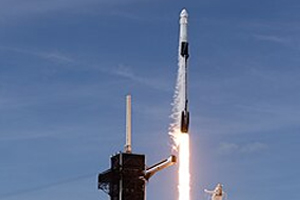
Starship Test Flight 4 Set for June 5 to Last >1 Hour, Test Re-Entry Survivability
The next dramatic Starship flight launching from Starbase at Boca Chica, Texas is scheduled for NET June 5 at 07:00 CDT — and dependent on FAA approval. It will be the fourth flight of a Starship and second flight this year (Flight 3 occurred March 14). The primary objectives are to achieve a successful landing burn of Super Heavy booster and controlled entry of Starship toward proving recoverability / reusability, as opposed to the goal of achieving orbit or performing fuel transfer or other tests. The Super Heavy Boost (B11) is planned to perform a landing burn and soft splashdown in the Gulf of Mexico about 7 minutes, 4 seconds after launch. The Ship 29 upper stage will attempt a controlled entry splashdown in the Indian Ocean at 1 hour, 5 minutes, 48 seconds. Starship 33 Raptor engines cutoff is planned at 8 minutes, 23 seconds setting up the ~39-minute coast phase, followed by the entry phase where it will become transonic, then subsonic before attempting a landing flip at 1 hour, 5 minutes, 38 seconds. Among software and hardware adaptations made after Starship Flight 3, more thrusters were added to help control Starship’s attitude, and the Super Heavy hot-stage ring will be jettisoned at 3 minutes, 54 seconds to reduce booster mass. This ring will likely be replaced in the future to fit into the rapid reusability scheme. (Image Credits: SpaceX)
MONDAY
☆ Jun 3 — International Space Station,~415-km LEO: Expedition 71 seven-member crew working with Progress 88P cargo, Astrobee – CLINGERS free flyer operation experiment, and preparing for June EVAs; planned to be nine-member crew if Starliner CST-100 crew launches June 1-2.
☆ Jun 3 — Tiangong Space Station, ~390-km LEO: Shenzhou 18 three-member crew monitoring new installations and work performed after 8.5-hour EVA in which pace debris protection devices were installed; future EVAs to install external payloads.
Highlights…
o NewSpace: ispace Japan in discussions with GISTDA of Thailand for potential future cislunar collaborations; Galactic Energy of Beijing successfully launches second Ceres 1 rocket from Yellow Sea platform, planning 4 sea launches this year; Pixxel of Bengaluru to launch 6 hyperspectral imagery satellites this year; Agnikul Cosmos working toward orbital flights after successfully launching 1st Agnibaan rocket.
☆ Galaxy: Euclid data from 24-hour observation period reveals 11 million objects in visible light and 5 million in infrared, including rogue exoplanets; existence of exoplanet HD 26965 bVulcan called into question after NASA instrument at Kitt Peak detects inherent wobble of parent star 40 Eridani A; NASA Milky Way Lego set containing 3,091 pieces continues to inspire public since May release.
CO School of Mines Assembles the 24th Space Resources Roundtable
Space Resources Roundtable will be convened by SRR President Dr Angel Abbud-Madrid at Colorado School of Mines, Golden, June 6-9, for world experts to address space-resource activities in cislunar space and on the Moon, Mars and small bodies, with presenters from Australia, Japan, Luxembourg, Canada, Germany, Turkey, United Kingdom, Hong Kong, South Korea and USA. Space agencies, research organizations, mining companies, manufacturers for transport, infrastructure and robotics, and analysts of legal, policy, economic, ethics and environmental issues will present technical papers and posters and engage in roundtable discussions. The Keynote Presentation is by Morgan Hendry of Blue Origin on “Space Resources for the Benefit of Earth.” NASA updates include Gerald Sanders on In-Situ Resource Utilization (ISRU), Julie Kleinhenz on PRIME-1 and VIPER, which is planned for mission to the Moon South Pole to view concentration of water, ice. Other NASA updates to include testing results of TRIDENT Drill, ice formation experiments, effect of vacuum on Ultrasonic Penetrator, Regolith Simulant, Lunabotics Competition on Site Preparation, the International Mars Ice Mapper Mission, and Comparing Hydroponics and Regolith Growth and Evolution (CHRGE). Jun Shimada will report on JAXA’s Study of a Lunar ISRU Pilot Plant, Antonino Salmeri on Space Law, Laszlo Keszthelyi of USGS on Lunar Resource Assessments, and Thomas Gardner and Jeffrey Parker of Advanced Space on cislunar navigation. (Image Credits: CO School of Mines, SRR, PTMSS, NASA, SpaceResources.lu)
★ NET Jun / Summer — SpaceX, Launch Falcon 9 / Polaris Dawn Crew Dragon, LC-39A, Kennedy Space Center FL: Jared Isaacman, Scott Poteet, Sarah Gillis, and Anna Menon to reach apogee of 1,400 km, perform first commercial EVA, and test spacecraft-to-spacecraft communications with Starlink on 5-day mission.
o NET Jun — Australia Space Agency, Adelaide, Australia: Two national industry consortia AROSE and EPE & Lunar Outpost Oceania rover prototypes to be developed by this month.
TUESDAY
☾ Jun 4 — Chang’E-6 Lunar Sample Return, Apollo Basin, South Pole–Aitken Basin: Up to 2kg of samples from lunar regolith taken from scooping / drilling on lunar farside from a depth of up to 2 meters now in return capsule to be returned to Inner Mongolia, China.
● Jun 4 — The Washington Post, Washington DC: The New Space Age with the Artemis II Crew; a discussion with NASA Astronauts Reid Wiseman, Victor Glover and Christina Koch and Canadian Space Agency Astronaut Jeremy Hansen.
☾ Jun 4 — Moon: At superior conjunction with Sun, 1.735 AU from Earth, 05:00; with Jupiter and Pleiades within circle of diameter 5.21°, 23:00.
☆ Jun 4 — Mercury: 0.12° SE of Jupiter, 01:00.
☆ Jun 4 — Venus: At superior conjunction with Sun, 1.735 AU from Earth, 05:00
☆ Jun 4 — Apollo Asteroid 2024 KF: Near-Earth Flyby (0.063 AU)
WEDNESDAY
★ NET Jun 5 — SpaceX, Launch Starship (4th Flight), Starbase, Boca Chica TX: Starship Flight Test 4 with Super Heavy Booster 11 (splashdown in Gulf of Mexico) and Ship 29 upper stage (powered descent in Indian Ocean after 1 hour, 5 min, 48 sec mission).
☆ Jun 5 — Tiangong Space Station, ~390-km LEO: Today marks 2nd full year / starts 3rd year of continuous Human occupation of TSS; Shenzhou 14 three-member crew launched on this day in 2022, beginning occupation.
● Jun 5-7 — National Academies of Sciences, Engineering and Medicine Space Studies Board (SSB), Washington DC: 2024 Spring Meetings of SSB.
☾ Jun 5 — Moon: 0.41° SE of Pleiades, 00:00; 4.5° N of Jupiter, 03:00; with Mercury and Jupiter within circle of diameter 4.77°, 04:00; 4.5° N of Mercury, 07:00.
☆ Jun 5 — Venus: At brightest, magnitude -3.91°, 00:00.
☆ Jun 5 — Apollo Asteroid 2008 YN2: Near-Earth Flyby (0.026 AU)
THURSDAY
● Jun 6-7 — NSF-NASA-DOE Astronomy and Astrophysics Advisory Committee (AAAC), Alexandria VA and Online: Meeting of the AAAC.
☾ Jun 6 — Moon: New Moon, 02:39; 4.5° N of Venus, 04:00.
☆ Jun 6 — Mars: Winter solstice for Mars northern hemisphere, 19:00.
☆ Jun 6 — Aten Asteroid 2021 LW3: Near-Earth Flyby (0.024 AU)
FRIDAY
☆ Jun 7 — Daytime Arietid Meteors: Meteor shower offers up to 30 per hour, they streaming from a radiant point in constellation Aries.
☾ Jun 7 — Moon: 4.1° N of M35 cluster, 07:00.
☆ Jun 7 — Mercury: 5.3° NNW of Aldebaran, 16:00.
☆ Jun 7 — Aten Asteroid 2024 BD4: Near-Earth Flyby (0.063 AU)
SATURDAY
● Jun 8-13 — Space Northwest, New Space Nexus, The Museum of Flight, USSF, Air Force Research Lab, et al,Seattle WA: Seattle Space Week 2024; 6 different venues
At the Spokane Convention Center. The meeting will have a broad scope, with a wide-ranging program of science and workforce topics, and celebrating planetary...
Convene, connect, and collaborate at the 19th annual von Braun Space Exploration Symposium! This year’s event will spotlight how bold ideas, emerging technologies, and...
Themes include: Space & the Arctic; Space & AI; Space & International Collaboration. There is a Student Session, a Technical Session, a Frontier Session,...
Oslo Spaceport Norway offers monthly a knowledgeable speaker and opportunity for networking, 17:00-20:00 local time; free entry but registration required. Ground Control is for...
45 satellites to launch for Amazon Leo, formerly named Project Kuiper. This LEO mega constellation will offer broadband internet access with 3,276 satellites.
Occurring 31 October from 09:00-11:00 local time (16:00-18:00 HST, 19:00-21:00 PDT, 22:00-24:00 EDT on 30 October), this Galaxy Forum will be in hybrid format...
Originally planned around this date for Wenchang, China -- TBC (to be confirmed); As the only professional association for astronauts, ASE supports the advancement of...
Coordinating Division Division C Education, Outreach and Heritage The IAU Symposium on Innovative Research and Techniques in Astronomy Communication will take place from November...
Change clocks back 1 hour from Daylight Saving to Standard Time; does not include Hawai’i, Arizona (except the Navajo Nation), American Samoa, Guam, Northern...
ESWW is the main annual event in the European Space Weather and Space Climate calendar. It is an international meeting organised annually within the...
IAU Symposium: IAUS409 - A Journey Towards Effective Astronomy Communication; online and at National Astronomical Observatory of Japan, 2-21-2 Osawa Mitaka, Tokyo. Topics include:...
Launch Complex 1, ~39°S, Mahia Peninsula, New Zealand
iQPS Launch 9, an Earth observation satellite with Synthetic aperture radar for Japan-based imaging company iQPS, to launch on "The Sea God Surveys" mission...
Launch window 10:34am - 2:34pm local time for the 15th batch of classified satellites for a reconnaissance constellation built by SpaceX and Northrop Grumman...
Expecting senior government and executives from NASA, Firefly, Blue Origin to discuss innovation, competitive advantages and a "space industrial revolution in LEO". Capped at...
Launch Complex 1, ~39°S, Mahia Peninsula, New Zealand
iQPS Launch 10, an Earth observation satellite with Synthetic aperture radar for Japan-based imaging company iQPS, to launch on “The Mountain God Rises” mission...