Lunar Surface Science and LunarCubes 2024 Workshops Focus on Next-Gen Mission Concepts
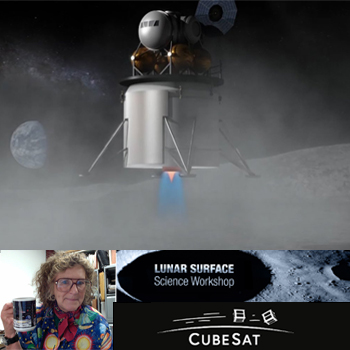
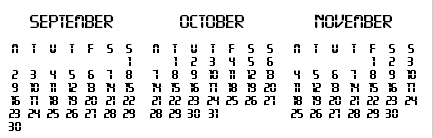
The 25th virtual session of the Lunar Surface Science Workshop (LSSW) is being held September 17-18 by LPI, USRA and NASA with theme ‘Plume-Surface Interactions.’ The LSSW series began in 2020 to determine what science could be done and experiments deployed by Artemis crew on the surface of the Moon and has expanded to include science input for Commercial Lunar Payload Services (CLPS) and other lunar spacecraft. This workshop will focus on understanding rocket exhaust-induced plume-surface effects at lunar touchdown as regards general safety, protecting hardware / lunar environment, and conducting science experiments. Goals would be to identify potential community knowledge gaps / areas for collaboration and potentially shape future instrumentation / missions. Also this week is the LunarCubes 2024 meeting on Sep 21 as part of the September 19-21 Appalachian Space Technology & Research Advancement Conference (ASTRA-Con) at Morehead State University (Kentucky). The LunarCubes Working Group is choosing ‘Moon Shot Moon Bots’ as the theme of the 4-hour meeting. Pamela Clark (pictured) of the Space Science Center and Tod Mesirow are the originators of the decade-old concept of Moon Bots, that is, “multi-platform flyover / multi-encounter / rover mobility with commercial off-the-shelf cell phone ‘payload’ technology,” which needs an update that includes today’s technology. (Image credits: Morehead Univ., NASA, Langley Research Center, USRA, LPI)
MONDAY
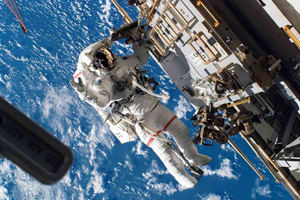
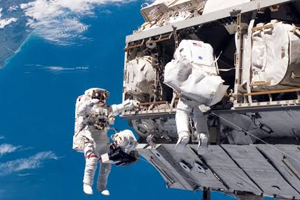
☆Sep 16 — International Space Station,~415-km LEO: Expedition 71 seven Astronauts and Boeing Starliner CST-100 two members welcome newly-arrived Soyuz MS-26 Cosmonauts Ovchinin & Vagner and NASA Astronaut Pettit; studies are being done of blood clotting with megakaryocyte cell cultures, effects of moisture on plants grown in space with lettuce, and if vision changes in astronauts can be avoided with B vitamins.
☆Sep 16 — Tiangong Space Station, ~390-km LEO: Shenzhou 18 three-member crew will be sent various bricks made from simulated lunar soil to determine which will be most suitable for building structures on the Moon; one type will have been heated to 1,000°C using electromagnetic induction in a sintering furnace, creating a brick in just 10 minutes.
o Sep 16-20 — Novaspace Group, Airbus, ArianeSpace, IntelSat, Milbank, Paris, France: World Space Business Week; 27th year, The Westin, full registration €3,600.
● NET Sep 15 — SpaceX, Polaris Dawn, Earth Splashdown: Polaris Dawn crew of Isaacman, Poteet, Gillis and Menon arriving back to Earth, splashing down off the coast of Florida, after first orbital test mission and EVAs.
●Sep 15-17 — Advanced Maui Optical and Space Surveillance Technologies (AMOS), Millennium Space Systems, Space Generation Advisory Committee (SGAC),Maui HI:7th annual EMER-GEN® with mentoring / networking for young professionals and students interested in careers in space.
● = Terrestrial and… o = International terrestrial events
☾ = Moon activity
★ = Space and… ☆ = International space / astro events; in Hawaii Standard Time unless noted. Add 10 hours to obtain UT (‘Universal Time’).
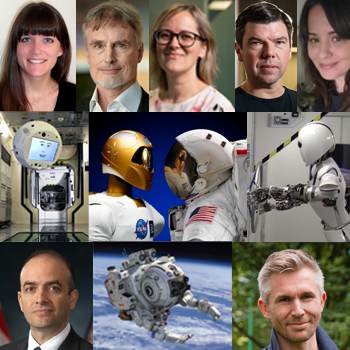
Two conferences this week focus on the uses of artificial intelligence (AI) for space missions. The European Space Agency and International Academy of Astronautics are convening SPAICE 2024: AI in and for Space in the UK September 17-19 to allow “fertile ground for novel ideas and trends” that have potential for a profound impact. Presentations by attendees from 25 countries include 45 oral / 62 poster and have 8 general themes with largest numbers covering onboard AI or navigation / control. Keynote speakers are Angela Schoellig from Technical University of Munich, Jürgen Schmidhuber representing institutions in both Switzerland and Saudi Arabia, Katja Hofmann of Microsoft Research, Ryan S. McClelland of NASA, Ioana Ciucă from Australian National University. New York City sees the U.S. premiere of documentary film AI AND ROBOTICS: A Near Future You’re Not Prepared For the evening of September 17. Produced by David Savage and Harvey Nash companies, with 36 locations globally, it features interviews with AI experts from The National Robotarium in Scotland, the Estonian Government, which has been a leader in using AI, and prominent academics. Following the film, a panel discussion led by NASA Goddard Chief AI Officer Omar Hatamleh may echo themes mentioned at the UK premiere discussion of maintaining the human element in decision-making, allowing innovation and not mistaking AI for a friend. AI autonomous systems and predictive analytics are assisting space missions. (Pictured L-R top: Schoellig, Schmidhuber, Hofmann, McClelland, Ciucă; L-R bottom: Hatamleh, Savage. Image credits: Airbus, NASA, DFKI, Georgia Tech, NashSquared, Microsoft, respective speakers)
o Sep 17-19 — ESA, Harwell, United Kingdom:SPAICE: AI in and for Space; unified conference on Space and Artificial Intelligence at European Centre for Space Applications and Telecommunications (ECSAT).
☆ Sep 18 — Apollo Asteroid (2024 RH8): Near-Earth Flyby (0.021 AU)
THURSDAY
● Sep 19 — Space Renaissance, New York NY / Online:Space 18th SDG hybrid workshop for public discussion on re-examination / possible amendment of the Space 2030 Agenda.
●Sep 19 — STEAMSPACE Education Outreach,Online: Cities in Space Podcast; Episode 6 guest astronaut candidate Dr. Shawna Pandya speaks on space medicine, 30 minutes.
☆ Sep 19 — Apollo Asteroid (2015 SH): Near-Earth Flyby (0.004 AU)
FRIDAY
★ Sep 20 — Juno, Perijove 65 / 64th Science Flyby,Jupiter Orbit: NASA craft to perform Jupiter flyby during Perijove 65, its 65th close flyby of Jupiter and 64th science flyby with instruments turned on.
☆ Sep 22 — September Equinox: The Sun rises exactly in east traveling through sky for 12 hours, sets exactly in west; every place on Earth experiences a ~12-hour day; 02:42.
At the Spokane Convention Center. The meeting will have a broad scope, with a wide-ranging program of science and workforce topics, and celebrating planetary...
Convene, connect, and collaborate at the 19th annual von Braun Space Exploration Symposium! This year’s event will spotlight how bold ideas, emerging technologies, and...
Themes include: Space & the Arctic; Space & AI; Space & International Collaboration. There is a Student Session, a Technical Session, a Frontier Session,...
Oslo Spaceport Norway offers monthly a knowledgeable speaker and opportunity for networking, 17:00-20:00 local time; free entry but registration required. Ground Control is for...
45 satellites to launch for Amazon Leo, formerly named Project Kuiper. This LEO mega constellation will offer broadband internet access with 3,276 satellites.
Occurring 31 October from 09:00-11:00 local time (16:00-18:00 HST, 19:00-21:00 PDT, 22:00-24:00 EDT on 30 October), this Galaxy Forum will be in hybrid format...
Originally planned around this date for Wenchang, China -- TBC (to be confirmed); As the only professional association for astronauts, ASE supports the advancement of...
Coordinating Division Division C Education, Outreach and Heritage The IAU Symposium on Innovative Research and Techniques in Astronomy Communication will take place from November...
Change clocks back 1 hour from Daylight Saving to Standard Time; does not include Hawai’i, Arizona (except the Navajo Nation), American Samoa, Guam, Northern...
ESWW is the main annual event in the European Space Weather and Space Climate calendar. It is an international meeting organised annually within the...
IAU Symposium: IAUS409 - A Journey Towards Effective Astronomy Communication; online and at National Astronomical Observatory of Japan, 2-21-2 Osawa Mitaka, Tokyo. Topics include:...
Launch Complex 1, ~39°S, Mahia Peninsula, New Zealand
iQPS Launch 9, an Earth observation satellite with Synthetic aperture radar for Japan-based imaging company iQPS, to launch on "The Sea God Surveys" mission...
Launch window 10:34am - 2:34pm local time for the 15th batch of classified satellites for a reconnaissance constellation built by SpaceX and Northrop Grumman...
Expecting senior government and executives from NASA, Firefly, Blue Origin to discuss innovation, competitive advantages and a "space industrial revolution in LEO". Capped at...
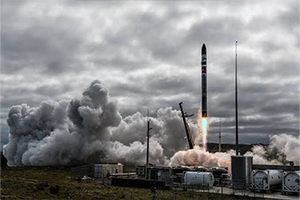
Launch Complex 1, ~39°S, Mahia Peninsula, New Zealand
iQPS Launch 10, an Earth observation satellite with Synthetic aperture radar for Japan-based imaging company iQPS, to launch on “The Mountain God Rises” mission...