Western Australia Space Week Sees 2 Space Meetings, APRSAF-30 + IPSEC
Perth, Australia’s sunniest city, is hosting 2 conferences late November in its delightful Spring season, during Western Australia Space Week. A joint reception is evening of Nov 26. Both conferences offer the same exhibition hall Nov 26-28 and the same technical tours on Nov 25 to the Australian Automation and Robotics Precinct, University of Western Australia or Fugro SpAARC in the morning, and Curtin University in the afternoon. Fugro SpAARC is building the AROSE Lunar Trailblazer Rover, and 4 Indo-Pacific Space and Earth Conference (IPSEC) speakers are from the company. Curtin University offers 7 IPSEC speakers. IPSEC day of 100+ speakers is Nov 26, with a welcome by Enrico Palermo, Head of the Australian Space Agency (ASA), and an astronaut panel. Then, 3 tracks focus on AI for space, venture capital, mining. Nov 27 has Space Cyber Workshop 10:30-14:30. Asia-Pacific Regional Space Agency Forum (APRSAF-30) expects participation by 300+ people from 40+ countries / regions / organizations for its working groups and initiatives on Nov 25-26, which include space legislation / policies, robotics, space agriculture, Earth-monitoring from space and education. Its plenary Nov 28 has greetings by Enrico Palermo, as well as a panel on space sustainability moderated by Evie Kendal of Australia’s Swinburne University of Technology. This is followed by space activities reports of many countries and reports of the working groups / initiatives. Nov 29 has a 30th year commemorative session, economic presentations and awards. (Image credits: APRSAF, IPSEC, Enrico Palermo, Evie Kendal)
MONDAY
☆Nov 25 — International Space Station, ~415-km LEO: Expedition 72 seven-member crew unloading fresh food and supplies from newly arrived (via Soyuz rocket) Progress 90 spacecraft; Progress 89 fired thrusters 5.5 minutes to dodge space debris.
☆Nov 25 — Tiangong Space Station, ~390-km LEO: Shenzhou crew oversaw first life-cycle cultivation of vertebrates in a space station with 43-day life-cycle of zebra fish, genome of which has 70%+ similarity to that of humans; the fish swam upside-down, spun and looped due to microgravity, were in a closed system with plants producing oxygen for them / they producing food for the plants.
★ Nov 25 — Juno, Perijove 67 / 66th Science Flyby,Jupiter Orbit: NASA craft to perform Jupiter flyby during Perijove 67, its 67th close flyby of Jupiter and 66th science flyby with instruments turned on.
★ Nov 25 — SpaceX, Launch Falcon 9 / Starlink Group 6-76, Space Launch Complex 39A, Kennedy Space Center FL: Satellites for Starlink mega-constellation; launch cost ~US$52M, NET 17:31 HST (launch window open 4 hours).
o Nov 25-28 — American Institute of Aeronautics and Astronautics (AIAA),Online / Melbourne, Australia; Region VII Student Conference; for worldwide high school and college students other than North America; Swinburne University of Technology.
o Nov 25-28 — Australia In Space Magazine, et al,Perth, Australia; Indo-Pacific Space and Earth Conference; 100+ speakers from 20 countries; tech tours Nov 25, conference Nov 26 (1-day Student Pass Aus$199), Exhibition Nov 26-28; Aus$699, at Crown Hotel.
TUESDAY
☆ Nov 26 — LandSpace, Zhuque-2E / Unknown Payload, Launch Area 96, Jiuquan Satellite Launch Center, China: Medium-sized rocket, liquid oxygen / methane powered, able to take 6,000 kg into 200 km LEO, or 4,000 kg into 500 km SSO; 16:00 HST (launch window open to 17:09 HST).
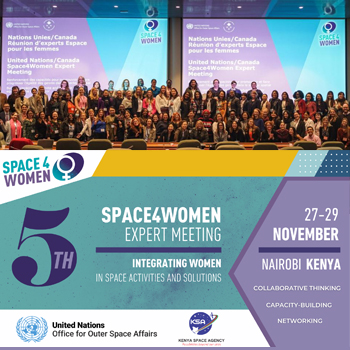
5th UNOOSA Space for Women (Space4Women) Event Held in Nairobi, Kenya
The latest edition of the Space for Women Expert Meeting, with theme “Integrating women in space activities and solutions” is being held November 27-29, 2024 in Nairobi, Kenya and online. Past events were held in USA, UAE, South Korea and Canada, gathering experts and decision-makers from national space agencies, governments, NGOs, international organizations, United Nations entities, private commerce and academia. Last year’s event in Canada had about 70 participants. (Image credits: UNOOSA)
Ongoing…
● Sep 4 – Nov 25 —NASA, Online:Lunar Navigation Challenge; ahead of Artemis mission, 2 prizes available for invention of orienteering aid and device to map bottom of Shackleton Crater.
★ NET Nov — Blue Origin, Launch New Glenn / Blue Ring, LC 36A, Cape Canaveral SFS FL: Maiden New Glenn flight, to carry Blue Origin Blue Ring payload tug; initial USSF National Security Space Launch certification flight.
o Nov 24-28 — Center of Space Exploration (COSE) Ministry of Education, Chongqing University, Beijing Institute of Technology, et al, Chongqing, China: ICSHE 2024: International Conference on Space Habitation and Exploitation; topics are Progress of International Lunar / Planetary Exploration, Space Habitation / Construction of Extraterrestrial Ecosystem, Development / Utilization of Space Science / Technology; 600-2400CNY, US$83-332.
☾ Nov 27 — Moon: 0.41° NE of Spica, occultation, 03:00.
☆ Nov 27 — Aten Asteroid (2023 RS2): Near-Earth Flyby (0.074 AU)
THURSDAY
☆ Nov 28 — Apollo Asteroid (2024 TZ9): Near-Earth Flyby (0.060 AU)
FRIDAY
☆ Nov 29 — Apollo Asteroid (2018 DC4): Near-Earth Flyby (0.048 AU)
SATURDAY
☆ Nov 30 — Roscosmos, Launch Soyuz 2.1a Fregat-M / Kondor-FKA No. 2, Vostochny Cosmodrome Site 1S, Siberia, Russia: Small civilian radar Earth observation satellite designed by NPO Mashinostroyeniya, can survey 10 km swath or detailed spot, ground resolution 1-30 m from SSO; launch cost ~US$80M.
☾ Nov 30 — Moon: New Moon, 20:21; 0.30° ESE of Antares, 22:00.
☆ Nov 30 — Apollo Asteroid (2019 JN2): Near-Earth Flyby (0.023 AU)
☾ Dec 1 — Chang’E-5,Mons Rümker, Oceanus Procellarum, Moon (43° N, 51.9° W): CE-5 lander as part of sample return mission reaches 4 full years / enters 5th year on lunar surface, having landed on this day in 2020, with sample return launching from the Moon 2 days later.
☆ Dec 1 — Deep Space: James Webb Space Telescope finds 3 massive galaxies in early Universe (with similar mass to the Milky Way) after expectations that only small ones would exist within the first billion years after the Big Bang.
● Dec 1 — American Institute of Aeronautics and Astronautics (AIAA),Online: Nominations due today for 2025 Trailblazing STEM Educator Award for K-12 teachers of Science, Technology, Engineering, Math; 23:59 EST.
At the Spokane Convention Center. The meeting will have a broad scope, with a wide-ranging program of science and workforce topics, and celebrating planetary...
Convene, connect, and collaborate at the 19th annual von Braun Space Exploration Symposium! This year’s event will spotlight how bold ideas, emerging technologies, and...
Themes include: Space & the Arctic; Space & AI; Space & International Collaboration. There is a Student Session, a Technical Session, a Frontier Session,...
Oslo Spaceport Norway offers monthly a knowledgeable speaker and opportunity for networking, 17:00-20:00 local time; free entry but registration required. Ground Control is for...
45 satellites to launch for Amazon Leo, formerly named Project Kuiper. This LEO mega constellation will offer broadband internet access with 3,276 satellites.
Occurring 31 October from 09:00-11:00 local time (16:00-18:00 HST, 19:00-21:00 PDT, 22:00-24:00 EDT on 30 October), this Galaxy Forum will be in hybrid format...
Originally planned around this date for Wenchang, China -- TBC (to be confirmed); As the only professional association for astronauts, ASE supports the advancement of...
Coordinating Division Division C Education, Outreach and Heritage The IAU Symposium on Innovative Research and Techniques in Astronomy Communication will take place from November...
Change clocks back 1 hour from Daylight Saving to Standard Time; does not include Hawai’i, Arizona (except the Navajo Nation), American Samoa, Guam, Northern...
ESWW is the main annual event in the European Space Weather and Space Climate calendar. It is an international meeting organised annually within the...
IAU Symposium: IAUS409 - A Journey Towards Effective Astronomy Communication; online and at National Astronomical Observatory of Japan, 2-21-2 Osawa Mitaka, Tokyo. Topics include:...
Launch Complex 1, ~39°S, Mahia Peninsula, New Zealand
iQPS Launch 9, an Earth observation satellite with Synthetic aperture radar for Japan-based imaging company iQPS, to launch on "The Sea God Surveys" mission...
Launch window 10:34am - 2:34pm local time for the 15th batch of classified satellites for a reconnaissance constellation built by SpaceX and Northrop Grumman...
Expecting senior government and executives from NASA, Firefly, Blue Origin to discuss innovation, competitive advantages and a "space industrial revolution in LEO". Capped at...
Launch Complex 1, ~39°S, Mahia Peninsula, New Zealand
iQPS Launch 10, an Earth observation satellite with Synthetic aperture radar for Japan-based imaging company iQPS, to launch on “The Mountain God Rises” mission...