X-Ray Imaging and Spectroscopy Mission (XRISM) Begins Next Year in Space
Japan's X-Ray Imaging and Spectroscopy Mission (XRISM), studying galactic plasma, surpasses another full year in space today at ~550-km LEO, having launched 2023.
Japan's X-Ray Imaging and Spectroscopy Mission (XRISM), studying galactic plasma, surpasses another full year in space today at ~550-km LEO, having launched 2023.
Officials will brief on H3 launch rocket, HTV-X resupply vehicle, Martian Moon Exploration project, Hayabusa2, challenges to Japanese astronauts, and more.
48-hour hackathon in French and English for space enthusiasts, programmers, designers, engineers, entrepreneurs and students; 2800+ local events and online
To discuss the scientific achievements from the first two years of observations from the JAXA/NASA X-Ray Imaging and Spectroscopy Mission, XRISM. The X-Ray Imaging and Spectroscopy Mission (XRISM), launched on September 7th, 2023, is a collaborative mission between JAXA and NASA, with contributions from over 70 institutions in Japan, the […]
Launch of Japan Aerospace Exploration Agency (JAXA) first upgraded HTV cargo vehicle, HTV-X1, to the International Space Station. Hawai'i Time for launch is October 20 at 15:58. Japan Aerospace Exploration Agency (JAXA) hereby announces the launch schedule of new unmanned cargo transfer spacecraft 1 (HTV-X1) aboard the 7th H3 Launch […]
The APRSAF-31 will be held in Cebu City, Philippines on 18 November to 21 November 2025, under the theme “Empowering the Region through Space Ecosystems in Action”. APRSAF, as an open and flexible space forum for the Asia-Pacific region, consistently promotes international collaboration for the peaceful uses of space. In […]
Join “Space Industry Connect” Bridging the Asia-Pacific Space Ecosystem at APRSAF-31 in Cebu As a program partner, SPACETIDE is supporting the Space Industry Connect (SIC) business matching event as an official program of the 31st Asia-Pacific Regional Space Agency Forum (APRSAF-31), taking place in Cebu, Philippines, on November 20, 2025. […]
The International Conference on Space Robotics (iSpaRo) is a new conference aiming to provide a framework for scientists and industry experts to engage in fruitful discussions and share their insights on the emerging topic of Space Robotics. In the last decade, the advances in in-orbit servicing and satellite operations, the […]
Japan Aerospace Exploration Agency (JAXA) Hayabusa surpasses 11 full years in space today; launched Dec 3, 2014, returned samples to Earth in 2020, and now in extended mission to flyby asteroid 98943 Torifune in 2026 and rendezvous with 1998 KY26 in 2031.
Navigation system satellite intended to assist in urban canyons and mountainous areas because of inclined, elliptical geosynchronous orbit. "22" designation on H3 rocket indicates 2 engines on main stage and 2 boosters.
From 1300-1600 JST at Miraikan Hall; led by the Artemis program, which is being carried out through international cooperation, humanity is returning to the Moon and even further afield, toward Mars. Human space exploration is now entering a new phase. The launch of "Artemis II", a lunar orbit mission by […]
Second annual observation of JAXA lunar landing Moon near side equatorial region in 2024 and Japan becoming 5th country to successfully land on Moon.
1st test flight of vertical-takeoff-and-vertical-landing RV-X small rocket (6.76 m tall, 1.83 m dia., 3,138 kg); 2nd test flight planned for March 14. RV-X is the first of two flight experiments planned by JAXA in developing a reusable 1st stage for a next-generation launch vehicle. A 2nd vehicle planned to […]
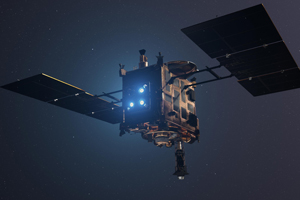
JAXA Hayabusa 2 mission to flyby S-type asteroid 98943 Torifune within 1 to 10 km of the asteroid's surface at a relative velocity of approximately 5 km/s. The mission is planned to rendezvous with asteroid 1998 KY26 in 2031, after returning samples from (162173) Ryugu to Earth in 2020.
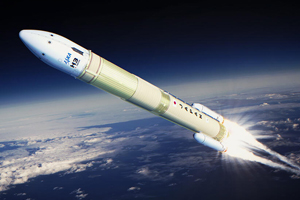
(No earlier than 10 Aug) Japan to launch the MICHIBIKI No. 7 | Quasi-Zenith Satellite System (QZS-7) navigation satellite. Launch window remains open through August 31, with flight times available in September as well.
Japan's X-Ray Imaging and Spectroscopy Mission (XRISM), studying galactic plasma, surpasses another full year in space today at ~550-km LEO, having launched 2023.
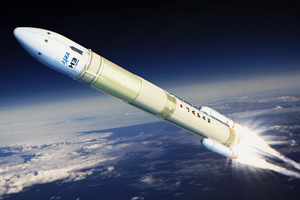
Launch Oct 19 at 3:41 pm EDT (Oct 20, 4:41 am JST), Japan's first Mars mission is planned to conduct observations of Mars, Phobos & Deimos, to land on Phobos to collect samples and return them to Earth. Led by JAXA with major contributions from international partners including NASA, ESA, […]