21st Century Humanity – A Multi World Species: The Moon, Mars and Solar System Complete
|
MONDAY
|
 Spacemonth 2016 and the 47th Observation of Humans becoming a Multi World Species with Apollo 11 in 1969 are celebrated this July. As candidates vie for U.S. Presidency, we note nearly 44 years since Humans were on the Moon or even past LEO. The USA can reassert itself as a pioneering leader in space, go many steps beyond the current Mars focus and capitalize on investments made in human space exploration. Progress is vital toward permanent bases on other Worlds starting with the Moon. America’s next frontier could be the Moon South Pole with its peaks of eternal light, water ice and continuous line of sight communications to Earth allowing for solar-powered bases, and eventual fuel-depots to launch toward next endeavors at Mars, Jupiter, Saturn and Beyond for Solar System Complete exploration. The science, technology, economic and species survival benefits depend on 21st Century visionary leadership, and should not be ignored or postponed. The political candidates, from the two major parties dating back to the 19th century, make supportive references to the space program and commercial space enterprise, but a contemporary and ambitious message of “Women on the Moon” and “Moon, Mars, Solar System Complete” could inspire 21st Century leadership similar to that of John F. Kennedy “We choose to go to the Moon”, Neil Armstrong “One giant leap for Mankind”, and “We came in Peace for all.” (Image Credit: NASA, SAIC, Pat Rawlings, ESA)
 = All times
for terrestrial events in local time unless noted.
 = All times for international terrestrial events in local time unless noted.
 = All times for space events, and…
 = All times for international space / astro events in Hawaii Standard Time unless noted. Add 10 hours to obtain UT (‘Universal Time;’ Greenwich, England).
Weekly Planet Watch – Evening Planets: Mercury (WNW), Venus (WNW), Mars (SW), Jupiter (W), Saturn (SW); Morning Planets: Uranus (SE), Neptune (SE).
Galaxy New Worlds / Exoplanets Come into Focus as Deep Space Awareness Broadens
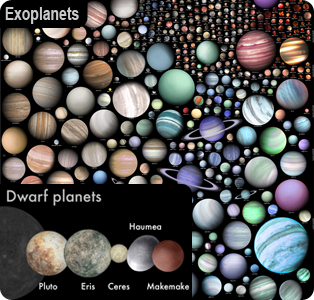
With Juno arriving at Jupiter, New Horizons zipping past Pluto toward the Kuiper belt and Kepler scouting out thousands of exoplanets, there is rising momentum toward deep space research and exploration. The Institute of Astrophysics and Space Science and the University of Porto are holding the 4th Azores International Advanced School: Asteroseismology and Exoplanets – Listening to the Stars and Searching for New Worlds in Azores, Portugal July 17-27. The NASA Nexus for Exoplanet System Science (NExSS) and Astrobiology Institute are hosting the Exoplanet Biosignatures Workshop Without Walls in Seattle WA Jul 17-19. Galaxy Forums in Kansas (Aug 13) and possibly at Scarsdale High School in New York (Sep 23) will feature Exoplanet matters. The Kepler space telescope in its redefined K2 mission is cooperating with W. M. Keck Observatory in Hawai`i, the twin Gemini North and South telescopes in Hawaii and Chile, the Automated Planet Finder of University of California Observatories and the Large Binocular Telescope in Arizona to confirm Exoplanet discoveries. The latest announcement validates 104 new worlds out of 197 candidates spotted during the first year of the Kepler reboot. It seems certain that there are billions, if not trillions or quadrillions of planets in our Galaxy. Even within our own Solar System there are fascinating new worlds to explore and more to be discovered. Some projections indicated there may be 200 Dwarf Planets in the Kuiper Belt and up to 10,000 in the Oort Cloud beyond. So far 5 are officially recognized: Pluto, Eris, Haumea, Makemake and Ceres. (Image Credit: NASA, Hubble/STSI, M. Vargic) |
Jul 25 — Communitech, Kitchener, Ontario, Canada: Big Data Open House, MaxQ Accelerator Day; to discuss Canada first space data accelerator program MaxQ, free, 13:00-14:30.
Continued from…
|
TUESDAY
Jul 26 — SETI Institute, Mountain View CA: SETI Institute Weekly Colloquium: Bringing Nuclear Power to Mars; Frank Shu, Professor Emeritus, UC Berkeley
Jul 26-29 — Lunar and Planetary Institute, Boulder CO: Conference: Enceladus and the Icy Moons of Saturn; at Hotel Boulderado.
Jul 26 — Moon: At last quarter, 13:00.
Jul 26 — Apollo Asteroid 2016 NE39: Near-Earth flyby (0.017 AU).
Jul 26 — Amor Asteroid 2016 NW15: Near-Earth flyby (0.035 AU).
WEDNESDAY
Jul 27-29 — NExSS, NASA Astrobiology Institute (NAI), Exoplanet Exploration Program (ExEP), Seattle WA: Exoplanet Biosignatures Workshop Without Walls and Exoplanet Biosignatures Study Analysis Group (SAG 16).
Jul 27-29 — Military School of Engineering (Escuela Militar de Ingeniería – EMI), La Paz, Bolivia: Aerospace Bolivian Conference.
Jul 27 — Moon: At perigee (distance 369,263 km), 01:38.
Jul 27 — Amor Asteroid 2016 NS16: Near-Earth flyby (0.079 AU).
THURSDAY
Jul 28 — ExoMars 2016, Trajectory Correction Maneuver, Mars Trajectory: ESA spacecraft to perform TCM today, expected to enter Mars orbit Oct 16 and release Schiaparelli lander for Oct 19 landing.
Jul 28 — Cassini OTM-455, Saturn Orbit: Spacecraft conducts Orbital Trim Maneuver #455 today.
Jul 28 — United Launch Alliance, Launch Atlas 5 / NROL-61, Cape Canaveral AFS FL: United Launch Alliance Atlas 5 rocket, designated AV-065, to launch classified payload for U.S. National Reconnaissance Office.
Jul 28 — Canadian Space Commerce Association, Toronto, Ontario, Canada: CSCA Bi-monthly Meeting; featuring Hassan Khan, CEO of Quantius and Bennett Leong, Rocketry Lead at University of Toronto Aerospace Team.
Jul 28 — W. M. Keck Observatory, Rob & Terry Ryan Foundation, Honoka’a HI: Astronomy Talk: The Remaining 95 Percent: Insights From Gravitational Lensing; with UCLA astronomer Tommaso Treu, 19:00.
Jul 28 — Harrogate Astronomical Society, Harrogate, United Kingdom: Odyssey Dramatic Presentation: Uranus – George’s Planet; 19:30.
Jul 28 — Moon: 9.1° S of Pleiades, 08:00.
FRIDAY
Jul 29 — The Space Show, Online / Tiburon CA: Dr. David Livingston talks with Author and Embry-Riddle Aeronautical University Assistant Professor Erik Seedhouse and students.
Jul 29 — Moon: 0.29° NNW of Aldebaran, 01:00.
Jul 29 — Aten Asteroid 2016 NF23: Near-Earth flyby (0.081 AU).
SATURDAY
Jul 30 — International Academy of Astronautics (IAA), Istanbul, Turkey: IAA Academy Day; Canceled.
Jul 30 – Aug 7 — Committee on Space Research, ZARM Center of Applied Space Technology and Microgravity, Istanbul, Turkey: 41st COSPAR Scientific Assembly; Canceled.
Jul 30 — Southern Delta-Aquarids Meteor Shower Peak: Shower mostly visible in Southern Hemisphere, meteors appear to radiate from Aquarius constellation; shower may produce up to 20 meteors per hour with speed of ~41 km/sec.
Jul 30 — Moon: 5.8° S of M35, 01:00.
Jul 30 — Mercury: 0.29° NNE of Regulus, 09:00.
SUNDAY
Jul 31 – Aug 5 — American Astronomical Society, Avalon CA: Conference: Mapping the Pathways of Galaxy Transformation Across Time and Space.
Jul 31 – Aug 5 — Asia Oceania Geosciences Society, Beijing, China: 13th Annual Meeting of the Asia Oceania Geosciences Society (AOGS).
Jul 31 – Aug 6 — Rencontres du Vietnam, HCM International University, Quy Nhon, Vietnam: 4th Vietnam School of Astrophysics: Stellar Astrophysics.