SpaceX Falcon Heavy Debut and a Multi World Civilization
|
MONDAY Ongoing…
|
 Feb 5 —
  Feb 5 — NewSpace:
  Feb 5 — USA: Reactions to President
 = All times
for terrestrial events in local time unless noted.
 = All times for international terrestrial events in local time unless noted.
 = All times for space events, and…
 = All times for international space / astro events in Hawaii Standard Time unless noted. Add 10 hours to obtain UT (‘Universal Time’).
Weekly Planet Watch – Evening Planets: Uranus (SW), Neptune (WSW); Morning Planets: Mars (ESE), Jupiter (ESE), Saturn (SE).
Juno to Perform 11th Jupiter Flyby; ESA Advancing JUICE Mission for 2022
|
Feb 5 — Cornell University, Ithaca NY: Lecture: Ghosts of Atmospheres Past – Modeling Atmospheric Formation and Evolution on Rocky Planets; Laura Schaefer of Arizona State University.
Continued from…
|
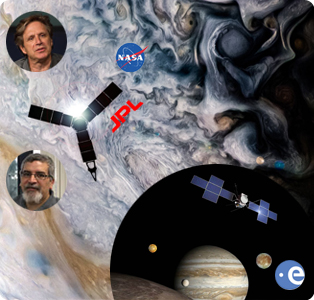 The most massive planet in the Solar System, Jupiter, is set to have NASA Juno craft speed by at 209,000 km/h during its 11th perijove and 10th science flyby February 7. It will pass within 3,500 km of swirling cloud tops with all 9 of its instruments collecting data and images. The US$1.1B mission aims to determine the mass of the unseen core of Jupiter, measure the abundance of water, study auroras, and map gravity and magnetic fields, as well as variations in atmospheric composition. Scott Bolton is the Principal Investigator for Juno and Ed Hirst recently took over as Project Manager. Juno 53-day orbit and science investigation is set to continue at least until 2020. In May of 2022 European Space Agency is planning to launch Jupiter Icy moons Explorer (JUICE) with 10 science instruments and an experimental payload, reaching Jupiter October 2029 for at least 3.5 years of study on Jupiter atmosphere and magnetosphere, and Galilean moons Io, Europa, Ganymede and Callisto. The JUICE Industrial Consortium Workshop is being held Feb 8 at ESTEC featuring prime contractor Airbus Defence and Space. With multiple core teams, subgroups, equipment and services to develop JUICE, this meeting will present current mission status, near and far future critical activities and allow participants to learn how they fit into the large-scale JUICE development while producing high-quality, fast-paced work. to maintain the launch date on 20th of May 2022. (Image Credit: NASA, ESA, JPL-Caltech, SwRI, MSSS, Kevin Gill, Aubrey Gemignani)
TUESDAY
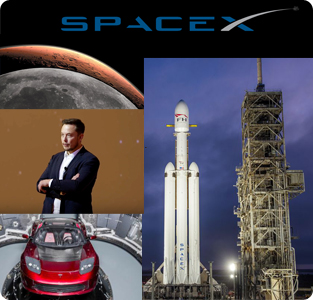
Feb 6 — SpaceX, Launch Falcon Heavy Demo, Cape Canaveral AFS FL: SpaceX maiden falcon heavy planned to launch today, launch window 13:30-16:00; will attempt to place Tesla Roadster on an Earth escape trajectory into Hohmann transfer orbit; rocket consists of standard Falcon 9 rocket core with 2 additional strap-on boosters (total of 27 Merlin engines).
Feb 6 — Lunar and Planetary Laboratory, University of Arizona, Tucson AZ: Colloquium: Reading Between the Lines – Using Fractures to Understand Icy Satellite Evolution; Alyssa Rhoden, Assistant Professor ASU, 15:45 at Kuiper Space Sciences Room 312.
Feb 6-9 — National Tsing Hua University, NRAO, Academia Sinica Institute of Astronomy and Astrophysics (ASIAA), Hsinchu, Taiwan: Magnetic Fields or Turbulence: Which is the critical factor for the formation of stars and planetary disks?
Feb 6-11 — APT Showfreight, StarHub, Axxel Marketing, Singapore: Singapore Airshow 2018.
Feb 6 — Aten Asteroid 2017 YS8: Near-Earth Flyby (0.077 AU).
Feb 6 — Aten Asteroid 2018 BB5: Near-Earth Flyby (0.090 AU).
WEDNESDAY
Feb 7 — Juno, Perijove 11 / 10th Science Close Flyby, Jupiter Orbit: NASA craft in 53-day orbit to come within ~3,500 km of Jupiter cloud tops during Perijove 11, its 11th close flyby of Jupiter and 10th science flyby with instruments turned on.
Feb 7— Goddard Space Flight Center, NASA, Greenbelt MD: Colloquium: Black Hole Entropy, Entanglement, and Holographic Spacetime; Ted Jacobson from University of Maryland, 15:30.
Feb 7-8 — Commercial Spaceflight Federation, Federal Aviation Administration, Washington DC: 21st Annual FAA Commercial Space Transportation Conference; at Ronald Reagan Building and International Trade Center.
Feb 7-9 — Australian Centre for Space Engineering Research, University of New South Wales, Sydney, Australia: Conference: International Global Navigation Satellite Systems (IGNSS) 2018.
Feb 7 — Moon: At last quarter, 05:55; 4.1° NNE of Jupiter, 12:22.
Feb 7 — Apollo Asteroid 505657 (2014 SR339): Near-Earth Flyby (0.054 AU).
THURSDAY
Feb 8 — ESA, ESTEC, Airbus Defence and Space, Noordwijk, The Netherlands: JUICE Industrial Consortium Workshop.
Feb 8 — Lunar and Planetary Society, Houston TX: Cosmic Explorations Speaker Series: Titan; by Ralph Lorenz from Johns Hopkins University.
Feb 8 — Cornell University, Ithaca NY: Lecture: Beyond Detection – Constraining Properties of Exoplanet Atmospheres; Nikole Lewis of Space Telescope Science Institute.
Feb 8 — AIAA San Francisco Section, Mountain View CA: Dinner Meeting – The Century of Biology on Earth and Beyond; with Jill Tarter of SETI, 19:00.
Feb 8 — Institute of Physics in Ireland, Dublin Institute for Advanced Studies, British Council, Northern Ireland Science Festival, Dublin, Ireland: Standing Up For Science Workshop; at Dublin City University.
Feb 8-9 — ESA, ESTEC, Noordwijk, The Netherlands: Space Science Horizon 2000 A Retrospective View.
Feb 8 — Moon: 4.3° N of Mars, 21:00.
Feb 8 — Apollo Asteroid 2018 BJ3: Near-Earth Flyby (0.056 AU).
FRIDAY
Feb 9 — Royal Astronomical Society, London, United Kingdom: Royal Astronomical Society Ordinary Meeting; From the Outer to the Inner Solar System – The Origin and Evolution of Comets; The Epoch of Reionisation – UK Community Update.
Feb 9-10 — Astronomy Now Magazine, London, United Kingdom: European AstroFest 2018; at Kensington Conference & Events Centre .
Feb 9 — Moon: 9.4° N of Antares, 01:00; 0.93° S of 4 Vesta, 02:35.
Feb 9 — Apollo Asteroid 2015 BN509: Near-Earth Flyby (0.033 AU).
Feb 9 — Apollo Asteroid 2018 BL1: Near-Earth Flyby (0.043 AU).
SATURDAY
NET Feb 10 — SpaceX, Launch Falcon 9 / Paz, Vandenberg AFB CA: SpaceX Falcon 9 rocket to launch Paz radar imaging / Earth observation satellite for Hisdesat of Madrid, Spain.
Feb 10 — Jet Propulsion Laboratory, NASA, Pasadena CA: Educator Workshop: Engineering a Journey to Mars; for teachers of grades 4-12.
Feb 10 — Aten Asteroid 2015 FV118: Near-Earth Flyby (0.093 AU).
SUNDAY
Feb 11 — Roscosmos State Corporation, Launch Soyuz / Progress 69P (MS-08), Baikonur Cosmodrome, Kazakhstan: Russia Soyuz rocket to launch Progress 69P resupply ship to ISS.
Feb 11— International Astronautical Federation, Online: Applications Due for 2018 IAF Emerging Space Leaders Grant Programme, held in conjunction with 69th International Astronautical Congress to be held Oct 1-5.
Feb 11 — Moon: at apogee (distance 405,701 km), 04:00; 2.5° N of Saturn, 05:00; 5.1° N of Antares, 16:00.
Feb 11 — Aten Asteroid 2014 WQ202: Near-Earth Flyby (0.039 AU).
Feb 11 — Apollo Asteroid 1991 VG : Near-Earth Flyby (0.047 AU).
Feb 11 — Apollo Asteroid 2016 WQ3: Near-Earth Flyby (0.095 AU).