IAA Holds 6th Planetary Defense Conference in Washington DC Area
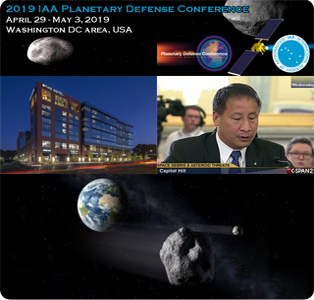
International Academy of Astronautics convenes its biannual Planetary Defense Conference April 29 – May 3 at The Hotel at University of Maryland in College Park. International experts will gather to analyze dangers from and contingencies to avoid asteroid and comet collisions with Earth – including keynote speakers NASA Administrator James Bridenstine, Romana Kofler of UNOOSA, Rüdiger Jehn of ESA, and Hary Harel Ben-Ami of Israel Space Agency, as well as representatives of ISRO and Russian Academy of Sciences. A detailed impact scenario designed by Jet Propulsion Laboratory will be conducted, allowing participants to practice engaging with their peers in such a hypothetical event, attempting to answer questions such as “[Despite being] able to deflect the object… could our leaders provide funding and make other decisions at critical points?”. The imagined object (dubbed ‘2019 PDC’ by Minor Planet Center) would be a 100- to 300-meter asteroid that has a 1% chance of impacting on April 29, 2027, about 0.38 au (57 million kilometers or 35 million miles) away when discovered, approaching Earth at about 14 km/s (8.5 mi/s or 31,000 mph). According to the Center for Near Earth Object Studies, 19,985 known Near Earth Objects exist – 987 of which are 1 km in diameter or larger. Asteroid Day, a UN sanctioned global event dedicated to raising awareness of asteroids supported by the B612 Foundation, occurs on June 30. (Image Credits: NASA, IAA, B612 Foundation) |
MONDAY Highlights…
|
 Apr 29 —
  Apr 29 — NewSpace: Momentus Space announces
  Apr 29 — USA: Human Return to Moon “within 5 years” stressed by Administrator Bridenstine, public awaits details for committed funding, planning, strategies;
 = All times
for terrestrial events in local time unless noted.
 = All times for international terrestrial events in local time unless noted.
 = All times for space events, and…
 = All times for international space / astro events in Hawaii Standard Time unless noted. Add 10 hours to obtain UT (‘Universal Time’).
Weekly Planet Watch – Evening Planets: Mars (W), Jupiter (SE); Morning Planets: Mercury (E), Venus (E), Saturn (S).
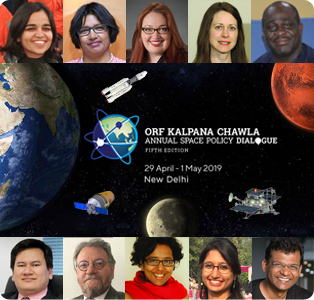
5th Kalpana Chawla Space Policy Dialogue Conference in New Delhi to Promote Space Enterprise, International Cooperation |
Apr 29-30 — Cubesat Developers Workshop, California Polytechnic State University, San Luis Obispo CA: Interplanetary Smallsat Conference 2019.
Continued from…
TUESDAY
|
Apr 30 — NASA Advisory Council Technology, Innovation & Engineering (TI&E) Committee, Washington DC: NAC TI&E meeting; 08:00-17:00.
Apr 30 — Lunar and Planetary Laboratory, University of Arizona, Tucson AZ: Colloquium: Ocean Dynamics of Outer Solar System Satellites; by Krista Soderlund from University of Texas at Austin, 15:45.
Apr 30 — Moon: 3.3° SSE of Neptune, 52° from Sun in morning sky, 01:00.
WEDNESDAY
NET May – Jun — Hayabusa2, Asteroid 1999 JU3: JAXA craft planning for 2nd / last sample collection touchdown within this period.
May 1 — Deep Space, Kuiper Belt: New Horizons sending data from Ultima Thule flyby back to Earth, initial imagery indicates no atmosphere or moons; craft has enough fuel for at least one more KBO mission.
May 1 — Commerce-Justice-Science (CJS) Subcommittee of the Senate Appropriations Committee, Washington DC: Senate Appropriations Subcommittee will hold a hearing on NASA FY2020 budget request, webcast available.
May 1 — May Day, Northern Hemisphere, Earth: Spring festival commonly held on this day (or about halfway between the spring equinox and the summer solstice) to celebrate fertility, fire, and abundance.
May 1 — Saturn: 2.71° W of Pluto, 19:00.
THURSDAY
May 2 — ‘Imiloa Astronomy Center, Hilo HI: Planetarium Showing of Cyber Canoe, Skies Above Hawai’i: Live Sky Program, and Maunakea: Between Earth and Sky.
May 2 — ESA, University of Barcelona, Barcelona, Spain: Seminar: Solar Energetic Particle Environment Activities at ESA’s Space Environment and Effects Section.
May 2 — Moon: 3.4° SSE of Venus, 05:00.
FRIDAY
May 3 — International Space Day 2019, Worldwide: Events and presentations to promote STEM education and inspire people to continue the work of Space explorers; originally began as ‘National Space Day’ in 1997 by Lockheed Martin Corp.
May 3 — Moon: 2.73° SSE of Mercury, 00:00.
SATURDAY
May 4 — Rocket Lab, Launch Electron / STP-27RD, Launch Complex 1, Mahia Peninsula, New Zealand: Rocket Lab launch window for Electron sixth flight carrying 3 satellites for US Air Force.
May 4 — March for Science, Global: March for Science 2019; advocates join together for a day of action in support of science.
May 4 — MaunaKea Observatories, Hilo HI: 2019 AstroDay; 10:00-16:00, at Prince Kuhio Plaza, with demonstrations, solar viewing, science, starlab, prizes and giveaways, preview of Apollo@50.
May 4-10 — UC Santa Barbara, Kavli Institute for Theoretical Physics, Santa Barbara CA: Dynamical Models for Stars and Gas in Galaxies in the Gaia Era.
May 4 — Moon: 4.4° SSE of Uranus, 17:00; New Moon, 12:46.
SUNDAY
May 5 — InSight, Elysium Planitia, Mars Surface: Interior Exploration using Seismic Investigations, Geodesy and Heat Transport (InSight) lander reaches 1 full year / enters 2nd year in Space today, launched in May 2018, landed on Mars Nov 26, 2018.
May 5 — Uniphi Space Agency, Federation of Galaxy Explorers, Space Foundation, Challenger Center, et al, Nationwide USA: National Astronaut Day 2019; inspiring people to reach for the Stars and celebrate Astronauts; on this date in 1961 Astronaut Alan Bartlett Shepard Jr. became the 1st American in Space (15 minute suborbital flight to 186-km altitude).
May 5 — Eta Aquarids Meteor Shower Peak: The 1st of 2 annual showers that occur as a result of Earth passing through dust released by Halley’s Comet; Eta Aquarid meteors appear to radiate from Constellation Aquarius, Northern Hemisphere observers may to see 10+ meteors per hour, Southern Hemisphere 20-40 per hour; peak 19:00.
May 5 — Moon: 7.9° SSE of Pleiades, 19:00.
May 5 — Amor Asteroid 2016 GF216: Near-Earth Flyby (0.092 AU)
