NYC Hosts World Science Festival and Dawn of Private Space Science Symposium
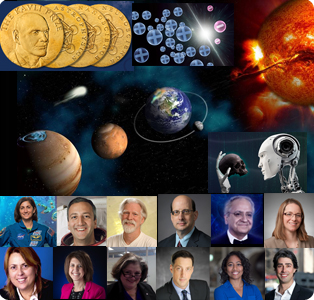
The 11th annual World Science Festival, produced by World Science Foundation, celebrates innovations in science and arts spanning over 27 venues in New York City May 29-June 2. The festival plans to feature 70 events including discussions, debates, interactive explorations, and musical performances. Some topics to be covered are black holes, AI, DNA editing, wildlife, and kids in science. Highlighted events include gala performances honoring achievements of women in science, lab tours encouraging women in STEM, and the announcement of 10th annual Kavli Prize winners in astrophysics, nanoscience, and neuroscience. Among ~190 scheduled speakers are (L-R) Astronauts Nicole Stott and Mike Massimino, NASA Head of Space Science and Astrobiology Steve Howell, JPL Nutritional Biochemistry Laboratory Lead Scott Smith, and award-winning physicist Cumrun Vafa. The 2nd annual Dawn of Private Space Science Symposium, sponsored by Science Partnership Fund, is set for June 2-3 at Columbia University with theme Commercial Space Stations: Building an Ecosystem in Space. Topics will focus on future space stations, commercial sectors, research, technology, transportation, habitation, finances, and policy. Among the 25 scheduled speakers are United Launch Alliance Program Manager Melissa Sampson, UNOOSA Director Simonetta di Pippo, Amy Kaminski and Patricia Jacobberger of NASA, Christopher Johnson of Secure World Foundation, Sirisha Bandla of Virgin Orbit, and Science Partnership Fund Founder Mark Jackson. (Image Credit: World Science Foundation, NASA, ESA, ULA, Science Partnership Fund, Secure World Foundation) |
MONDAY Ongoing…
|
 May 28 —
  May 28 — NewSpace:
  May 28 — USA:
 = All times
for terrestrial events in local time unless noted.
 = All times for international terrestrial events in local time unless noted.
 = All times for space events, and…
 = All times for international space / astro events in Hawaii Standard Time unless noted. Add 10 hours to obtain UT (‘Universal Time’).
Weekly Planet Watch – Evening Planets: Venus (WNW), Jupiter (SE); Morning Planets: Mercury (E), Mars (S), Saturn (S), Neptune (ESE).
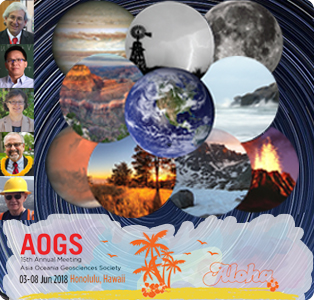
Asia Oceania Geosciences Society Gathers in Hawai’i for 15th Annual Meeting
|
May 28 – Jun 1 — CNES, AIAA, Marseilles, France: 15th International Conference on Space Operations (SpaceOps 2018); technical forum of Space Mission Operations and Ground Systems community that addresses state-of-the-art operations principles, methods and tools.
Continued from…
TUESDAY
|
May 29 – Aug 3 — Lunar and Planetary Society, NASA SSERVI, Center for Lunar Science and Exploration, Houston TX: 2018 Exploration Science Summer Intern Program; students to be involved in activities that support missions to the Moon that utilize Orion crew vehicle, Deep Space Gateway, and robotic assets on lunar surface.
May 29 — Moon: Full Flower Moon, 04:20; 8.8° N of Antares, 09:00.
May 29 — Mercury: 4.5° SSE of Pleiades, 21:00.
May 29 — Aten Asteroid 68347 (2001 KB67): Near-Earth Flyby (0.024 AU)
May 29 — Apollo Asteroid 2014 WG365: Near-Earth Flyby (0.061 AU)
May 29 — Apollo Asteroid 2018 JZ1: Near-Earth Flyby (0.062 AU)
WEDNESDAY
May 30 — United Nations Committee on the Peaceful Uses of Outer Space (COPUOS), Vienna, Austria: Briefing on the 61st session of the Committee on the Peaceful Uses of Outer Space.
May 30 — The National Academies, Online / Washington DC: Teleconference: Exoplanet Science Strategy Meeting 12.
May 30 – Jun 1 — ESA, Madrid, Spain: Dusty Visions 2018; to discuss present state and new avenues in cosmic dust research including results from Cassini, Rosetta, New Horizons, Ikaros, Stardust, Spitzer, Herschel, STEREO and other space missions.
May 30 — Amor Asteroid 2018 JJ2: Near-Earth Flyby (0.053 AU)
May 30 — Apollo Asteroid 2018 JJ3: Near-Earth Flyby (0.055 AU)
May 30 — Apollo Asteroid 2018 KD1: Near-Earth Flyby (0.093 AU)
THURSDAY
NET May 31— SpaceX, Falcon 9 / SES 12, KSC FL: SpaceX Falcon 9 rocket to launch SES 12 communications satellite for SES of Luxembourg.
May 31 — The Kavli Foundation, Norwegian Academy of Science, World Science Festival, Broadcast / Oslo, Norway: 2018 Kavli Prizes in Astrophysics, Nanoscience, and Neuroscience to be announced live from Norwegian Academy of Science to World Science Festival in New York City; 08:30 EDT.
May 31 — Moon: 1.9° S of 4 Vesta, 03:47; 1.6° N of Saturn, 15:00.
May 31 — Amor Asteroid 2013 LE7: Near-Earth Flyby (0.046 AU)
FRIDAY
NET Jun — ISRO, Launch GSLV Mk. 3 / GSAT 29, Satish Dhawan Space Center, Sriharikota, India: Geosynchronous Satellite Launch Vehicle Mk. 3, dubbed GSLV Mk.3-D2, to launch GSAT 29 communications satellite.
Jun 1 — Deep Space: Juno spacecraft gathering detailed data is nearing 2 full years in Jupiter orbit and end of mission planned 14 flybys; future mission goals and science to be decided, could operate until 2020+.
Jun 1 — Moon: 1.2° N of Pluto, 18:00.
Jun 1 — Apollo Asteroid 2018 KE1: Near-Earth Flyby (0.028 AU)
SATURDAY
Jun 2-3 — Science Partnership Fund, Columbia University, NYC NY: Dawn of Private Space Science Symposium 2018 (DPSS18); to facilitate communication between private space industry and scientists.
Jun 2 — Moon: at apogee (distance 404,4877 km), 07:00.
Jun 2 — Apollo Asteroid 2016 XF: Near-Earth Flyby (0.077 AU)
SUNDAY
Jun 3 — ISS, Soyuz MS-07 Undocking & Landing: Expedition 54/55 members Shkaplerov, Tingle and Kanai to return to Earth; undocking scheduled at 04:45 EDT, live coverage available; landing near Dzhezkazgan, Kazakhstan at 08:40.
Jun 3-7 — American Astronomical Society, Denver CO: 232nd Meeting of the AAS; in Conjunction with Annual Meeting of AAS Laboratory Astrophysics Division; at Sheraton Denver Downtown.
Jun 3-8 — Asia Oceania Geosciences Society (AOGS), Honolulu HI: Asia Oceania Geosciences Society (AOGS) 15th Annual Meeting.
Jun 3 — Moon: 3.1° N of Mars, 01:00.
Jun 3 — Mercury: 5.8° NNW of Aldebaran, 01:00.