New USA Administration May Consider Women on Moon to Enable 21st Century “Stretch Goal”
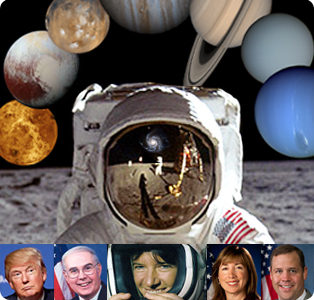
U.S. President Elect Donald Trump (L) will have the responsibility to nominate new NASA administrators, define space exploration plans for the country and adjust budgets during his term which will include the 50th observation on July 20, 2019 of the greatest Human achievement, becoming a Multi World Species with Apollo 11. A stretch goal toward Solar System Complete exploration is highlighted by NASA Planetary Science Vision 2050 Workshop held February 2017 to discuss technologies enabling the next phase of exploration. The recent RFI for lunar payloads is encouraging for lunar and commercial development. Mars will remain a focus, perhaps not as an ultimate goal, but as another intermediate step into the Galaxy. Achieving more ‘firsts’ for America seems likely and could include the 1st Woman on the Moon and venturing to the new frontier Moon South Pole. Representative Jim Bridenstine (R-OK) supports a lunar return, proposes the American Space Renaissance Act and states “NASA should utilize somewhere we have already pioneered – the Moon.” A strong Trump supporter, Newt Gingrich proposed a Moon base in 2012 when he ran for President. Former Congressman / senior advisor to Trump campaign Robert Walker (CL) indicates a long-term goal for Human exploration of the Solar System by the end of this century through public-private partnerships. Lori Garver (CR) notes Earth science will likely be cut, but the Moon and Commercial Crew may play a significant role. Hopefully international collaboration, cooperation and constructive competition will be emphasized in the new space policy with the emphasis on “In Peace For All.” (Image Credit: NASA, M. Vadon; Also pictured 1st USA Woman in Space Sally Ride (C)) |
|
MONDAY
Ongoing…
 Nov 21 — ISS, 330-435-km LEO: Expedition 50 underway with 3 newly arrived crew members (Oleg Novitskiy, Thomas Pesquet, Peggy Whitson), Cygnus OA-5 to be released today – it will remain in space a few days to deploy ocean ship tracking CubeSats & conduct Saffire-II fire study; 3 spacecraft are docked to station (Soyuz MS-03, Soyuz Soyuz MS-02, Progress 64P). Nov 21 — ISS, 330-435-km LEO: Expedition 50 underway with 3 newly arrived crew members (Oleg Novitskiy, Thomas Pesquet, Peggy Whitson), Cygnus OA-5 to be released today – it will remain in space a few days to deploy ocean ship tracking CubeSats & conduct Saffire-II fire study; 3 spacecraft are docked to station (Soyuz MS-03, Soyuz Soyuz MS-02, Progress 64P).
Nov 21 — Tiangong-2, 393-km LEO: Experiments being monitored from Earth, Banxing-2 CubeSat continues imaging Space Lab with 25 megapixel camera, next mission Tiangzhou-1 cargo docking expected April, crewed Shenzhou 12 to launch 2017-18 and may include woman Astronaut.
Nov 21 — Spitzer Space Telescope, 1-AU Earth Trailing Orbit: In warm mission phase (Helium depleted 2009) sending data to Earth on microlensing event of Brown Dwarf OGLE-2015-BLG-1319 which may be between 30-65 Jupiter masses; observed Star in first-of-its-kind collaboration with Swift X-ray Telescope.
Nov 21 — Cassini OTM-465, Saturn Orbit: Craft in its 249th orbit of planet, scheduled to perform Orbital Trim Maneuver #465.
 Nov 21 — China Long March Rocket Company Ltd., Beijing, China: NewSpace company plans to produce commercial rockets, develop satellite rocket interface standardization, reduce cost of launches, perform suborbital tourism for US$200K per seat in 2020s; Landspace Technology also in Beijing may use design based on Long March 11. Nov 21 — China Long March Rocket Company Ltd., Beijing, China: NewSpace company plans to produce commercial rockets, develop satellite rocket interface standardization, reduce cost of launches, perform suborbital tourism for US$200K per seat in 2020s; Landspace Technology also in Beijing may use design based on Long March 11.
 Nov 21 — Project Blue, San Francisco CA: Crowdfunding US$1M to begin analysis, design, simulations for mission to build & launch telescope to observe Earth-like planets around Alpha Centauri (nearest star system, 4.37 LY away); estimates 85% probability of Earth-like planets existing around α Cen A and / or B. Nov 21 — Project Blue, San Francisco CA: Crowdfunding US$1M to begin analysis, design, simulations for mission to build & launch telescope to observe Earth-like planets around Alpha Centauri (nearest star system, 4.37 LY away); estimates 85% probability of Earth-like planets existing around α Cen A and / or B.
Nov 21 — Asgardia, Paris, France / Multiple Locations: Will seek UN recognition to become to 1st Space Nation, starting with support by nations around World and set up regional coordination centers; so far 531,846 people have signed up for Asgardia citizenship; Founder Igor Ashurbeyli.
 Nov 21-23 — ESA, Brussels, Belgium: Conference: The ARIEL Space Mission. Nov 21-23 — ESA, Brussels, Belgium: Conference: The ARIEL Space Mission.
Nov 21-24 — ESA, Leibniz Institute for Astrophysics Potsdam, International Virtual Observatory Alliance, et al, Heidelberg, Germany: Gaia Data Workshop. |

 = All times
for terrestrial events in local time unless noted.
= All times for international terrestrial events in local time unless noted.
 = All times for space events, and…
 = All times for international space / astro events in Hawaii Standard Time unless noted. Add 10 hours to obtain UT (‘Universal Time;’ Greenwich, England).
Weekly Planet Watch – Evening Planets: Venus (SW), Mars (SSW), Saturn (SW), Uranus (SE), Neptune (S); Morning Planets: Jupiter (ESE).
International Events in Egypt, Turkey and Dubai Advancing Space Age Development
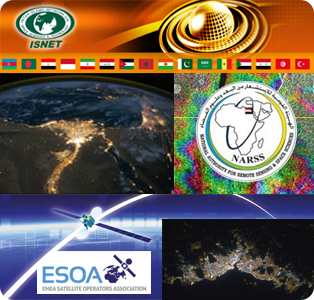
The 16 nation Inter Islamic Network on Space Sciences and Technology is partnering with the National Authority for Remote Sensing & Space Sciences in Cairo, Egypt to host a Workshop on Earth Remote Sensing with Synthetic Aperture Radar (SAR) on Nov 27 – Dec 1. Intensive lecture-based hands-on training with the latest software, tools and trends for SAR applications will provide valuable experience for scientists, analysts and students in this specialized field from ‘Crescent Moon’ countries. The program includes Seminar and Experts sessions with opportunities for interaction, as well as a technical visit to NARSS facilities. The EMEA Satellite Operators Association is hosting the 2nd Global Satshow with theme Smart Connections on Nov 29-30 in Istanbul, Turkey. This Europe, Middle-East, Africa focused event features a 5,000 m2 exhibition floor with more than 200 exhibitors from over 50 countries expected to see in excess of 10,000 trade visitors. Other highlights include a Global Satellite Operations CEO Summit featuring: Christodoulos Protopappas of Hellas Sat Consortium, Rashad Nabiyev of Azercosmos, Ali Ahmed Al-Kuwari of Es’hailSat, Cenk Sen of TurkSat, Khalid Balkheyour of ArabSat, and Rupert Pearce of INMARSAT. Dubai recently hosted the biannual World Space Risk Forum 2016 on Nov 2-4 to explore new technology and innovations to mitigate risks and make Space a safer place to do business. (Image Credit: ISNET / NARSS, ESOA)
|
|
Nov 21-25 — Council for Scientific and Industrial Research, SKA South Africa, IEEE South Africa Section, Stellenbosch University, Stellenbosch, South Africa: European School: Antennas for Radio Telescopes.
Nov 21 — Amor Asteroid 2016 VJ2: Near-Earth Flyby (0.067 AU).
Nov 21 — Apollo Asteroid 2016 VT1: Near-Earth Flyby (0.098 AU).
Continued from…
Nov 20-24 — UNOOSA, United Arab Emirates Space Agency, Dubai, United Arab Emirates: United Nations/United Arab Emirates – High Level Forum: Space as a Driver for Socio-Economic Sustainable Development.
Oct 15 – Sep 4, 2017 — Peabody Essex Museum, Salem MA: Lunar Attraction Exhibit; featuring 60 Apollo memorabilia, paintings, sculptures, photographs, books, movies, jewelry that illustrate our profound connection to the Moon.
TUESDAY
Nov 22 — NASA, Online / Washington DC: Proposals due for CubeSat Launch Initiative (CSLI); winners selected Feb 17, 2017, experiments to be deployed from ISS between 2017-2020.
Nov 22 — SETI, Mountain View CA: Lecture: How Galaxies are Influenced by the Largest Structures in the Universe; Mehmet Alpaslan from NASA Ames, 12:00.
Nov 22-23 — ESA / ESTEC, Noordwjick, The Netherlands: Industry Days – Additive Manufacturing for RF/Microwave Hardware.
Nov 22 — Moon: 0.10° N of comet 45P Honda-Mrkos-Pajdusakova, 23:00. |
WEDNESDAY
Nov 23 — Australia National Telescope Facility, CSIRO, Sydney, Australia: Colloquium: KM3NeT’s ARCA detector: neutrino astronomy in the Mediterranean; Clancy James of Erlangen Centre for Astroparticle Physics, 15:00 Marsfield Lecture Theatre.
Nov 23 — Mercury: 3.4° S of Saturn, 06:00.
Nov 23 — Amor Asteroid 2005 TF: Near-Earth Flyby (0.095 AU).
THURSDAY
Nov 24-25 — Canadian Space Agency, Montréal, Québec, Canada: Canadian Space Exploration Workshop (CSEW 2016); six areas of action; Entrepreneurial & Creative Society, Global Science Excellence, World-Leading Clusters & Partnerships, Grow Companies & Accelerate Clean Growth, Compete in the Digital World, Ease of Doing Business.
Nov 24-25 — University of Sydney, Sydney, Australia: Workshop: Fine-tuning, the Multiverse and Life.
Nov 24 — Moon: 1.8° NNE of Jupiter, 17:00.
Nov 24 — Comet 323P/SOHO: Near-Earth Flyby (0.040 AU).
FRIDAY
Nov 25 — IAA, China National Space Administration, China Aerospace Science and Technology Corporation, Beijing, China: IAA Symposium on Space International Cooperation Promoting Economic and Social Development of Developing Country.
Nov 25 — Moon: 5.6° NNE of Spica, 09:00.
Nov 25 — Venus: 3.5° S of Pluto, 01:00.
Nov 25 — Aten Asteroid 2003 WU21: Near-Earth Flyby (0.081 AU).
SATURDAY
Nov 26 — Cassini OTM-466, Saturn Orbit: Spacecraft conducts Orbital Trim Maneuver #466 today.
Nov 26 — Curiosity, Mars Surface: 5th observation of the launch of Curiosity (Mars Science Laboratory), landed Aug 5, 2012 (Pacific Daylight Time).
SUNDAY
Nov 27 — Cassini, Saturn Orbit: Flyby of moon Enceladus (22,000-km altitude) and Epimetheus (86,000-km altitude).
Nov 27 – Dec 1 — Inter Islamic Network on Space Sciences and Technology (ISNET), National Authority for Remote Sensing & Space Sciences (NARSS), Cairo, Egypt: ISNET / NARSS Workshop on Earth Remote Sensing with Synthetic Aperture Radar (SAR).
Nov 27 — Moon: At apogee (distance 406,087 km), 10:00.