Peggy Whitson Breaks Multiple ‘Women in Space’ Records During 2nd ISS Command
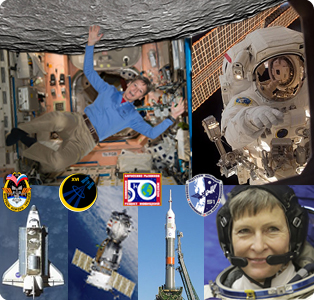
Expedition 51 Commander Peggy Whitson begins her 2nd Command of the International Space Station, during her 3rd trip to space. She is the 1st ever woman commander of the ISS (Expedition 16 in 2007) and the 1st woman to command the ISS twice. She holds the record for the most cumulative spacewalking time by a woman (total of 8 EVAs at 53 hours, 22 minutes), having recently surpassed Sunita Williams’ EVA record of 32 hours, 36 minutes. Whitson also has the title of the oldest woman in space at 57 years old and she is the most experienced female NASA Astronaut. She is set to surpass the U.S. record currently held by Jeff Williams of 534 days for total off-planet time on April 24. Originally planned to leave the station June 15, her stay has now been extended until September which will likely place her as the 6th overall Astronaut from any country for cumulative time in space at ~679 days. Whitson is one of only 60 women who have been to space. Many are looking ahead to the next giant record for women: The First Woman to the Moon and on the Moon. Women could crew the commercial circumlunar mission proposed by SpaceX and the first SLS / Orion flight, both potentially launching 2018. (Image Credit: NASA, P. Whitson) |
|
MONDAY
Ongoing…
 Apr 10 — ISS, 330-435-km LEO: Expedition 51 mission commencing, Soyuz MS-02 undocks and Expedition 49/50 members Robert Kimbrough, Andrei Borisenko, Sergey Ryzhikov and various experiments / equipment return to Earth. Apr 10 — ISS, 330-435-km LEO: Expedition 51 mission commencing, Soyuz MS-02 undocks and Expedition 49/50 members Robert Kimbrough, Andrei Borisenko, Sergey Ryzhikov and various experiments / equipment return to Earth.
 Apr 10 — Maven, Mars Orbit: Orbiter and Curiosity rover data indicate 80-90% of early Mars atmosphere, likely containing significant amount of carbon, was lost to space due to Solar wind. Apr 10 — Maven, Mars Orbit: Orbiter and Curiosity rover data indicate 80-90% of early Mars atmosphere, likely containing significant amount of carbon, was lost to space due to Solar wind.
Apr 10 — Chang’e-3 Lander, Guang Han Gong, 44.12°N 19.51°W, Moon Surface: In Lunar Day 42 collecting data on binary Stars, images of Earth & other celestial bodies; mission chief commander was Ma Xingrui.
 Apr 10 — Canadian Space Agency, Longueuil, Quebec, Canada: Proposals sought for Lunar Surface Mobility Concept Study RFP study, to be completed over 6 month period. Apr 10 — Canadian Space Agency, Longueuil, Quebec, Canada: Proposals sought for Lunar Surface Mobility Concept Study RFP study, to be completed over 6 month period.
 Apr 10 — Blue Origin, Kent WA: Jeff Bezos aims for 2018 human spaceflight with caveat of ‘fluid timeline’ stating “we are not racing… we’re going to make it as safe as we can”; proposing 2020 Moon South Pole cargo deliveries. Apr 10 — Blue Origin, Kent WA: Jeff Bezos aims for 2018 human spaceflight with caveat of ‘fluid timeline’ stating “we are not racing… we’re going to make it as safe as we can”; proposing 2020 Moon South Pole cargo deliveries.
Apr 10 — JPL, NASA, Pasadena CA: Testing tools for exploring Europa, other icy, ocean worlds including subsurface burrowing probe, robotic claw, projectile launcher.
Apr 10 — Arizona State University, Tempe AZ: Steadily advancing LunaH-Map CubeSat to detect amount of hydrogen at Moon South Pole for 2018 SLS flight.
Apr 10 — Lockheed Martin Corp., Bethesda MD: Proposes 2028 Mars Space Station, six-person Mars Base Camp precursor to Human Mars surface missions.
Apr 10 — Roscosmos, Moscow, Russia: Super-heavy Angara-A5V rocket could fly 2027, 1st lunar flight 2030, lunar landing 2035; head Igor Komarov states Russia planning ~30 launches in 2017.
|

 = All times
for terrestrial events in local time unless noted.
 = All times for international terrestrial events in local time unless noted.
 = All times for space events, and…
 = All times for international space / astro events in Hawaii Standard Time unless noted. Add 10 hours to obtain UT (‘Universal Time;’ Greenwich, England).
Weekly Planet Watch – Evening Planets: Mercury (W), Mars (W), Jupiter (ESE); Morning Planets: Venus (E), Saturn (S).
World Celebrates Dawn of Space Travel April 12: In Remembrance of Yuri Gagarin, 1st Human in Space
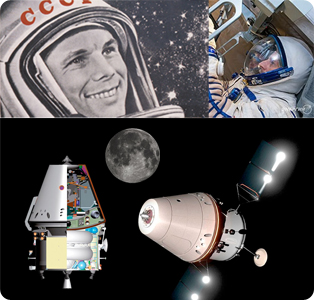
Yuri’s Night celebrations worldwide and Cosmonautics Day activities in Russia on April 12 work to advance and enhance the Space Age in the 21st Century as we build on great achievements of the past. This year marks 56th Commemoration of Gagarin’s historic 108-minute flight 327 km over the surface of the Earth in the Vostok 1 spacecraft in 1961. Russia space manufacturing giant RSC Energia has now launched development of its new Federatsiya (Federation) spacecraft for deep space and Earth orbit missions. The first automated orbital test flight is scheduled for 2021 with a crewed test in 2023. The new vehicle, made of 80% composite materials, is scheduled to launch on the in-development Angara rocket. The vehicle features multiple touch screen interfaces and a full-sized cabin-style head for comfort and privacy on long missions. Roscosmos First Deputy CEO Aleksandr Ivanov has announced that 6-8 trainees are to be selected by the end of the year, and that they will be “the first Russians to fly to the Moon”. The Commercial Space Blog is hosting a Yuri’s Night World Space Party in downtown Toronto with presentations from the Canadian Space Society and the Royal Astronomical Society of Canada.(Image Credit: RSA, RSC Energia)
|
|
Apr 10 — West Didsbury Astronomical Society, Manchester, United Kingdom: Space Elevator Presentation by Peter Robinson from International Space Elevator Consortium.
Apr 10 — NASA SSERVI, University of Central Florida, Online / Orlando FL: Online Seminar: In-Situ Resource Utilization (ISRU) – Overview of Lunar, Asteroid and Martian ISRU Mining Camps.
Apr 10 — Lunar and Planetary Laboratory, University of Arizona, Tucson AZ: Lecture: Chirps, Jets and Kicks: The Spectacular World of Black Hole Binaries; Vasilios Paschalidis, Associate Research Scholar from Princeton University, 16:00.
Apr 10-14 — Department of Astronomy at the University of the Republic, Montevideo, Uruguay: Asteroids, Comets, Meteors, with focus on the research of small Solar System bodies, series of meetings organized every ~3 years in different places around the world.
Apr 10 — Moon: 2.2° N of Jupiter, 11:20; Full (Pink Moon), 20:08.
Continued from…
NET Apr — CNSA, Launch Long March 7 (Y2) / Tianzhou-1, Wenchang Satellite Launch Center, Hainan Island, China (19° N): Cargo ship to launch to Tiangong-2 space lab for 305-day mission; will test technologies related to cargo transport, propellant re-supply, rapid rendezvous, docking, other experiments; will be 2nd Long March 7 launch.
NET Apr 4 — ISRO, Launch GSLV Mk. 2 / GSAT 9, Satish Dhawan Space Center, Sriharikota, India: India Geosynchronous Satellite Launch Vehicle Mk. 2, flying on GSLV-F09 mission, to launch GSAT 9 satellite to provide communications services over India and neighboring countries.
NET Apr 5 — Arianespace, Launch Soyuz / SES 15, Kourou, French Guiana: Arianespace Soyuz rocket, designated VS17, to launch SES 15 communications satellite for SES of Luxembourg. |
TUESDAY
Apr 11 — Cornell University, Ithaca NY: Lecture: Future Shock – Where are the Interesting Fields in Astronomy? Shri Kulkarni, Director Caltech Optical Observatories, 16:00.
Apr 11-12 — United Nations Office for Outer Space Affairs, Italian Space Agency (ASI), Rome, Italy: United Nations/Italy Workshop on the Open Universe Initiative and Open Space Science Data.
Apr 11-13 — Infrared Processing and Analysis Center (IPAC), Caltech, NASA, Pasadena CA: Workshop: Making the Case – Outreach and Communications for Large, International Science Projects.
WEDNESDAY
Apr 12 — Cassini, Saturn Orbit: Flyby of Atlas, in outer-edge of Saturn A-ring, scheduled at 15,000-km altitude; Janus at 9,000 km, Aegaeon at 21,000 km, Prometheus at 88,000 km, Mimas at 98,000 km.
Apr 12 — CNSA, Launch Long March 3B / Shijian 13, Xichang Satellite Launch Center, China: Long March 3B rocket to launch experimental Shijian 13 communications satellite to demonstrate electric propulsion systems & test a high-throughput communications payload to provide Internet connectivity on airliners and high-speed trains.
Apr 12 — 56th Commemoration of Human Spaceflight / Cosmonautics Day, Worldwide: Celebrating Yuri Gagarin of Russia, the 1st human to orbit Earth on Vostok 1 spacecraft in 1961; the flight lasted 108 minutes at 27,400 kph and 327 km above Earth.
Apr 12 — 36th Observation of STS-1 Columbia Flight, Nationwide: USA working on next gen Space Launch System to send Humans to Moon, Mars and Beyond, commemorations occur today in honor of 1st ever NASA Space Shuttle Columbia carrying John Young and pilot Robert Crippen around Earth on 54.5-hour mission in 1981.
Apr 12 — Yuri’s Night Celebrations, Global: Yuri’s Night 2017; annual worldwide party to celebrate Yuri Gagarin’s 1st flight into space and promote space exploration.
Apr 12 — Commercial Space Blog, Toronto, Ontario, Canada: Yuri’s Night World Space Party; featuring Canadian Space Society presentation, games, food, at Polish Combatants’ Hall, 19:00-23:00.
Apr 12 — Apollo Asteroid 2017 GP4: Near-Earth Flyby (0.029 AU).
Apr 12 — Apollo Asteroid 2017 FH1: Near-Earth Flyby (0.053 AU).
THURSDAY
Apr 13 — University of California – Riverside, Riverside CA: Lecture: Alien Planets: Are There Other Earths Lurking in Our Galaxy? Antigona Segura Peralta, Professor of Astrobiology, National Autonomous University of Mexico.
Apr 13 — AIAA, Online: Protocol Live: A Cybersecurity Conversation with Richard Clarke; with host Sandy Magnus, 13:00 EDT.
Apr 13 — Apollo Asteroid 2017 FF128: Near-Earth Flyby (0.017 AU).
Apr 13 — Amor Asteroid 2017 FX2: Near-Earth Flyby (0.064 AU).
FRIDAY
Apr 14 — Haviland Digital, Online / In Theaters: Showing of Mission Control: The Unsung Heroes of Apollo; featuring Mission Control team at the heart of Apollo space program who helped put people on the Moon.
Apr 14 — Space Center Houston, Houston TX: Lunch with an Astronaut, Clay Anderson, adult US$69.95.
Apr 14 — Amor Asteroid 2017 FH63: Near-Earth Flyby (0.092 AU).
SATURDAY
NET Apr 15 — ISRO, Launch PSLV / Cartosat 2E, Satish Dhawan Space Center, Sriharikota, India: Polar Satellite Launch Vehicle, flying on PSLV-C38 mission, to launch ISRO satellite 2E of the Cartosat series, the current generation of Indian remote sensing satellites.
Apr 15 — Moon: At apogee (distance 405,478 km), 00:05.
Apr 15 — Aten Asteroid 2017 GO4: Near-Earth Flyby (0.035 AU).
SUNDAY
Apr 16 — The Space Show, Online / Tiburon CA: Dr. David Livingston talks with Al Globus, National Space Society Board of Directors.
Apr 16 — Moon: 3.2° N of Saturn, 08:39.
Apr 16 — Apollo Asteroid 2017 FV128: Near-Earth Flyby (0.074 AU).