April 12 Will Commemorate Yuri’s Night, Cosmonautics Day, Columbia First Flight, and Las Cruces Space Festival
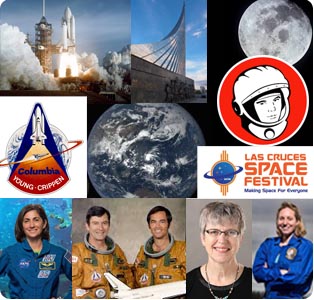
There will be a global observation for the first human in space, Yuri Gagarin, who orbited Earth on Vostok 1 on April 12, 1961. The flight lasted 108 minutes at 27,400 kph, 327 km above Earth. Yuri’s Night will celebrate humanity’s efforts in space with education, community outreach, and entertainment in hopes of promoting a sustainable and peaceful future. Currently ~110 events are scheduled in 32 countries on all 7 continents as well as virtual podcasts and webinars. The following day, Space Coast will host a celebration beneath Shuttle Atlantis at KSC and plans to feature Astronaut Nicole Stott, the 52nd woman in space. The 57th commemoration of Cosmonautics Day in Russia will celebrate Gagarin’s epical accomplishment with a ceremony in Korolyov, proceed to Gagarin’s grave in Red Square, and continue to Cosmonauts Alley and the monument “To the Conquerors of Space”. As NASA focuses on returning humans to the Moon, it will commemorate the 37th observation of the 1st Space Shuttle launch. The STS-1 Columbia flight carried John Young and Robert Crippen around Earth on a 54.4-hour mission in 1981. The inaugural Las Cruces Space Festival is planned for April 12-14 at the New Mexico State University campus to celebrate space-related activities. The event is scheduled to have ~15 presentations, 4 learning centers, 2 showcases, and entertainment. Presenters include Leicester University Associate Professor in Space Physics Suzie Imber and author Loretta Hall. (Image Credit: NASA, Moscow Museum of Cosmonautics, LCSF, Nicole Stott, Loretta Hall, University of Leicester)
|
MONDAY Ongoing…
|
 Apr 9 —
  Apr 9 — NewSpace:
  Apr 9 — USA: NASA
 = All times
for terrestrial events in local time unless noted.
 = All times for international terrestrial events in local time unless noted.
 = All times for space events, and…
 = All times for international space / astro events in Hawaii Standard Time unless noted. Add 10 hours to obtain UT (‘Universal Time’).
Weekly Planet Watch – Evening Planets: Mercury (W), Venus (W); Morning Planets: Mars (SE), Jupiter (S), Saturn (SE).
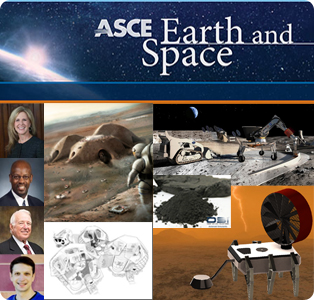
ASCE Aerospace Division to Discuss Engineering Structures / Tech for Exploration of Challenging Environments
|
Apr 9 — Johns Hopkins Applied Physics Laboratory, Laurel MD: Double Asteroid Redirection Test (DART) Mission Workshop.
Continued from…
TUESDAY
WEDNESDAY
|
THURSDAY
Apr 12 — ISRO, Launch PSLV / IRNSS 1I, Satish Dhawan Space Center, Sriharikota, India: Polar Satellite Launch Vehicle, flying on PSLV-C41 mission, to launch IRNSS 1I navigation satellite, the 9th spacecraft in Indian Regional Navigation Satellite System.
Apr 12 — 57th Commemoration of Human Spaceflight / Cosmonautics Day, Worldwide: Celebrating Yuri Gagarin of Russia, the 1st human to orbit Earth on Vostok 1 spacecraft in 1961; the flight lasted 108 minutes at 27,400 kph and 327 km above Earth.
Apr 12 — 37th Observation of STS-1 Columbia Flight, Nationwide USA: As NASA works on next gen Space Launch System to send Humans to Moon, Mars and Beyond, commemorations occur today in honor of 1st ever NASA Space Shuttle Columbia carrying John Young and pilot Robert Crippen around Earth on 54.5-hour mission in 1981.
Apr 12 — Yuri’s Night Celebrations, Global: Yuri’s Night 2018; annual worldwide party to celebrate Yuri Gagarin’s 1st flight into space and promote space exploration.
Apr 12-14 — New Mexico Space Grant Consortium / New Mexico State University, NASA White Sands Test Facility, Spaceport America, Virgin Galactic, Las Cruces Public Schools, Las Cruces NM: Las Cruces Space Festival.
Apr 12-14 — Marshall Space Flight Center, NASA, Huntsville AL: 2018 NASA Human Exploration Rover Challenge; at U.S. Space & Rocket Center.
Apr 12 — Moon: 1.8° SSE of Neptune, 14:00.
Apr 12 — Apollo Asteroid 363599 (2004 FG11): Near-Earth Flyby (0.049 AU)
Apr 12 — Apollo Asteroid 2018 FK4: Near-Earth Flyby (0.059 AU)
FRIDAY
Apr 13 — Icarus Interstellar, Kennedy Space Center, NASA, Titusville FL: Yuri’s Night Space Coast; featuring Astronaut Nicole Stott.
Apr 13 — Aten Asteroid 2005 GZ128: Near-Earth Flyby (0.074 AU)
Apr 13 — Apollo Asteroid 2013 GF84: Near-Earth Flyby (0.077 AU)
SATURDAY
Apr 14 — United Launch Alliance, Launch Atlas 5 / AFSPC 11, Cape Canaveral AFS FL: ULA Atlas 5 rocket, designated AV-079, to launch AFSPC 11 mission for U.S. Air Force.
Apr 14 — British Interplanetary Society, Buckinghamshire, United Kingdom: Current Topics in Rocket Propulsion – An Open Source Conference.
Apr 14 — March for Science Los Angeles, Los Angeles CA: March for Science 2018: Rally and Science Expo.
Apr 14 — American Physical Society, Columbus OH: Lecture: Exploring the Universe with Gravitational Waves; Rainer Weiss – physics professor emeritus the Massachusetts Institute of Technology and adjunct professor at Louisiana State University.
Apr 14 — Space Center Houston, Houston TX: Lunch with an Astronaut, Anna Fisher, adult US$69.95, child $35.95.
Apr 14 — Moon: 3.6° SSE of Mercury, 02:00.
Apr 14 — Aten Asteroid 2014 UR: Near-Earth Flyby (0.024 AU)
SUNDAY
Apr 15-16 — Space Generation Advisory Council, Colorado Springs CO: Space Generation Fusion Forum 2018.
Apr 15 — Moon: New Moon, 15:59; 4.4° SSE of Uranus, 20:00
Apr 15 — Saturn: 12.1° W of Pluto, 18:00.
Apr 15 — Apollo Asteroid 2016 GB222: Near-Earth Flyby (0.074 AU)