ASE 28th Planetary Congress Invites Astronauts to Share Experiences and Expertise
|
MONDAY
|

 = All times
for terrestrial events in local time unless noted.
 = All times for international terrestrial events in local time unless noted.
 = All times for space events, and…
 = All times for international space / astro events in Hawaii Standard Time unless noted. Add 10 hours to obtain UT (‘Universal Time;’ Greenwich, England).
Weekly Planet Watch – Evening Planets: Saturn (SW), Uranus (E), Neptune (SE); Morning Planets: Venus (E), Mars (E), Jupiter (E).
International Fleet of Mars Missions Piques Public Interest for Space Exploration and Considerations for Multi World Expansion
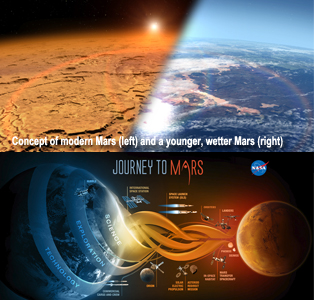
Two innovative missions at the Red Planet are set to begin year 2 of operations in orbit this week. The MAVEN mission, part of the Mars Scout program at NASA, is exploring the upper atmosphere, ionosphere and interactions with the Sun and solar wind. Analysis of the data is providing insights into how the loss of volatiles from the atmosphere over time, has impacted climate, liquid water and planetary habitability. The Mars Orbiter Mission (MOM) aka Mangalyaan, India’s first venture into interplanetary space, is studying surface features, morphology, mineralogy and atmosphere, as well as hosting a dedicated effort to identify methane levels, a possible indicator of present or past existence of life. Making a total of 7, there are 5 other Mars missions currently operating, 3 orbiters – Mars Odyssey, MRO (NASA) and Mars Express (ESA) – as well as 2 NASA rovers, Curiosity and Opportunity. Russia has attempted 35 missions with limited success. Japan attempted the Nozomi mission in 1998 but ran out of fuel before entering orbit. Overall, Mars missions have a success rate of just 53%. Getting to Mars is not easy, but is a goal that has inspired much action and thought. Future planned missions include the InSight lander (NASA, projected for launch in March 2016), ExoMars orbiter/lander/rover (ESA/Roscosmos, 2016-2018), Mars 2020 rover (NASA, 2020) and Mars Hope orbiter (UAE, 2020). There are also a variety of other national, independent and commercial enterprises considering robotic and human exploration and development of our planetary neighbor. Of course there is no need to make it all the way to Mars in order to reclaim Human Multi World status, the Moon, Luna, is a whole new world, only half the size but almost 600 times closer. (Image Credit: NASA, GSFC)
|
Continued from…
TUESDAY
|
WEDNESDAY
Sep 23 — Lunar and Planetary Laboratory, Tucson AZ: Lecture: The Kuiper Belt – Revealing the History of the Solar System; presented by Dr Kat Volk.
THURSDAY
Sep 24 — Mars Orbiter Mission (Mangalyaan), Mars Orbit: India ISRO orbiter enters 2nd year of operations in Mars orbit; launched Nov 5, 2013.
Sep 24 — The National Academies, Washington DC: Meeting: Review of NASA’s Evidence Reports on Human Health Risks.
Sep 24 — Cornell University, Ithaca NY: Lecture: Exploring Exoplanets with a Starshade Mission; presented by Dr. Margaret Turnbull of SETI Institute and Carl Sagan Center for Life in the Universe.
Sep 24 — Moon: 0.78° NNE of Regulus, 17:00.
Sep 24 — Apollo Asteroid 2012 TT5: Near-Earth flyby (0.055 AU).
FRIDAY
Sep 25 — Canadian Space Society, Toronto, Ontario, Canada: Canadian Space Summit Toronto Chapter Meeting: Project Voyager.
Sep 25-26 — Kama‘aha, Kamehameha Schools, The Kohala Center, Hawai‘inuiākea – School of Hawaiian Knowledge at University of Hawaii Mānoa, Honolulu HI: Aimalama: Pacific Peoples’ Lunar Conference on Climate Change; to bring together peoples of Hawai`i & the Pacific who are revitalizing lunar practices to share lunar methodologies with one another & build a regional community of practice; at UH Manoa.
Sep 25 — Moon: 3.1° NW of Neptune, 21:00.
SATURDAY
Sep 26 — International Lunar Observatory Association, Space Age Publishing Co., Vancouver, British Columbia, Canada: Galaxy Forum Canada 2015: Astronomy from the Moon; at Irving K. Barber Learning Centre 182, University of British Columbia, 09:00-12:30.
Sep 26 — Goddard Space Flight Center, NASA, Greenbelt MD: Goddard Space Flight Center Open House.
Sep 26-30 — United Nations Office for Outer Space Affairs, Iranian Space Agency, Inter-Islamic Network on Space Science and Technology, Tehran, Iran: United Nations/Islamic Republic of Iran Workshop on Space Technology Applications for Dust Storm and Drought Monitoring; Canceled.
Sep 26 — Apollo Asteroid 2015 RU36: Near-Earth flyby (0.038 AU).
SUNDAY
Sep 27 — Dawn, Ceres Orbit: NASA spacecraft enters 9th year in space today, launched Sep 27, 2007; entered orbit around 4 Vesta Jul 16, 2011, reached Ceres orbit March 6, 2015.
Sep 27 — Griffith Observatory, Los Angeles CA: Total lunar eclipse event at Griffith Observatory; 18:30-21:45.
Sep 27 — The Space Show, Online / Tiburon CA: Dr. David Livingston talks with Dr. Stuart Robbins from the Southwest Research Institute (SwRI).
Sep 27 – Oct 1 — Pro-physica Foundation, GSI Helmholtz Centre, Warsaw, Poland: NUSTAR Week 2015.
Sep 27 – Oct 2 — European Planetary Science Congress, University of Nantes, Nantes, France: European Planetary Science Congress 2015; at La Cité Nantes Events Center.
Sep 27 — Total Eclipse of Moon: Penumbral 14:10-19:24, Partial 15:07-18:27, Total 16:10-17:24; visible in most of Europe, South East Asia, Africa, N America, S America, Pacific, Atlantic, Indian Ocean, Arctic, Antarctica.
Sep 27 — Moon: At perigee (distance 356,457 km), 15:55; Full / Harvest “Blood” Moon,16:50.
Sep 27 — Aten Asteroid 2006 WV1: Near-Earth flyby (0.085 AU).