Vol 45, Week 14: Lunar Broadcast Precursor — Terrestrial Edition
Artemis – Weather and technical anomalies can always intervene, of course. The launch window is open through April 6. If they can’t launch by then, the next opportunity opens on April 30. As of this morning (Sunday), the Space Force’s 45th Weather Squadron gives a 20% Probability of Violation (POV), which is 80% “go.” Primary concerns are possible violations of the Cumulus Cloud Rule, the Thick Cloud Layers Rule, and Ground Winds. As with crew launches to the ISS, the weather also has to be good along the ascent corridor out to the east over the Atlantic Ocean should there be a need for an abort. Orion has a Launch Abort System just like Crew Dragon and Starliner that can separate the spacecraft from the rocket for the first three minutes or so of flight.
NASA has a number of public events leading up to the launch. Times are subject to change so check NASA’s website for updates. NASA news conference at 5:00 pm ET Monday following the Mission Management Team meeting, the pre-launch press conference on Tuesday at 1:00 pm ET, and then launch coverage on Wednesday starts with tanking at 7:45 am ET, and at 12:50 pm ET begins on NASA+ that continues through launch at 6:24 pm ET and until Orion’s solar arrays deploy after reaching orbit. A post-launch press conference will take place about 2.5 hours after launch. A detailed timeline of launch events is available on NASA’s website. It’s very important to bear in mind that everything may not go according to plan on this test flight, the first time humans will travel to the distance of the Moon in 53 years. Commander Reid Wiseman made clear on Friday: “April 1st is not a guarantee. April 6th is not a guarantee. We got to go feel this whole thing out.” Check NASA’s social media outlets and website as well.
Whenever they lift off, Artemis II will spend about a day in Earth orbit to check out systems before heading off on a 9-day trip around the Moon on a free-return trajectory that will bring them back to Earth even if the Orion propulsion system doesn’t perform as planned, splashing down in the Pacific Ocean at the end of trip.
. (Image Credits: )
Body. (Image Credits: )
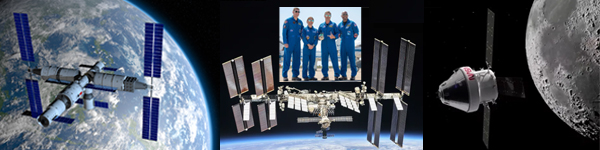
☆ International Space Station, ~415-km LEO: Expedition 74 seven-member …..
☆ Tiangong Space Station, ~390-km LEO: Shenzhou-21 three-member crew …..
◐ Lunar Enterprise News: …..
Near-Earth Objects Close Approaches – Mon Apr 6: Apollo Asteroid 2021 GN6 (0.014 AU); Tue Apr 7: Apollo Asteroid 2011 FT9 (0.008 AU); Tue Apr 7: Apollo Asteroid 2024 TB7 (0.012 AU); Sat Apr 11: Apollo Asteroid 2026 FE7 (0.022 AU)
First Woman FLIES to the Moon …
NET (no earlier than)
First Woman LANDS on the Moon …
Loading Moon data for your location...
Loading planet data...
Have your name sent to the Moon for FREE on the ILO-1 lunar mission via Astrolab FLEX rover (NET 2027). You will automatically be signed up for our weekly Space Calendar.