Ursids Meteor Shower Peak
From Comet Tuttle (8P), with up to 10 per hour. Moon only 3% full helps viewing on peak nights; active Dec 17-26.

The International Space Station is now running under Expedition 74, with crew including Commander Mike Fincke, Kimiya Yui, Zena Cardman, Chris Williams, Oleg Platonov, Sergey Kud-Sverchkov and Sergei Mikaev. Experiments are helping push forward Artemis tech, such as radiation shielding and 3D bioprinting. Plans for deorbiting the station are moving ahead with a SpaceX contract worth up to $843M, aiming for 2030 and a smooth handover to commercial stations. Over on Tiangong Space Station, the Shenzhou 21 crew is currently aboard, Zhang Lu, Wu Fei and Zhang Hongzhang. Shenzhou 22 craft is docked as their ride home, after a debris issue with the previous ship. Expansion plans call for new modules by around 2028, with research in areas like hydroponics and quantum optics. The station is opening up to international partners and will host its first international Astronaut, from Pakistan. Starlab, a joint project from Voyager Space, Airbus, Mitsubishi and MDA, is a single-module station with three levels inside. It’s slated for 2029 launch on Starship, with research volume matching the ISS and more than half dedicated to commercial users. Vast Haven-1 is a single-module station, heading for launch NET May 2026 on a Falcon 9. Blue Origin and Sierra Space are teaming up on Orbital Reef, a multi-module setup for up to 10 people in 830 cubic meters (~100 less than the ISS), targeting operations in the late 2020s. Axiom is building a modular station that starts attached to the ISS, with the first module aiming for 2028, before going independent. Max Space is working on scalable inflatable modules, with a demo planned for 2026. (Image Credits: Vast, Blue Origin, CNSA, NASA)
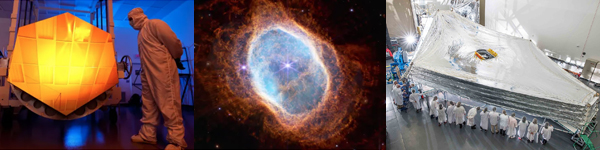 Webb 5th year in space begins this week, now in halo orbit around L2, ~1.5M km from Earth. 18 hexagonal mirror segments, of beryllium coated with ~48 grams of gold, must be kept <223°C to preserve precise alignment. A 5-layer sunshield protects even from sunlight reflected off Earth / Moon. ~6.5 square meter light-collecting area of Webb is about 6x that of Hubble, but with ~1/2 the mass at ~6,000kg. Webb can detect objects ~100x fainter–-much earlier in the history of the universe and has just found the earliest known supernova. Webb infrared-range images reveal galaxy formation, exoplanet atmospheres such as of Trappist-1, and first measurements of chemical / physical properties of a potential moon-forming disk encircling large exoplanet “CT Cha b”. Webb views Mars, Jupiter, Saturn, Uranus, Neptune, Pluto and their satellites, and Kuiper Belt Objects. Webb also views comets, asteroids and minor planets at or beyond the orbit of Mars. Recent findings from Webb include a supermassive black hole moving at 1,000+ km /second, an exoplanet with a helium-and-carbon-dominated atmosphere, and a lemon-shaped exoplanet orbiting a dead star. Partners NASA Space Telescope Science Institute, ESA and CSA-ASC provide the US$10B+ over 20+ years for the Webb. (Image Credits: mirror by Drew Noel at Ball Aerospace, NASA STScl / ESA / CSA-ASC, sunshield at Northrop Grumman
 International Space Station, ~415-km LEO: Expedition 74 seven-member crew led by Mike Fincke, with members Zena Cardman, Chris Williams, Kimiya Yui, Oleg Platonov, Sergey Kud-Sverchkov and Sergei Mikaev, are conducting science research via stem cell studies, robotics experiments, heart health monitoring, physics investigations; other activities include cargo transfers, Earth observations, station upkeep, and spacesuit maintenance for 2026 EVAs.
Tiangong Space Station, ~390-km LEO: Shenzhou-21 three-member crew with Commander Zhang Lu, Wu Fei and Zhang Hongzhang continue their 6-month mission performing cargo transfers, microgravity research and biological studies; while Tianzhou is the state-owned resupply craft for TSS, carrying 7,400kg of cargo, China is developing 2 commercial alternatives: Haolong and Qingzhou, potentially launching next year.
 Lunar Enterprise News: Intuitive Machines Forges Ahead with US$4.82B Lunar Relay Network │ Astrobotic Clavius-S to Assist Lunar Surface and Cislunar Safety
 Near-Earth Objects Close Approaches – Mon Dec 22: Amor Asteroid 2025 WT3 (0.040 AU); Wed Dec 24: Apollo Asteroid 488789 (2004 XK50) (0.053 AU); Fri Dec 26: Apollo Asteroid 2025 XP3 (0.034 AU); Sun Dec 28: Aten Asteroid 2021 AB1 (0.026 AU)
